
A sealed gamma calibration source has an activity of 2.0 Ci and a specific gamma-ray constant of 1.3 R·m²/(Ci·hr). Neglecting air attenuation and scatter, what is the unshielded exposure rate at a distance of 2.0 meters from the source?
Select an answer to reveal the explanation.
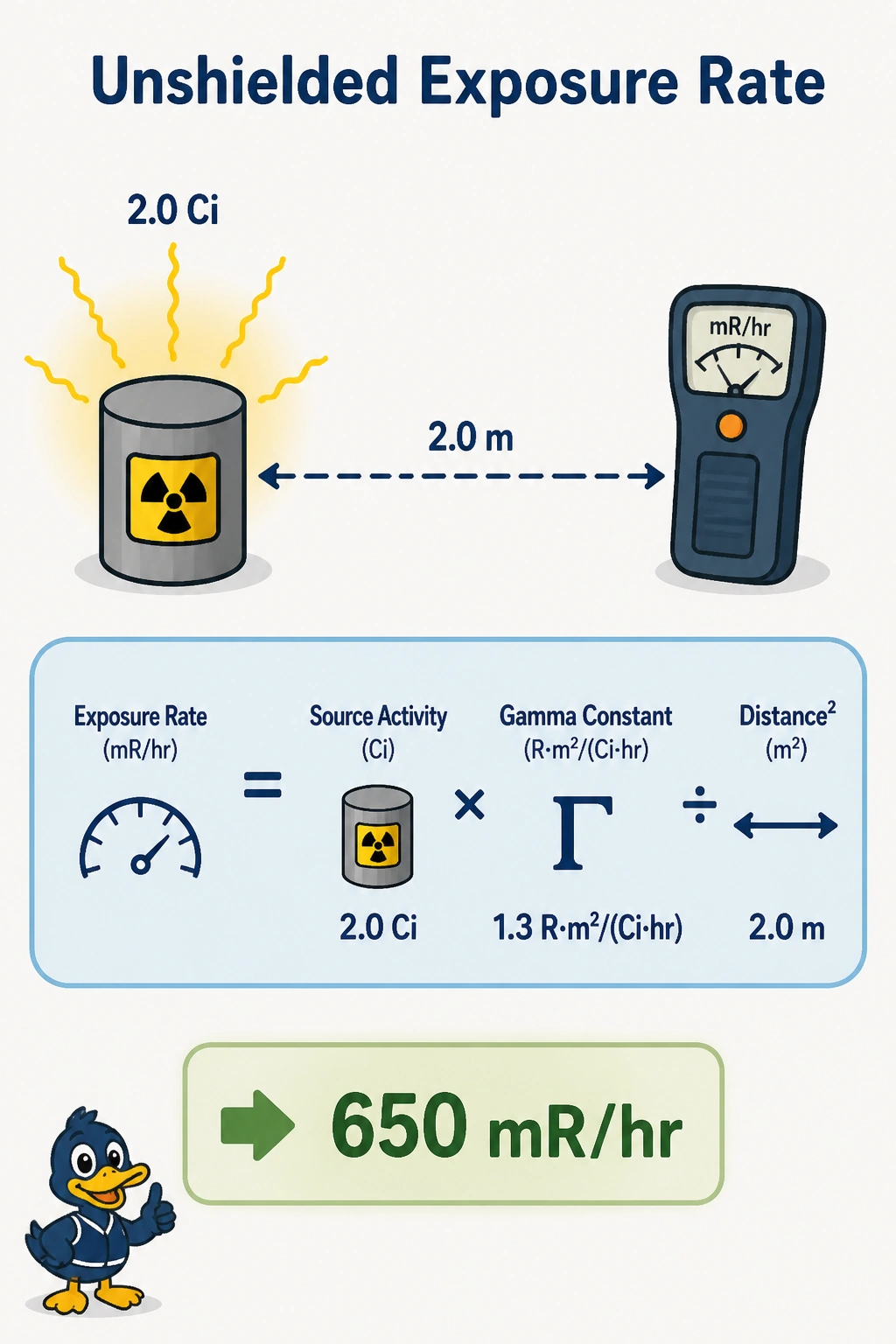
Short Explanation
The specific gamma-ray constant gives you the exposure rate at 1 meter per curie, so scaling to your target spot is a two-step multiply-and-square-divide. Here 2.0 Ci at 2.0 meters yields 650 mR/hr; the classic trap is forgetting to square the 2.0-meter distance.
Full Explanation
For an unshielded point gamma source, exposure rate equals the specific gamma-ray constant multiplied by activity and divided by the square of the distance. Multiplying 1.3 R·m²/(Ci·hr) by 2.0 Ci gives 2.6 R·m²/hr, and dividing by 2.0 meters squared (4.0 m²) yields 0.65 R/hr, which converts to 650 mR/hr. Therefore, 650 mR/hr is the correct result. Selecting 325 mR/hr results from dividing by 8 instead of 4, underestimating the actual field by a factor of two. Choosing 1,300 mR/hr occurs when the distance is not squared (dividing 2.6 by 2.0 instead of 4.0), which overestimates the field and misapplies the inverse square law. Selecting 2,600 mR/hr reflects the exposure rate at 1.0 meter rather than 2.0 meters, omitting the distance term entirely. As a caveat, the point-source formula assumes source dimensions are small compared with the 2.0-meter distance and ignores nearby wall scatter or self-absorption in the source capsule. Always verify calculated exposure rates with a calibrated ionization chamber before establishing stay-time limits.
Prefer to study offline? Printable PDF study book + test engine ($7.50, unofficial). These questions stay free here.