
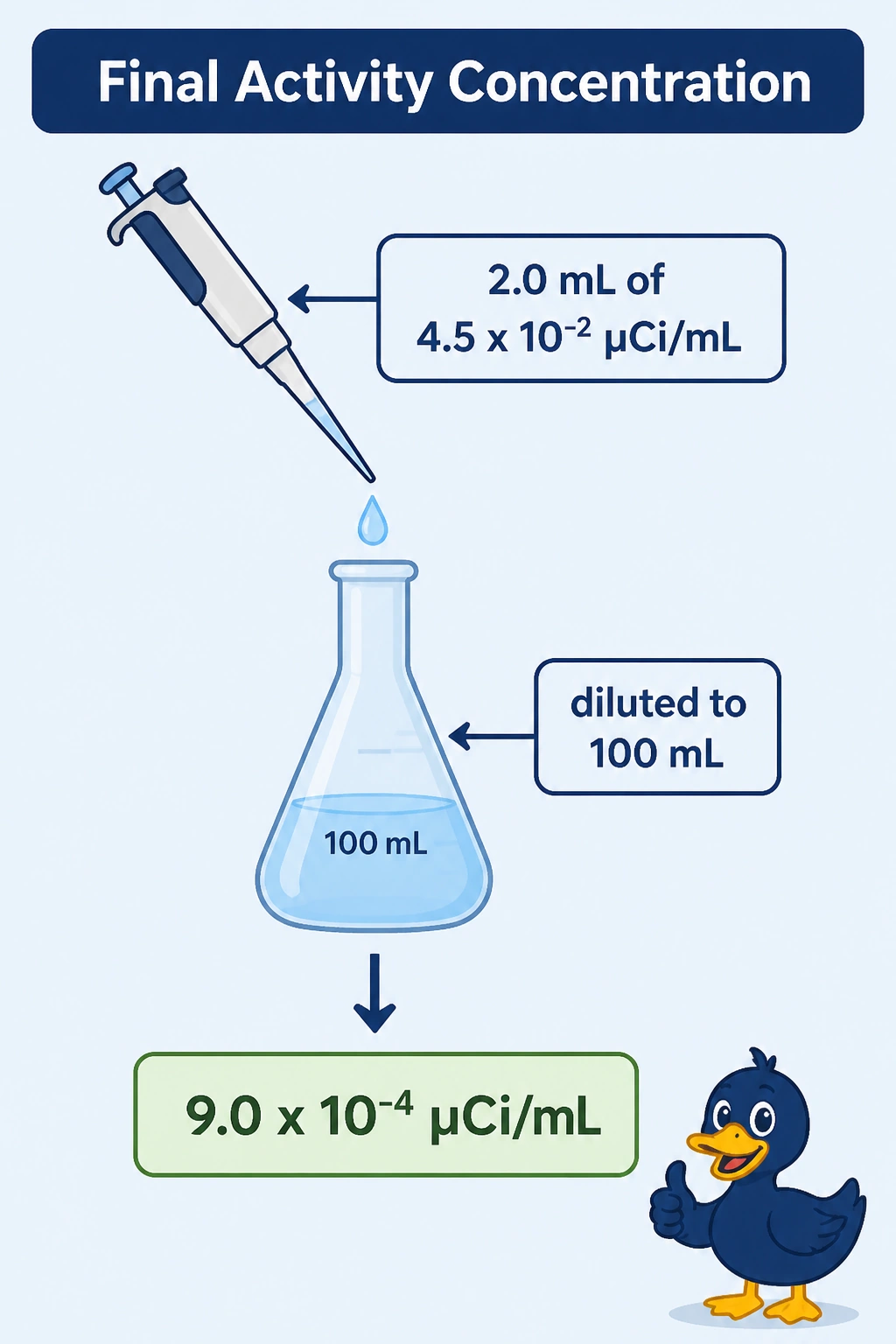
A radiochemistry technician pipettes 2.0 mL of a stock solution with an activity concentration of 4.5 × 10^-2 µCi/mL into a volumetric flask and dilutes it to a total volume of 100 mL. What is the activity concentration of the final diluted solution?
Select an answer to reveal the explanation.
Short Explanation
Think of diluting a stock radiotracer like mixing concentrate into a pitcher of water—the total activity stays fixed while the volume grows. If you forget to divide by the full final volume, your concentration will be off by orders of magnitude.
Full Explanation
Diluting a radioactive solution conserves total activity, so the initial concentration multiplied by the transferred volume equals the final concentration multiplied by the final volume (C1 × V1 = C2 × V2). Multiplying 4.5 × 10^-2 µCi/mL by 2.0 mL yields 9.0 × 10^-2 µCi of total activity in the flask. Dividing that total activity by the 100 mL final volume gives 9.0 × 10^-4 µCi/mL. Choosing 9.0 × 10^-2 µCi/mL reports the total transferred activity in microcuries rather than dividing by the final volume to obtain concentration. Selecting 9.0 × 10^-3 µCi/mL reflects a tenfold dilution error, as if the final volume were 10 mL instead of 100 mL. Picking 2.25 × 10^-4 µCi/mL mistakenly divides the stock concentration by 2.0 mL instead of multiplying by the pipetted volume. As a caveat, this relation assumes thorough mixing and negligible wall adsorption of carrier-free nuclides in the glassware. For an operational check, verify the dilution factor (100 mL / 2.0 mL = 50) and confirm that dividing 4.5 × 10^-2 µCi/mL by 50 yields 9.0 × 10^-4 µCi/mL before counting an aliquot.
Prefer to study offline? Printable PDF study book + test engine ($7.50, unofficial). These questions stay free here.