
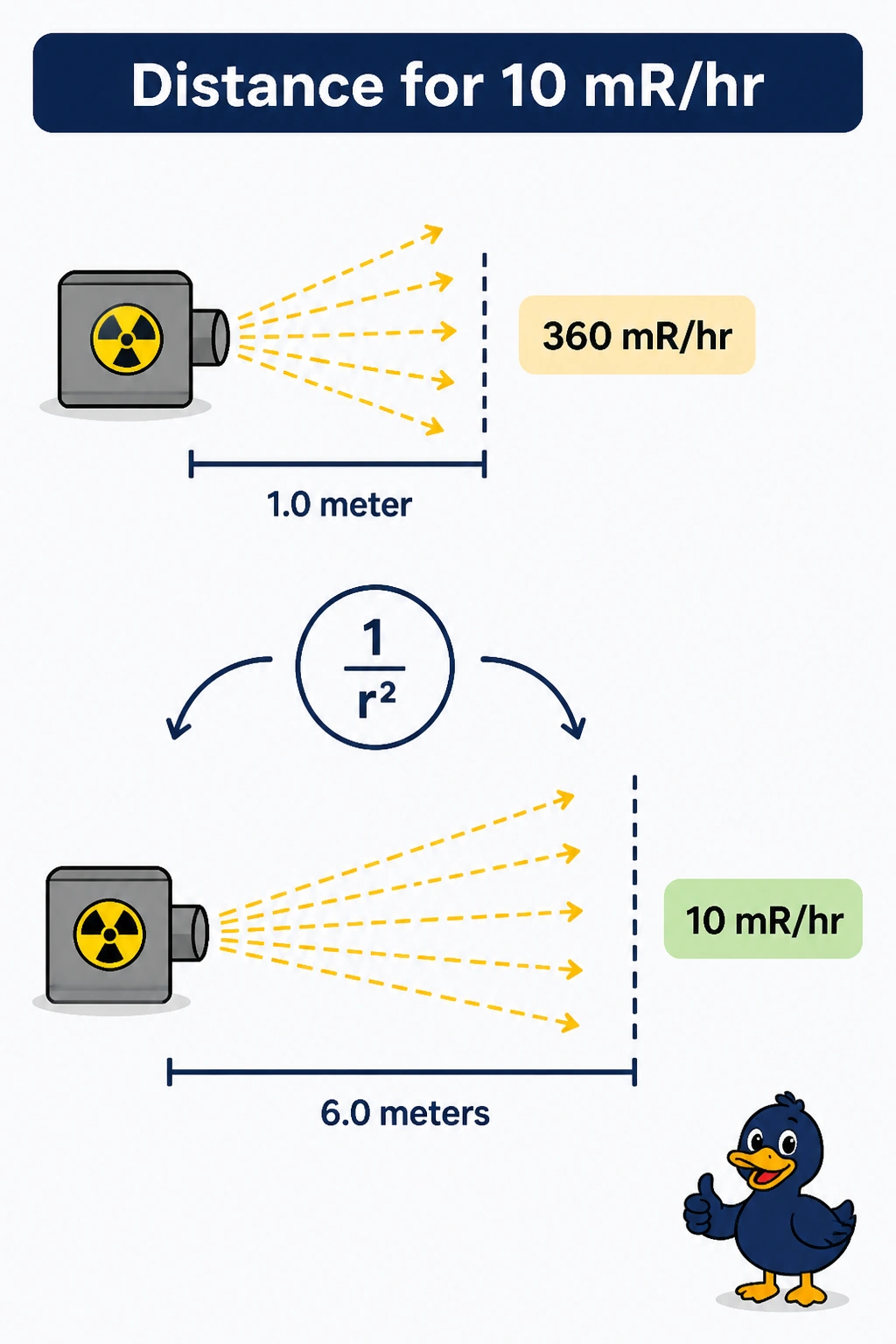
A technologist measures an unshielded gamma exposure rate of 360 mR/hr at 1.0 meter from a small point source. At what minimum distance from the source will the exposure rate drop to 10 mR/hr, assuming negligible air attenuation?
Select an answer to reveal the explanation.
Short Explanation
Because gamma intensity from a point source spreads out over the surface of a sphere, doubling your distance cuts your exposure rate to one-fourth, not one-half. You take the square root of the intensity ratio—360 divided by 10 gives 36, and its square root is 6.0 meters. The trap is forgetting to take the square root and assuming you must move 36.0 meters away.
Full Explanation
For a small gamma point source with negligible air attenuation, the inverse square law relates exposure rates at two distances by I1 times d1 squared equals I2 times d2 squared. Solving for the target distance gives d2 equals d1 times the square root of (I1 divided by I2), which is 1.0 meter times the square root of (360 mR/hr divided by 10 mR/hr), or 1.0 meter times the square root of 36, yielding "6.0 meters from the point source". Selecting "36.0 meters from the point source" results from forgetting to take the square root of the intensity ratio, treating the drop as linear rather than inverse-square. Choosing "18.0 meters from the point source" comes from halving the linear ratio of 36 instead of taking its square root. Picking "3.6 meters from the point source" misapplies a factor of ten by dividing 36 by 10 instead of taking the square root. As a caveat, the inverse square law assumes a true point source without significant scatter from nearby walls or floors; if the source is large or close to reflective surfaces, measured rates will exceed the calculated value. As an operational check, walk the perimeter with a calibrated survey meter to confirm the 10 mR/hr boundary before posting.
Prefer to study offline? Printable PDF study book + test engine ($7.50, unofficial). These questions stay free here.