
A medical research sample contains 640 mCi of Sodium-24, which has a physical half-life of 15.0 hours. How many hours must the sample be held in decay-in-storage for its activity to decrease to 5.0 mCi?
Select an answer to reveal the explanation.
Short Explanation
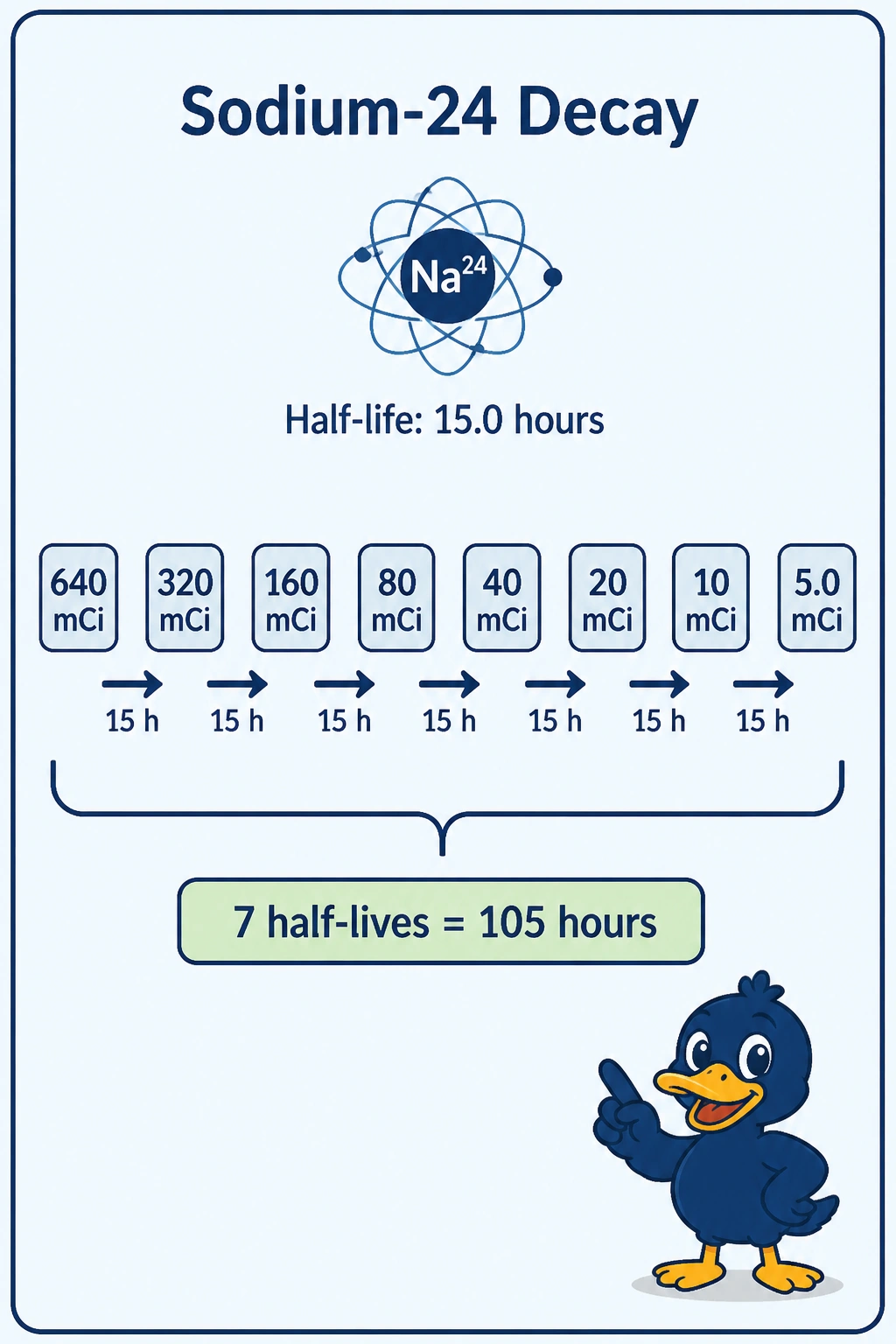
Every half-life cuts the remaining activity cleanly in half, so you just count how many halvings take 640 mCi down to 5.0 mCi. Seven halvings get you there, and the trap is miscounting the steps by one or two half-lives.
Full Explanation
To find the decay time, divide the initial activity by 2 repeatedly until reaching 5.0 mCi: 640 to 320, 160, 80, 40, 20, 10, and 5.0 mCi, which is 7 half-lives (since 640 divided by 2 to the 7th power, or 128, equals 5.0). Multiplying 7 half-lives by 15.0 hours per half-life gives 105 hours. Selecting 60 hours corresponds to only 4 half-lives, which reduces 640 mCi by a factor of 16 down to 40 mCi, leaving eight times the target activity. Selecting 75 hours equals 5 half-lives, reducing the sample by a factor of 32 to 20 mCi, which is still four times too high. Selecting 90 hours represents 6 half-lives, reducing the activity by a factor of 64 to 10 mCi rather than 5.0 mCi. As a caveat, decay-in-storage calculations only tell you when a target activity is reached; under NRC 10 CFR 35.92, medical decay-in-storage waste still cannot be disposed of in regular trash until it is held at least 10 half-lives and surveyed at background with all radiation labels removed. Double-check your step count by working backward from 5.0 mCi, doubling seven times to confirm you return to 640 mCi.
Prefer to study offline? Printable PDF study book + test engine ($7.50, unofficial). These questions stay free here.