
A shipment of Technetium-99m (physical half-life 6.0 hours) arrives at a nuclear medicine clinic with a measured activity of 40 mCi. If 18 hours elapsed between calibration at the radiopharmacy and arrival at the clinic, what was the activity at calibration?
Select an answer to reveal the explanation.
Short Explanation
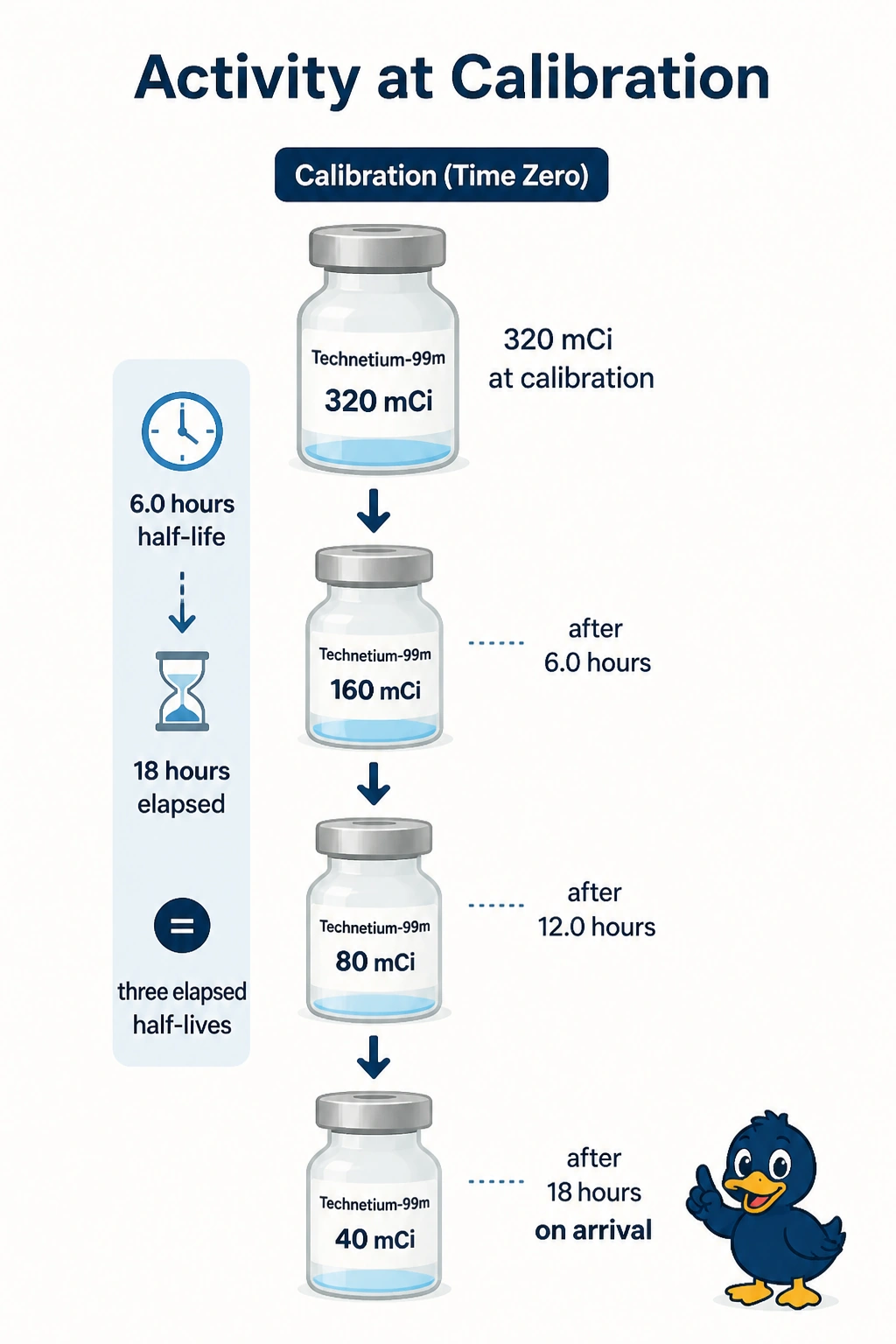
Running decay backward is like rewinding a doubling machine—every 6-hour half-life you step back doubles your activity. The trap is multiplying 40 mCi by 3 instead of multiplying by 2 three times (8) to reach 320 mCi.
Full Explanation
To find the original calibrated activity before transit decay, divide the 18-hour elapsed time by the 6.0-hour physical half-life of Technetium-99m to get exactly 3 elapsed half-lives. Since activity halves during each half-life, back-calculating requires multiplying the arriving 40 mCi by 2 raised to the third power (8), yielding 320 mCi, accounting for three elapsed half-lives. Selecting 120 mCi, multiplying the arrived activity by three mistakenly multiplies by the number of half-lives rather than using the exponential power of two. Choosing 160 mCi, doubling the arrived activity once per day applies an arbitrary daily factor instead of the 6.0-hour half-life, corresponding to only two half-lives. Picking 640 mCi, assuming four half-lives elapsed in transit miscounts 18 hours divided by 6.0 hours as four intervals instead of three. As a caveat, always verify whether the decay interval is measured from the exact calibration time-of-day rather than the shipping label print time. As an operational check, confirm the result forward: 320 mCi halves to 160 mCi at 6 hours, 80 mCi at 12 hours, and 40 mCi at 18 hours.
Prefer to study offline? Printable PDF study book + test engine ($7.50, unofficial). These questions stay free here.