
A radiation shield requires a mass thickness of 22.6 g/cm² of lead to adequately attenuate a gamma beam. Given that the density of lead is 11.3 g/cm³, what physical thickness of lead sheet is required?
Select an answer to reveal the explanation.
Short Explanation
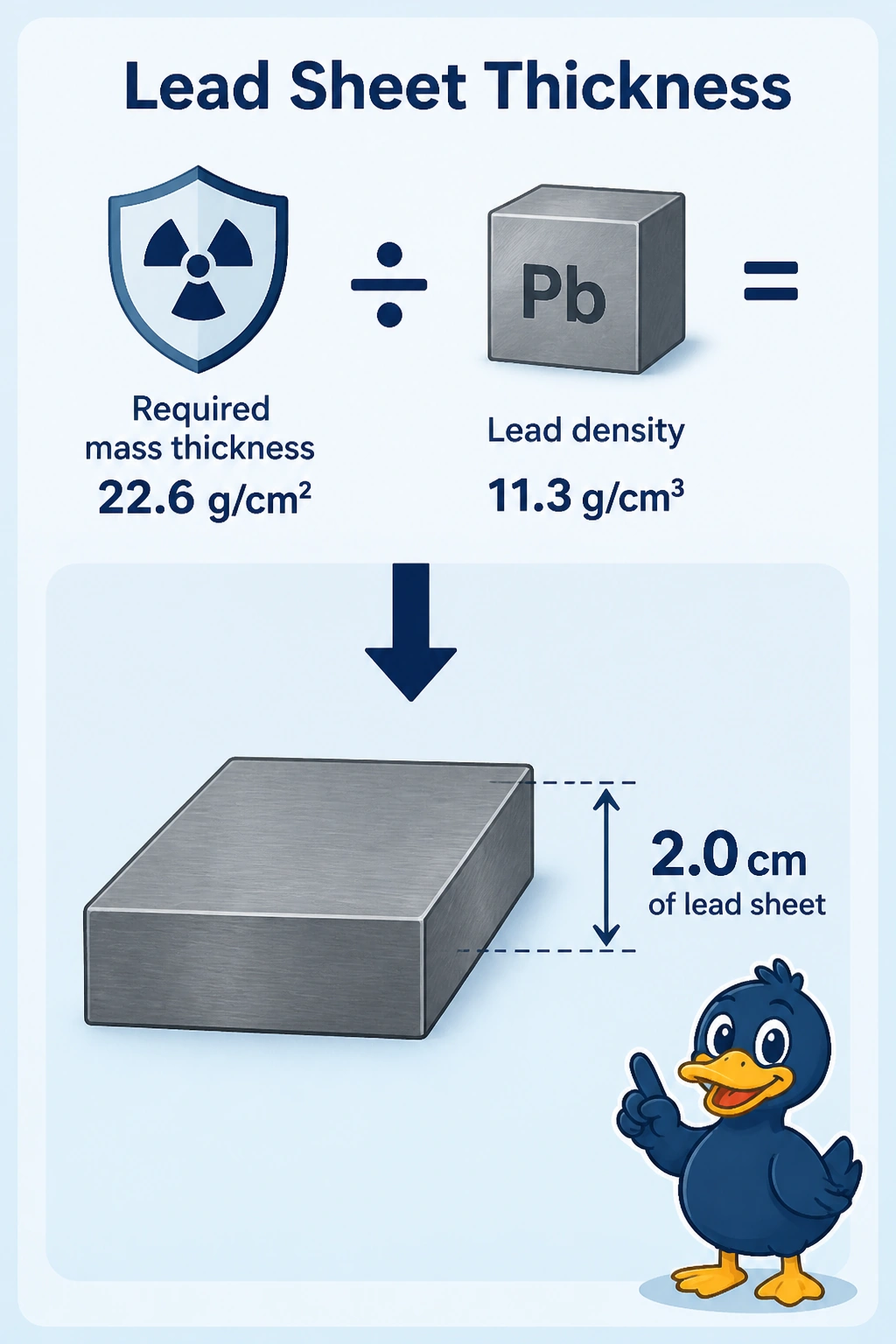
Think of mass thickness as how much lead weight sits in front of a square centimeter of beam, while density tells you how tightly packed that lead is. Dividing mass thickness by density gives you the physical thickness: 2.0 cm of lead sheet. The classic trap is multiplying the two numbers or inverting the ratio, which leaves you either way too thin or building an impossible wall.
Full Explanation
Mass thickness (also called areal density) equals the material density multiplied by its physical thickness, expressed in grams per square centimeter. Rearranging that relationship, physical thickness equals mass thickness divided by density: 22.6 g/cm² divided by 11.3 g/cm³ yields 2.0 cm of lead sheet, because the grams and square centimeters cancel to leave centimeters. Choosing 0.50 cm of lead sheet comes from inverting the fraction and dividing density by mass thickness, which under-shields the gamma beam by a factor of four. Choosing 11.3 cm of lead sheet simply repeats the density value of lead in the wrong units without performing the division. Choosing 255 cm of lead sheet results from multiplying mass thickness by density instead of dividing, producing an unrealistically thick shield. As a practical caveat, always confirm whether a shielding specification lists linear thickness or mass thickness before ordering materials, because mixing the two changes attenuation exponentially. For an operational check, verify the actual sheet thickness with calipers and check the manufacturer's density specification before stacking temporary shielding.
Prefer to study offline? Printable PDF study book + test engine ($7.50, unofficial). These questions stay free here.