
For a specific gamma-ray energy, ordinary concrete has a half-value layer (HVL) of 6.0 cm. Approximately what thickness of concrete equals one tenth-value layer (TVL) for this same gamma energy?
Select an answer to reveal the explanation.
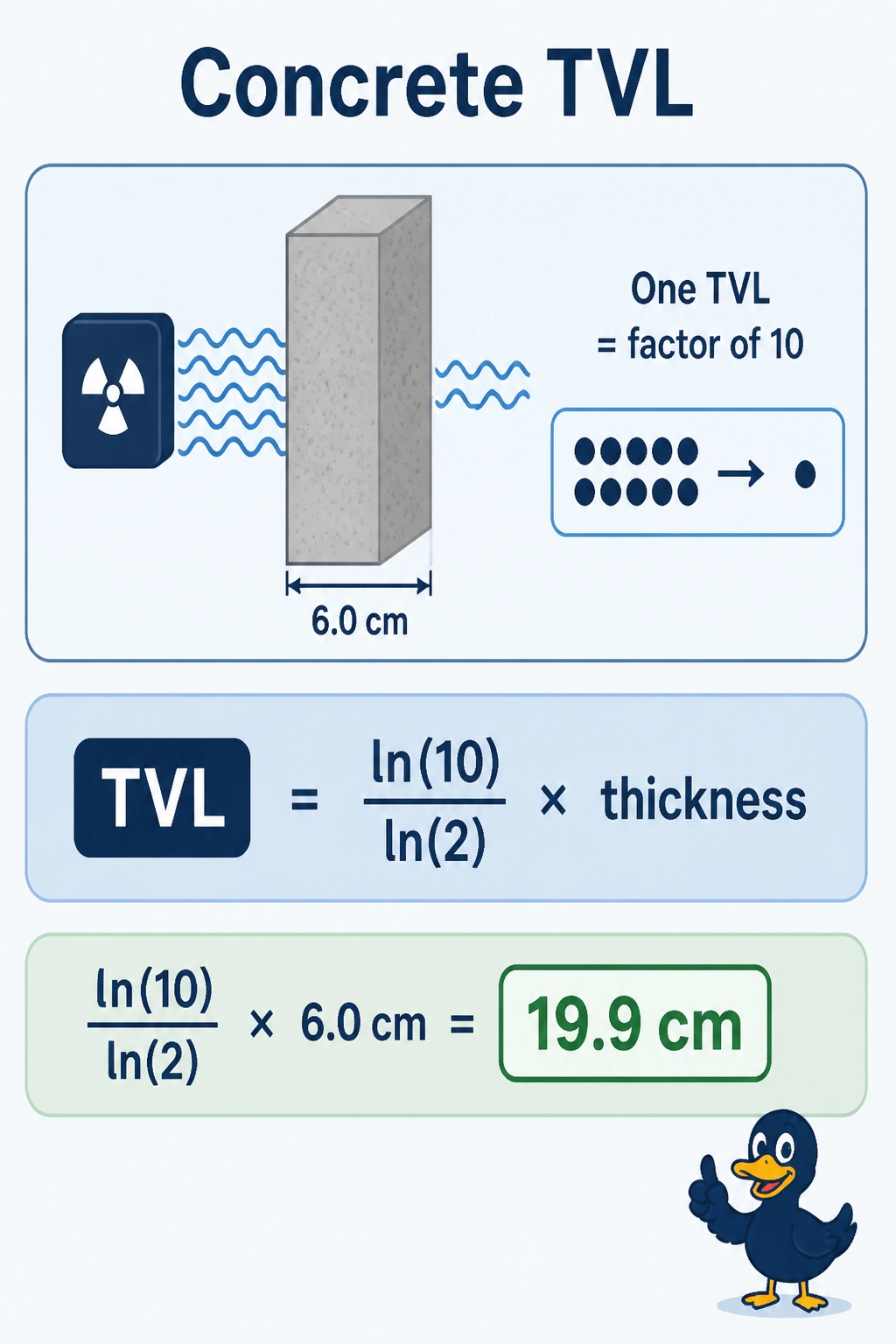
Short Explanation
Exponential shielding does not scale linearly, so you cannot just multiply a half-value layer by five or ten to get a tenth-value layer. You need the logarithmic factor of about 3.32 half-value layers, which turns 6.0 cm into 19.9 cm. Watch out for the trap of picking two half-value layers (one-fourth) or five half-value layers (1/32), both of which miss the exponential math.
Full Explanation
In narrow-beam exponential attenuation, one half-value layer (HVL) reduces beam intensity by a factor of 2, whereas one tenth-value layer (TVL) reduces intensity by a factor of 10. Selecting 19.9 cm, using the logarithmic ratio of ln(10) divided by ln(2) is correct because TVL = HVL x [ln(10) / ln(2)] = 6.0 cm x (2.3026 / 0.6931) = 6.0 cm x 3.322 = 19.93 cm. Selecting 12.0 cm, assuming two half-value layers reduce intensity to one-tenth is wrong because two half-value layers reduce intensity only to (1/2)^2 = 1/4, or 25 percent, which is far above 10 percent. Selecting 30.0 cm, assuming five half-value layers are needed for one-tenth confuses linear division (10 / 2 = 5) with exponential decay; five half-value layers actually reduce intensity to (1/2)^5 = 1/32, or about 3.1 percent. Selecting 60.0 cm, multiplying the single half-value layer thickness by ten applies linear scaling to an exponential curve, overestimating the shield by more than a factor of three. As an exam caveat, remember that 3.32 HVLs per TVL applies strictly to narrow-beam monoenergetic attenuation with a constant linear attenuation coefficient. As an operational check, always verify whether broad-beam buildup factors are needed before finalizing a concrete shield thickness in the field.
Prefer to study offline? Printable PDF study book + test engine ($7.50, unofficial). These questions stay free here.