
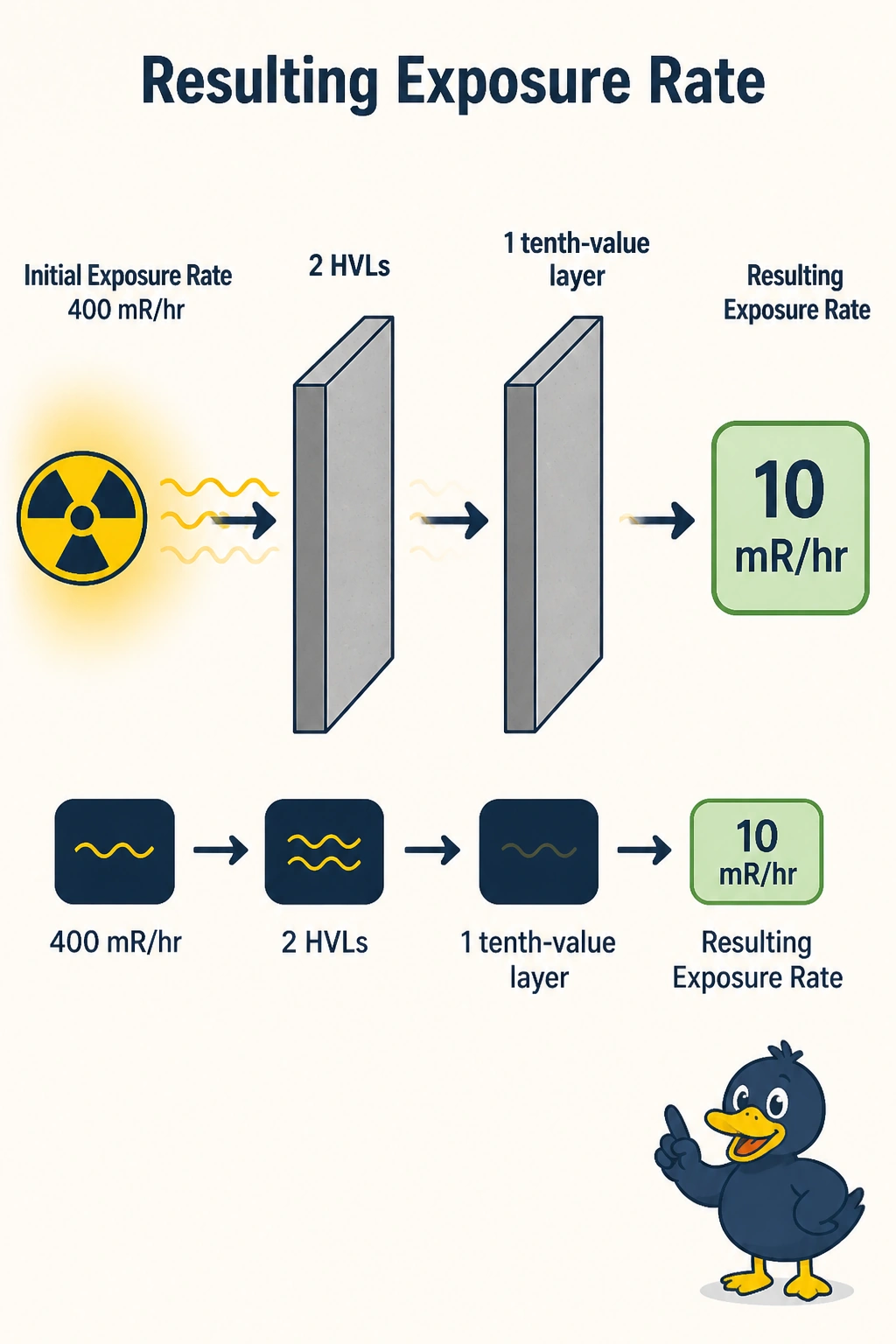
An unshielded gamma source produces an exposure rate of 400 mR/hr at an operator station. If a technologist places a shield equivalent to 2 half-value layers (HVLs) of lead and 1 tenth-value layer (TVL) of concrete in the beam, what is the resulting exposure rate under narrow-beam conditions?
Select an answer to reveal the explanation.
Short Explanation
Combined shields multiply their reduction factors together, so you apply each layer in sequence rather than adding them. Two half-value layers cut the beam to a quarter and one tenth-value layer cuts that by ten, while the trap is forgetting one of the halvings and landing on 20 mR/hr.
Full Explanation
Under narrow-beam conditions, each half-value layer (HVL) reduces the exposure rate by a factor of 2, and each tenth-value layer (TVL) reduces it by a factor of 10. Multiplying the initial 400 mR/hr by (1/2)^2 for 2 HVLs (a factor of 1/4, giving 100 mR/hr) and then by 1/10 for 1 TVL yields 10 mR/hr. Arriving at 20 mR/hr occurs if you apply only 1 HVL (halving to 200 mR/hr) before dividing by 10, or if you mistakenly divide 2 HVLs by 2 instead of 4. Obtaining 40 mR/hr results from applying only the 1 TVL of concrete while omitting the 2 HVLs of lead completely. Calculating 100 mR/hr accounts only for the 2 HVLs of lead and ignores the concrete TVL. As a caveat, real broad-beam geometries introduce scattered photons that increase the transmitted dose rate above the narrow-beam result unless a buildup factor is included, and HVL/TVL values depend on photon energy and material order. As an operational check, always measure the actual dose rate behind any newly installed composite shield with a calibrated ion chamber before authorizing work.
Prefer to study offline? Printable PDF study book + test engine ($7.50, unofficial). These questions stay free here.