
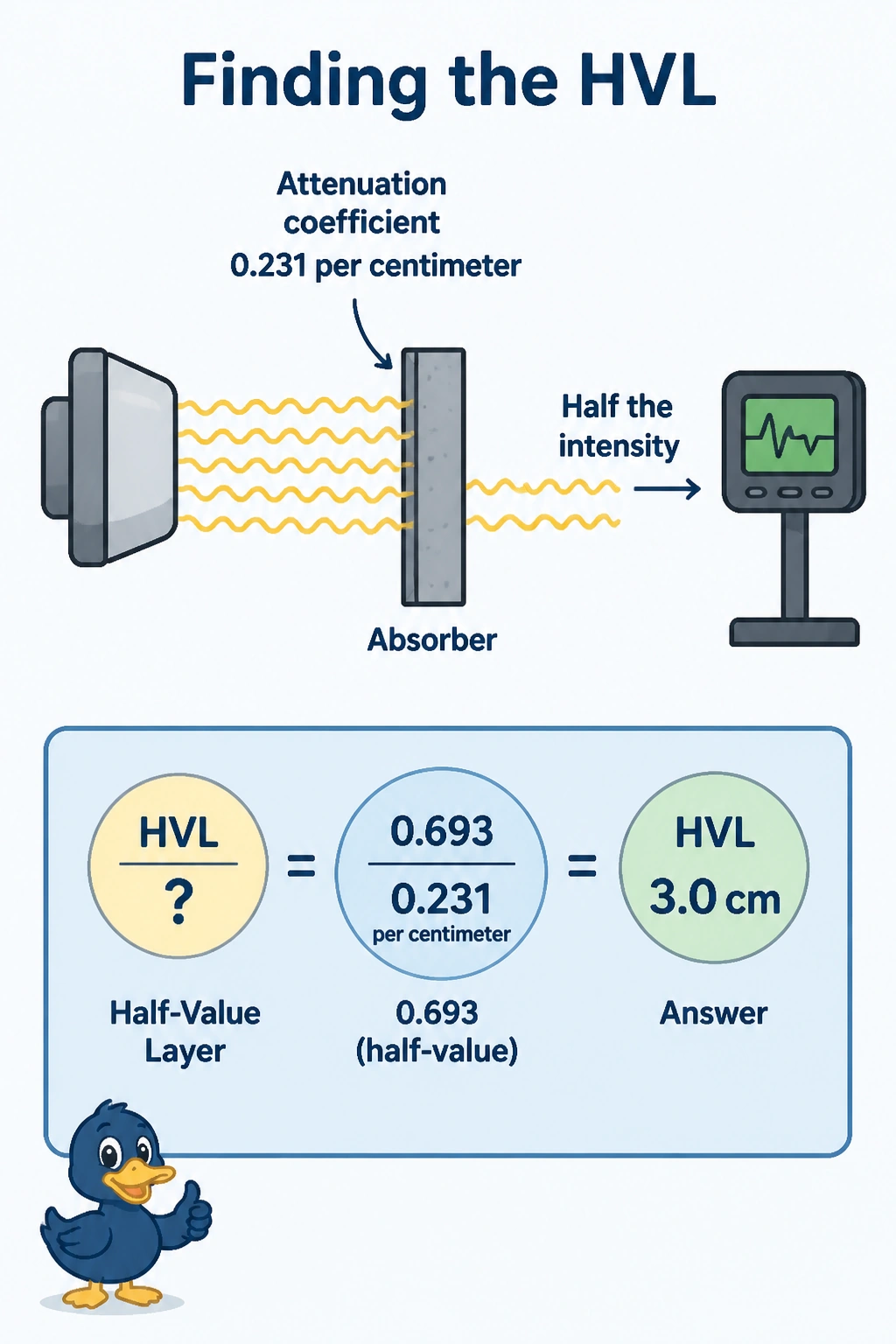
For a monoenergetic gamma beam, a shielding material has a linear attenuation coefficient of 0.231 per centimeter. What is the half-value layer (HVL) of this material?
Select an answer to reveal the explanation.
Short Explanation
To find a half-value layer from a linear attenuation coefficient, you divide the natural log of 2 (0.693) by the coefficient—never invert it directly. The classic trap is taking the simple reciprocal, which gives you the mean free path instead of the thickness that cuts the beam in half.
Full Explanation
Under the exponential attenuation law, transmitted intensity follows I = I_0 exp(-mu x), so setting I/I_0 = 0.5 yields HVL = ln(2) / mu = 0.693 / 0.231 cm^-1 = 3.0 cm, which is 3.0 cm, by dividing 0.693 by the attenuation coefficient. Selecting 0.16 cm, by multiplying the attenuation coefficient by 0.693 inverts the algebraic relationship and produces a value whose units (cm^-1) do not even match a thickness. Choosing 4.3 cm, by taking the reciprocal of the attenuation coefficient computes the photon mean free path (1/mu), which reduces a narrow beam to 1/e (about 37%) of its initial intensity rather than 50%. Calculating 10.0 cm, by dividing 2.303 by the attenuation coefficient uses ln(10) instead of ln(2) and therefore yields the tenth-value layer (TVL) rather than the half-value layer. As a caveat, this narrow-beam formula assumes no buildup of scattered photons; in thick, broad-beam shields, scattered radiation increases the transmitted dose rate above the simple exponential prediction. For an operational check, confirm whether broad-beam buildup factors are needed when sizing real-world walls or lead blankets.
Prefer to study offline? Printable PDF study book + test engine ($7.50, unofficial). These questions stay free here.