
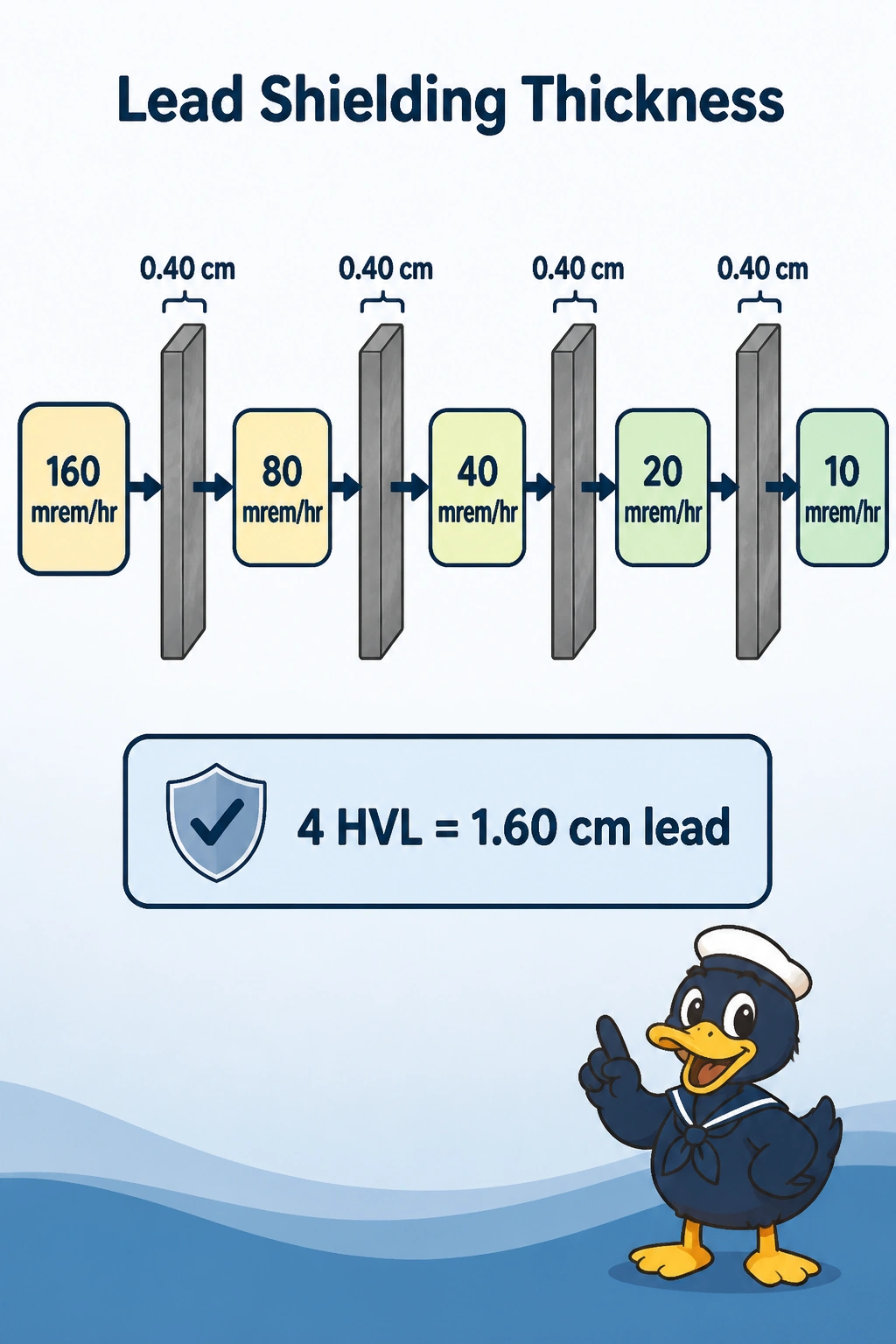
A gamma source produces an unshielded dose rate of 160 mrem/hr at a workstation. If the half-value layer (HVL) of lead for this photon energy is 0.40 cm, what minimum thickness of lead is needed to reduce the dose rate at the workstation to 10 mrem/hr?
Select an answer to reveal the explanation.
Short Explanation
Think of each half-value layer like folding a piece of paper in half—every layer cuts the remaining dose rate by two, not by a fixed chunk. Once you find how many halvings take 160 mrem/hr down to 10 mrem/hr, just multiply by the HVL thickness. Watch out for the trap of dividing 160 by 10 and multiplying linearly!
Full Explanation
Exponential photon attenuation reduces dose rate by a factor of two for every half-value layer added, following the relationship I = I_0 * (0.5)^n. Dividing the initial 160 mrem/hr by the target 10 mrem/hr gives a required reduction factor of 16. Because 2^4 equals 16, exactly 4 half-value layers are needed: 160 drops to 80, then 40, then 20, and finally 10 mrem/hr. Multiplying 4 half-value layers by 0.40 cm per layer yields 1.60 cm of solid lead. Choosing 0.80 cm of solid lead applies only 2 half-value layers, which reduces the dose rate to 40 mrem/hr and leaves the workstation four times above the target. Choosing 3.20 cm of solid lead applies 8 half-value layers, over-shielding by a factor of 16 due to confusing the reduction factor of 16 with 2^8 or doubling the thickness unnecessarily. Choosing 6.40 cm of solid lead plate results from multiplying the reduction factor of 16 directly by 0.40 cm, a linear calculation error that ignores exponential attenuation. As a caveat, simple HVL calculations apply to narrow-beam geometry; broad-beam conditions require a buildup factor for scattered photons. Operationally, always verify the predicted dose rate behind newly installed shielding with a calibrated ion chamber survey meter before releasing the workstation.
Prefer to study offline? Printable PDF study book + test engine ($7.50, unofficial). These questions stay free here.