
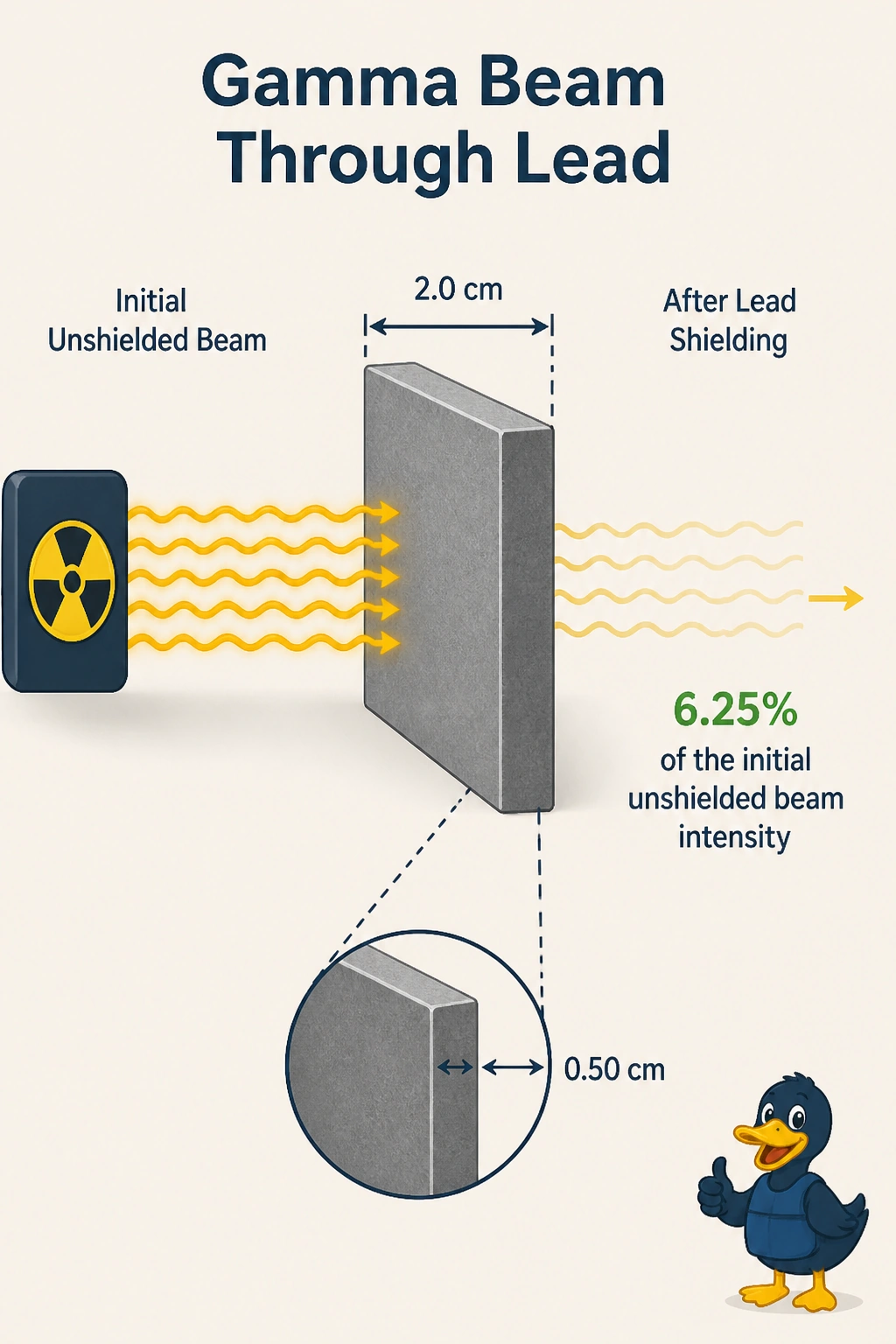
A narrow beam of monoenergetic gamma photons passes through 2.0 cm of lead, where the half-value layer (HVL) is 0.50 cm. What fraction of the original beam intensity is transmitted through the shield?
Select an answer to reveal the explanation.
Short Explanation
Each half-value layer slices the remaining beam in half again, just like folding a sheet of paper repeatedly. The trap is dividing 100 percent by the number of layers instead of halving your intensity four times in a row.
Full Explanation
6.25% of the initial unshielded beam intensity is transmitted because 2.0 cm divided by an HVL of 0.50 cm equals 4 half-value layers, and exponential attenuation reduces the beam by a factor of (1/2)^4, or 1/16 (0.0625). 50.0% of the initial unshielded beam intensity corresponds to only 1 half-value layer (0.50 cm of lead), which underestimates the total thickness by a factor of four. 25.0% of the initial unshielded beam intensity corresponds to 2 half-value layers (1.0 cm of lead), or an incorrect linear division of 100% by 4 layers. 12.5% of the initial unshielded beam intensity corresponds to 3 half-value layers (1.5 cm of lead) and results from miscounting the number of halving steps. One important caveat is that this simple exponential calculation assumes narrow-beam, monoenergetic geometry; broad-beam conditions or polyenergetic spectra introduce scattered photons and beam hardening that increase actual transmission. As an operational check, always confirm the shield thickness and HVL units match before dividing, and verify predicted dose rates with a calibrated survey meter after installing the shielding.
Prefer to study offline? Printable PDF study book + test engine ($7.50, unofficial). These questions stay free here.