
A radionuclide used in a calibration laboratory has a physical half-life of exactly 10.0 hours. What is its exponential decay constant?
Select an answer to reveal the explanation.
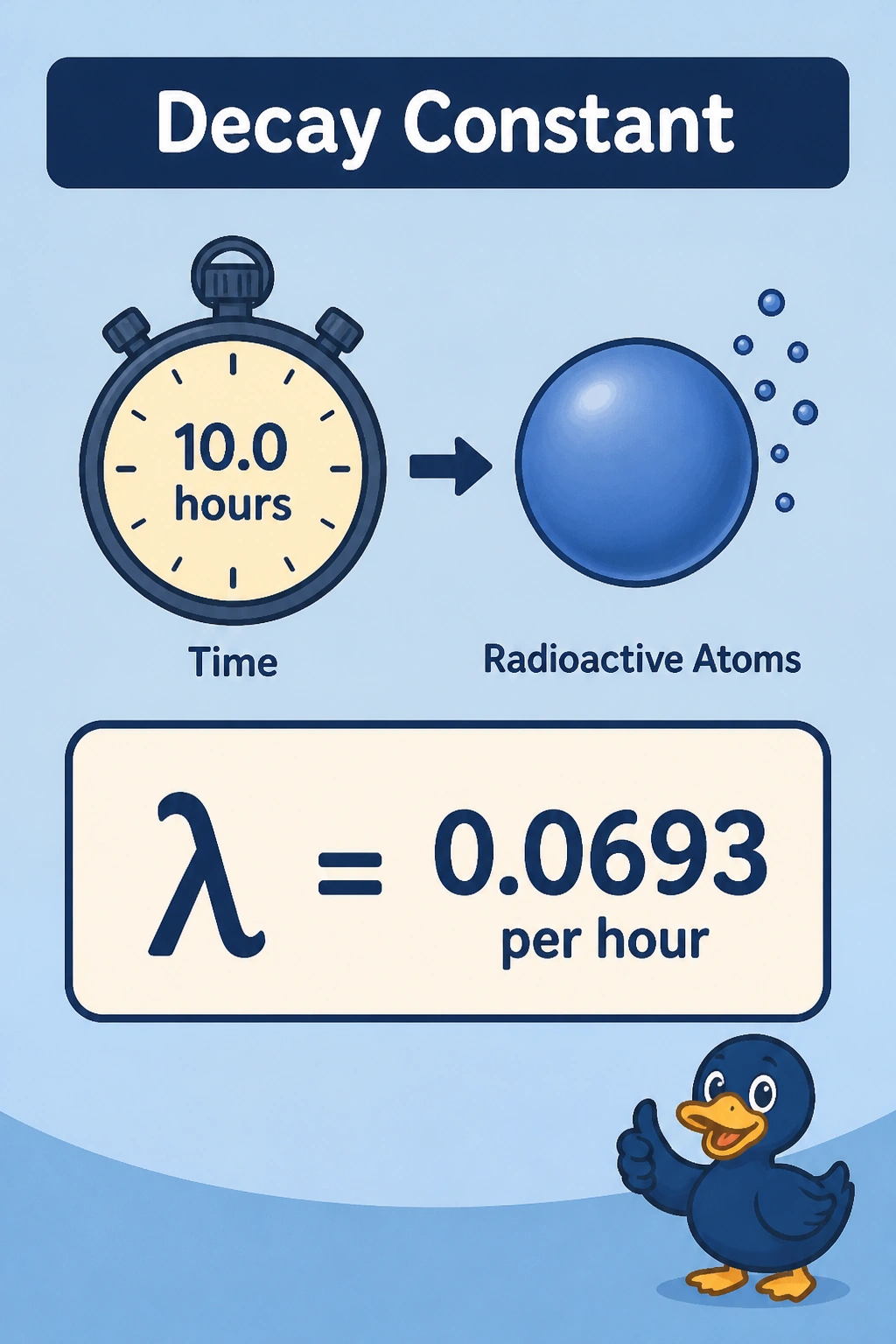
Short Explanation
The decay constant links a radionuclide's half-life to its instantaneous fractional decay rate, and you find it by dividing the natural log of two by the half-life. The trap is dividing one by the half-life instead of 0.693, which gives the reciprocal half-life rather than the exponential decay constant.
Full Explanation
Radioactive decay follows the exponential relationship A = A0 exp(-lambda t), where A is the remaining activity, A0 is the initial activity, lambda is the decay constant, and t is the elapsed time. Setting the remaining fraction A / A0 equal to 0.5 at one physical half-life (t = T1/2) and taking the natural logarithm of both sides gives lambda = ln(2) / T1/2, where ln(2) is approximately 0.6931. Dividing 0.6931 by 10.0 hours yields 0.0693 per hour as the correct decay constant. Selecting 0.1000 per hour comes from mistakenly computing 1 / T1/2 and omitting the natural logarithm of two, which gives the inverse half-life rather than the exponential rate constant. Choosing 0.1443 per hour comes from computing 1 / (0.693 10.0), which divides by ln(2) instead of multiplying by it and corresponds to an inverted exponential factor. Selecting 6.930 per hour results from multiplying 0.693 by 10.0 hours instead of dividing, producing a value two orders of magnitude too large with inconsistent time scaling. As a calculation caveat, always verify that the units of lambda and elapsed time t are reciprocals—such as per hour paired with hours—before evaluating any decay equation. As a quick operational check, substitute 0.0693 per hour back into exp(-lambda 10.0) on your calculator to confirm the remaining fraction equals 0.50.
Prefer to study offline? Printable PDF study book + test engine ($7.50, unofficial). These questions stay free here.