
A technician is scanning a large equipment laydown area with a portable count-rate survey meter that has a fast/slow response-time switch. Which setting should the technician select while actively sweeping the probe to avoid missing small, localized hot spots?
Select an answer to reveal the explanation.
Short Explanation
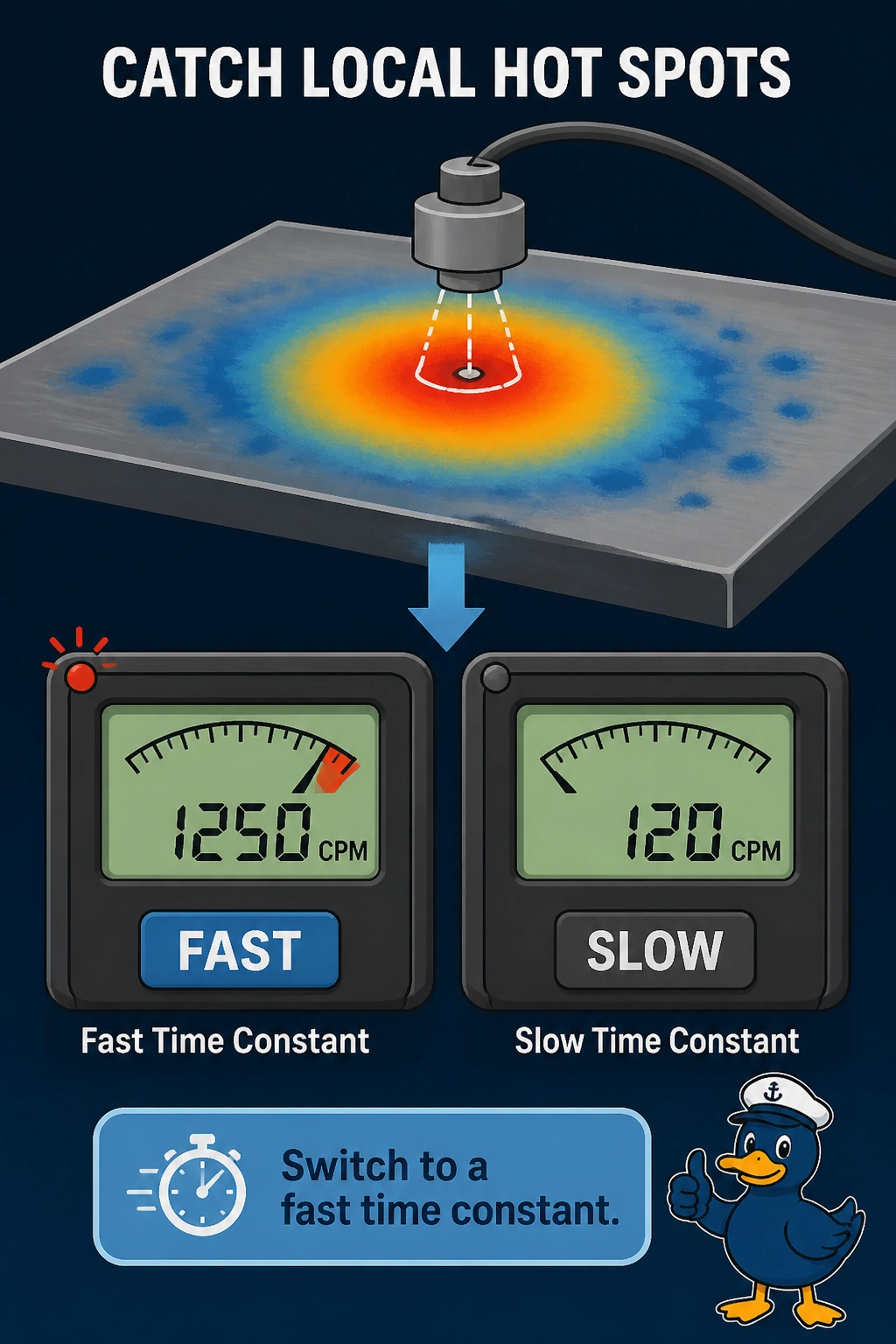
When you sweep a probe across a table, a fast time constant acts like a quick camera shutter that catches brief spikes before you move on. The trap is leaving the meter on slow, which smooths the needle so much that a small hot spot disappears into the average.
Full Explanation
Portable survey meters use an electronic RC time constant to average incoming pulses before driving the display. When scanning surfaces for small, localized contamination or streaming, the technician should Switch to a fast time constant so the meter responds rapidly to localized hot spots before the probe moves past them. Choosing to Select the slow time constant to make the needle jump higher over small spots is backwards: a slow time constant damps and delays rapid changes, causing the meter to miss brief peaks during a scan. Trying to Increase the high voltage past the Geiger plateau to double the pulse amplitude risks continuous discharge and tube damage without improving spatial response time. Attempting to Close the beta shield completely so the probe detects only low-energy alphas is wrong because closing the shield blocks both alpha and beta particles, leaving only penetrating gamma response. As a caveat, a fast time constant produces greater needle or digital fluctuation in low count-rate fields, so switch back to slow when taking a stationary quantitative reading. As an operational check, verify the response-time switch position during pre-use checks and maintain a steady scan speed.
Prefer to study offline? Printable PDF study book + test engine ($7.50, unofficial). These questions stay free here.