
A health physics technician uses a handheld pancake Geiger-Mueller (GM) probe for routine personnel frisking at a Contamination Area exit. Why is this probe constructed with an ultra-thin mica entrance window rather than a standard metal wall?
Select an answer to reveal the explanation.
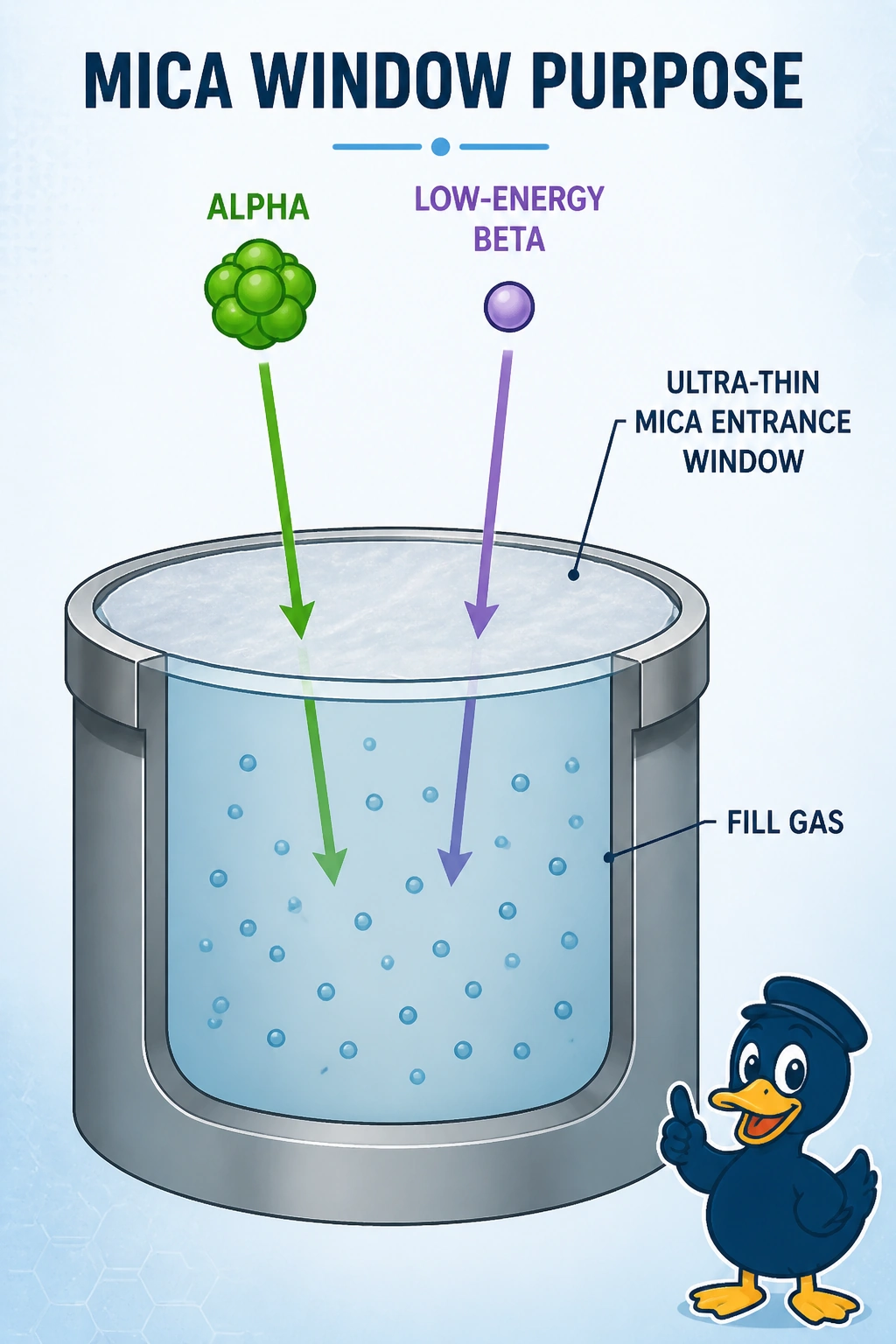
Short Explanation
Alpha and weak beta particles are like ping-pong balls hitting a brick wall if they run into a metal tube housing. A paper-thin mica window gives them an open doorway into your detector gas so your frisker actually hears them.
Full Explanation
A pancake GM probe uses a very thin mica window (typically around 1.5 to 2.0 mg/cm²) To allow alpha and low-energy beta particles to enter the fill gas. Because alpha particles and low-energy beta particles have very short ranges in solid matter, a standard metal GM wall would stop them completely before they could ionize the internal argon-quench gas mixture. To prevent atmospheric humidity from corroding the central anode wire is incorrect because any hermetically sealed metal housing keeps moisture out just as well, whereas thin mica is actually fragile and must be protected by a wire screen. To shield the detector against high-energy cosmic-ray background pulses is false because a thin window provides virtually no shielding against penetrating cosmic radiation. To enable the GM tube to resolve individual gamma-ray photon energies is impossible because a GM tube operates in the Geiger avalanche region where all output pulses have the same amplitude regardless of incident energy. As an operational caveat, even a tiny puncture in the delicate mica window allows the fill gas to escape and disables the probe. Operationally, inspect the protective screen and mica face before each frisk and verify normal response with a beta check source.
Prefer to study offline? Printable PDF study book + test engine ($7.50, unofficial). These questions stay free here.