
When high-energy beta particles pass through an absorber, they lose energy through both collisional ionization and radiative bremsstrahlung emission. Which factor increases the fraction of beta energy converted into bremsstrahlung X-rays?
Select an answer to reveal the explanation.
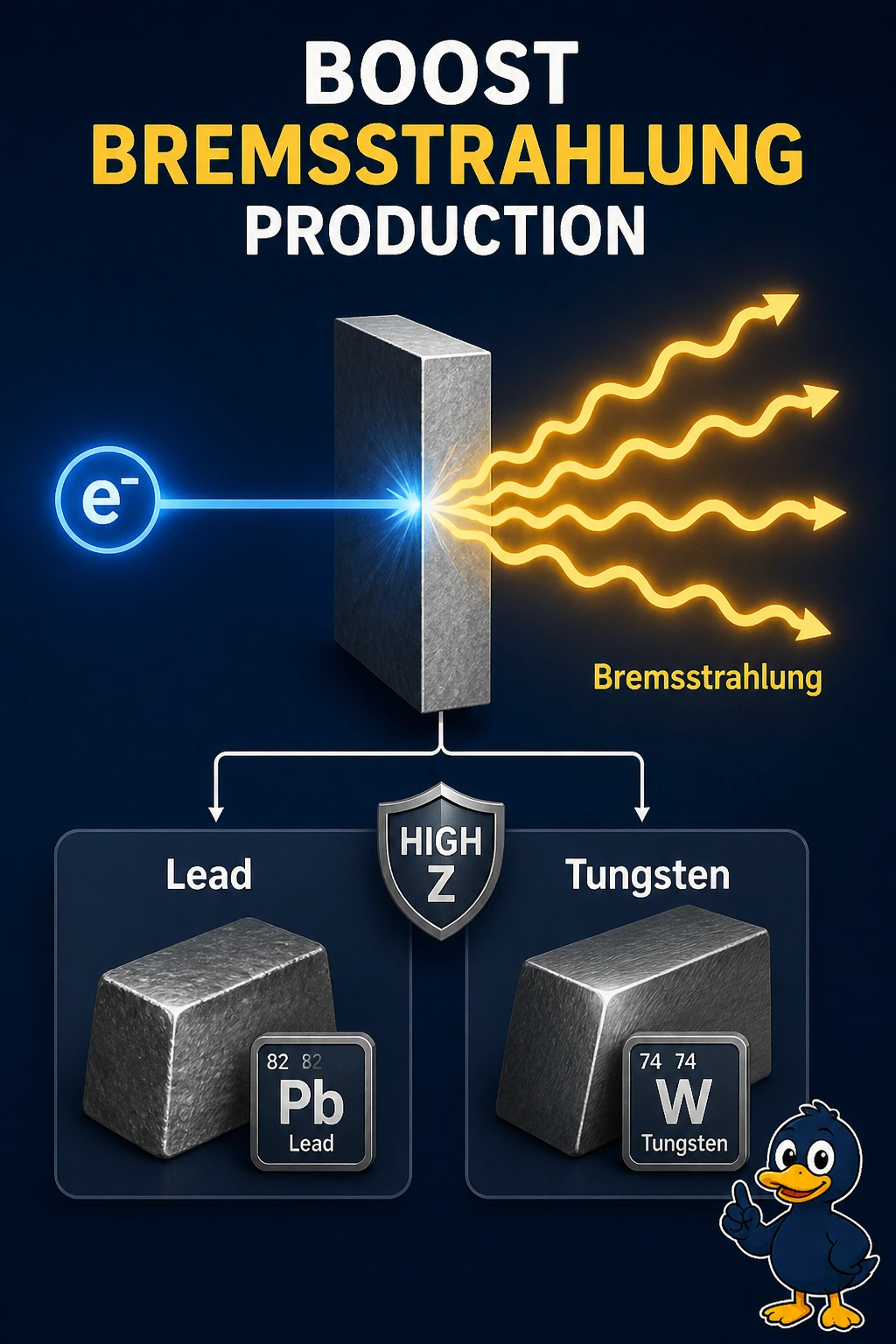
Short Explanation
You get a larger bremsstrahlung fraction when fast beta particles interact with a high-atomic-number absorber, such as lead or tungsten, because they brake strongly near its nuclei. Atomic number is the key here; lowering beta energy or adding thickness beyond the beta range does not increase that fraction, and low-Z plastic minimizes bremsstrahlung.
Full Explanation
As energetic beta particles decelerate in the electric field of atomic nuclei, some of their kinetic energy becomes continuous-spectrum bremsstrahlung X-rays. The ratio of radiative energy loss to collisional ionization loss is approximately proportional to the product of the absorber’s atomic number (Z) and the beta particle’s kinetic energy (E), so using a high-atomic-number absorber like lead or tungsten sharply increases the fraction converted into penetrating X-rays. Using a low-atomic-number plastic absorber minimizes bremsstrahlung because plastics consist of low-Z elements such as hydrogen and carbon. Decreasing the maximum beta particle energy reduces radiative yield rather than increasing it, since lower-energy electrons experience less radiative acceleration. Increasing the absorber thickness beyond the beta range does not increase the fraction converted to bremsstrahlung once all beta particles have been stopped within their finite range. As an exam caveat, shielding high-energy beta emitters directly with lead creates an unnecessary secondary X-ray hazard. As a practical check, inspect beta-shielding setups to confirm that a low-Z inner layer, such as acrylic, stops the betas before any outer high-Z gamma shield.
Prefer to study offline? Printable PDF study book + test engine ($7.50, unofficial). These questions stay free here.