
A health physicist needs to measure the average exposure rate outside a shielding wall around a pulsed medical linear accelerator that delivers radiation in brief microsecond bursts. Which portable survey instrument is best suited for this measurement?
Select an answer to reveal the explanation.
Short Explanation
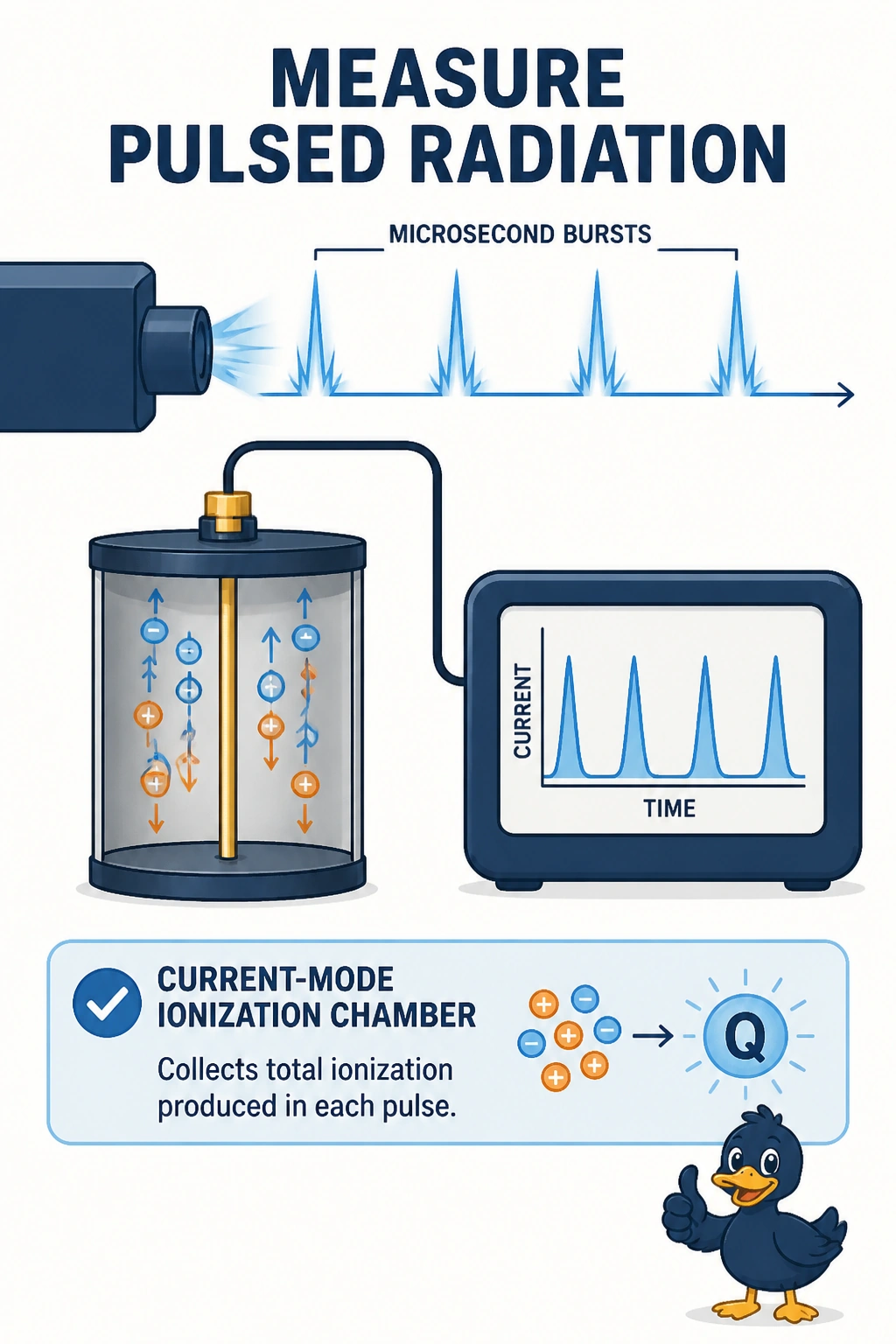
Measuring a pulsed accelerator with a Geiger-Mueller meter is like trying to count raindrops during a lightning flash using a camera that takes one photo per minute. You need a current-mode ionization chamber so the meter integrates all the ionization created in each brief burst. The common trap is trusting a pulse-counting detector, which freezes during dead time and only reports the machine's pulse repetition rate.
Full Explanation
Pulsed radiation fields deliver intense bursts of photons over a few microseconds separated by much longer off-periods. Selecting A current-mode ionization chamber because it collects total ionization produced in each pulse works because the chamber integrates charge continuously rather than resolving individual ionizing events, giving an accurate average exposure rate. Selecting A standard Geiger-Mueller probe because its gas amplification prevents pulse pile-up in short bursts fails because a Geiger-Mueller tube has a dead time of roughly 100 to 200 microseconds, so it fires at most once per machine pulse and severely underreads the true dose rate. Selecting A thin-window pancake Geiger-Mueller frisker because its large area captures fast pulses suffers from the exact same dead-time saturation and is designed for surface contamination frisking rather than exposure-rate surveys. Selecting A sodium iodide scintillator in count-rate mode because crystal light decay is instant also fails in intense bursts because pulse pile-up and photomultiplier saturation distort the count rate, and crystal response is energy-dependent. As an exam caveat, even an ionization chamber can underread in very high-intensity pulses if ion recombination occurs. As an operational check, verify the chamber battery voltage and confirm the instrument is rated for the accelerator's pulse dose rate before trusting the reading.
Prefer to study offline? Printable PDF study book + test engine ($7.50, unofficial). These questions stay free here.