
When counting a high-activity beta-gamma source with a Geiger-Mueller (GM) survey meter, the observed count rate begins to fall noticeably below the true rate of ionizing events entering the tube. What instrument phenomenon causes this under-response?
Select an answer to reveal the explanation.
Short Explanation
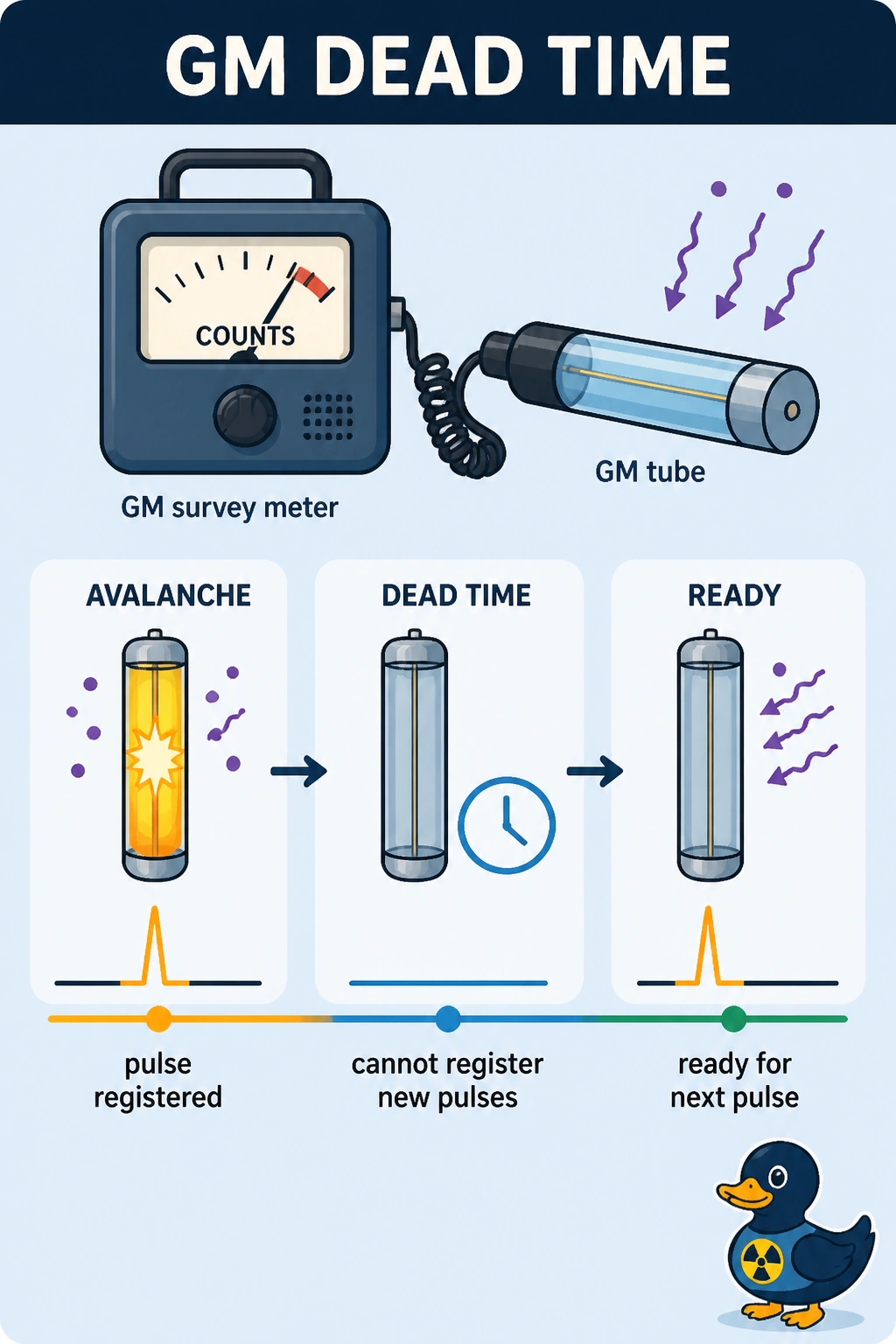
Imagine a turnstile that locks for a split second after each person walks through; if a crowd rushes in, people get turned away uncounted. Your GM tube works the same way because each Townsend avalanche leaves a positive ion sheath that momentarily blinds the detector. The trap is blaming photomultiplier noise or proportional recombination, which belong to scintillation and proportional detectors rather than GM tubes.
Full Explanation
In a Geiger-Mueller tube, every detected ionizing event triggers a full gas-multiplication avalanche along the anode wire, temporarily leaving a slow-moving sheath of positive ions around the wire. Selecting "Detector dead time during which the tube cannot register new pulses while recovering from an avalanche" accurately explains why incoming particles arriving during this recovery interval produce no countable pulse, causing observed count rates to lag behind true event rates at high intensities. Choosing "Space-charge recombination inside a proportional chamber operated below its plateau" confuses GM dead time with charge-collection losses in a proportional counter operated at insufficient voltage. Picking "Photoelectric escape peaks shifting counts out of the primary photopeak window" describes a gamma spectroscopy artifact in crystals like sodium iodide or germanium, whereas GM tubes have no energy resolution. Selecting "Thermal noise in the photomultiplier tube dynode chain masking true radiation pulses" applies to scintillation detectors, not gas-filled GM tubes. As a caveat, at extreme dose rates, dead time can progress to complete saturation where an analog GM meter drops toward zero. As an operational check, switch to a current-mode ionization chamber whenever dead-time losses exceed roughly ten percent or when surveying high-radiation fields.
Prefer to study offline? Printable PDF study book + test engine ($7.50, unofficial). These questions stay free here.