
A technician enters an area near an exposed high-activity gamma source with a standard Geiger-Mueller (GM) survey meter, and the analog needle suddenly drops toward zero despite a visibly unshielded source. What instrument limitation explains this behavior?
Select an answer to reveal the explanation.
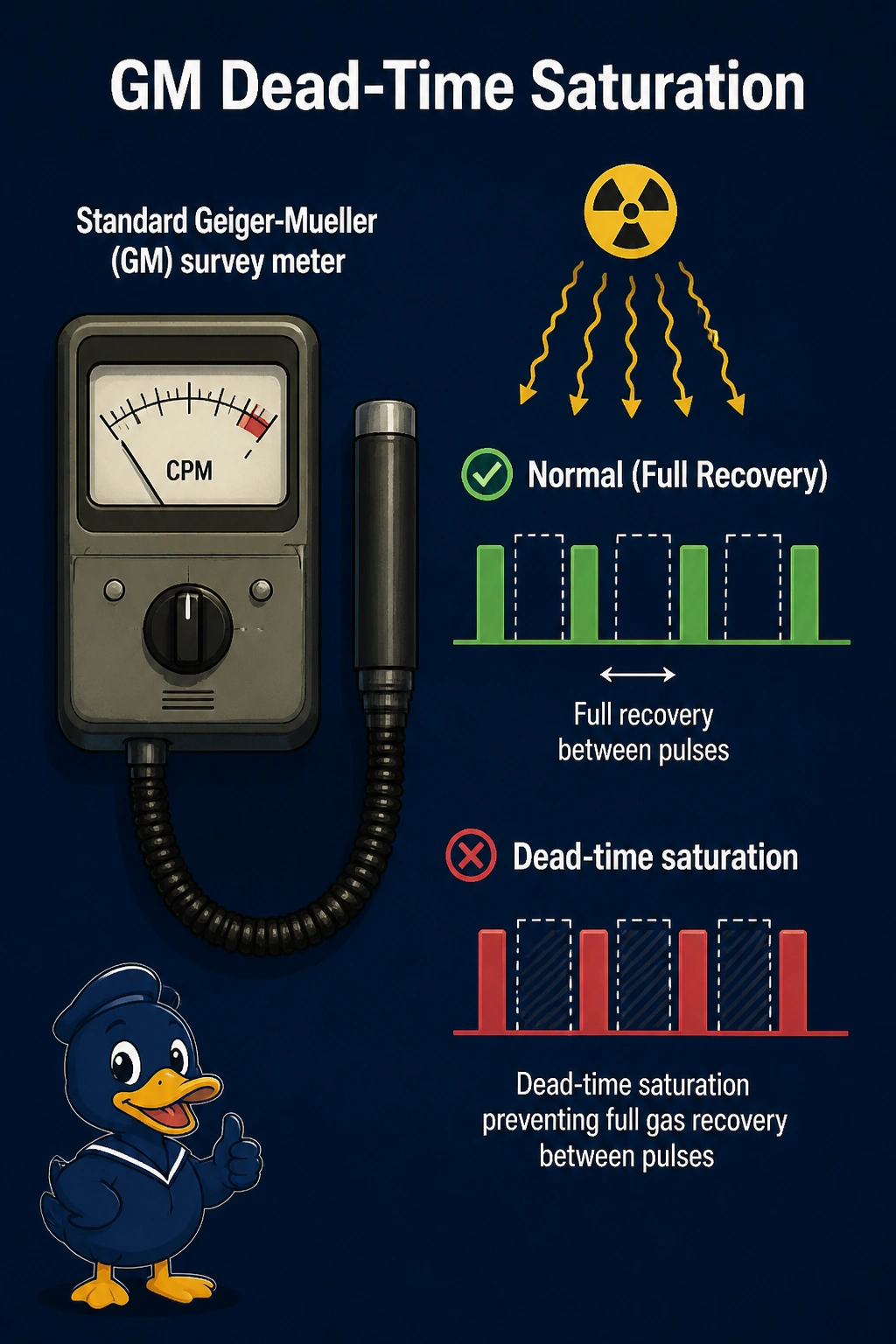
Short Explanation
If pulses hit a Geiger-Mueller tube faster than it can reset, the meter stops counting and can drop straight toward zero—giving you a dangerous false sense of safety. Never assume a sudden zero reading near a strong source means the area is clean.
Full Explanation
A Geiger-Mueller tube requires a brief recovery interval after each Townsend avalanche—known as dead time—before it can register another ionizing event, so Dead-time saturation preventing full gas recovery between pulses causes the detector to paralyze or drop toward zero in an intense radiation field. Because the anode voltage remains depressed by continuous ion-pair production, subsequent gamma interactions fail to trigger full output pulses, making a lethal field look deceptively low. Complete depletion of the quench gas inside the sealed tube occurs gradually over billions of counts at the end of a tube's service life and produces spurious multiple pulsing rather than sudden saturation only near a strong source. Insulator breakdown from excessive high-voltage battery power would cause erratic arcing or continuous full-scale noise regardless of source proximity. Photomultiplier tube gain drift caused by ambient temperature shifts applies to scintillation detectors such as NaI(Tl), not gas-filled GM tubes. As a caveat, some modern GM instruments include anti-saturation circuitry that holds the meter full-scale, but legacy units can still fold back. For an operational check, always carry an ionization chamber survey meter when entering potential high-radiation areas and verify meter response before crossing boundaries.
Prefer to study offline? Printable PDF study book + test engine ($7.50, unofficial). These questions stay free here.