
A technologist needs to survey a workbench for trace alpha contamination in an area with a moderate gamma background of 2 mR/hr. Which detector is best suited to detect the alpha emitters while rejecting the gamma background?
Select an answer to reveal the explanation.
Short Explanation
Alpha particles have paper-thin penetrating power, so your detector needs a razor-thin window and a phosphor that ignores stray gamma rays. The trap is picking a rugged gamma or beta probe whose housing stops alpha particles cold before they ever register.
Full Explanation
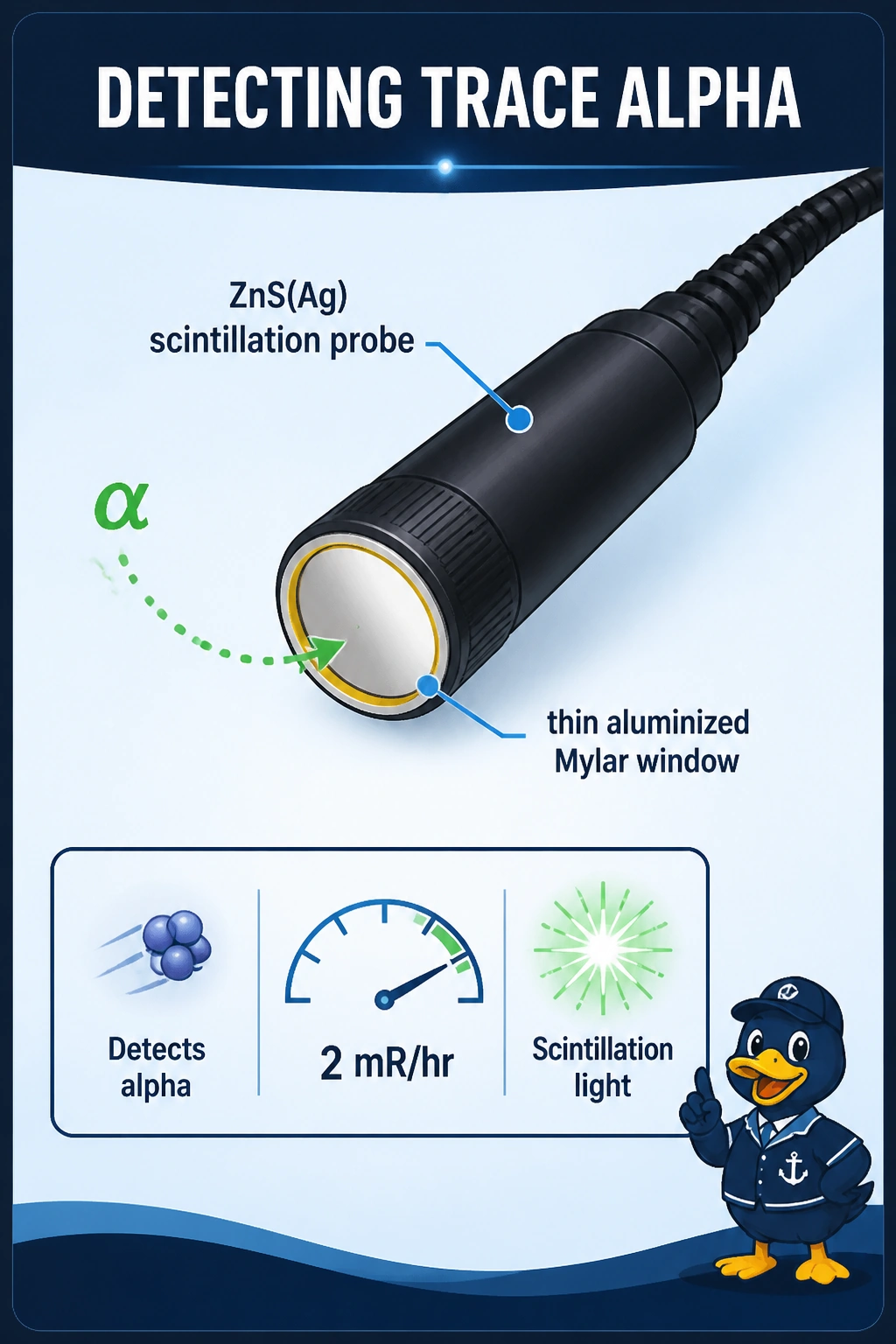
A zinc sulfide ZnS(Ag) scintillation probe with a thin aluminized Mylar window is the best choice because the ultra-thin window allows short-range alpha particles to reach the phosphor, where their high energy deposition produces bright light flashes easily discriminated from low-level gamma interactions. A thick-walled Geiger-Mueller probe with a closed beta shield completely blocks alpha particles from entering the sensitive gas volume and responds to the ambient gamma field instead. A sodium iodide scintillation detector set to integral mode uses a dense crystal encased in an aluminum housing that stops alpha particles externally while efficiently counting background gamma photons. A pressurized high-pressure ion chamber calibrated for exposure is built with thick metal walls for ambient gamma exposure-rate measurements and cannot detect surface alpha radiation. A key caveat is that aluminized Mylar windows are extremely fragile and susceptible to light leaks from pinholes, which can cause false counts. As an operational check, perform a dark-count background check and verify alpha response with a calibrated alpha check source held a few millimeters from the probe face.
Prefer to study offline? Printable PDF study book + test engine ($7.50, unofficial). These questions stay free here.