
A technologist uses a vented (unsealed) air-filled ionization chamber calibrated at sea level to measure gamma exposure rates at a high-altitude facility. Why must the meter readings be corrected for ambient temperature and barometric pressure?
Select an answer to reveal the explanation.
Short Explanation
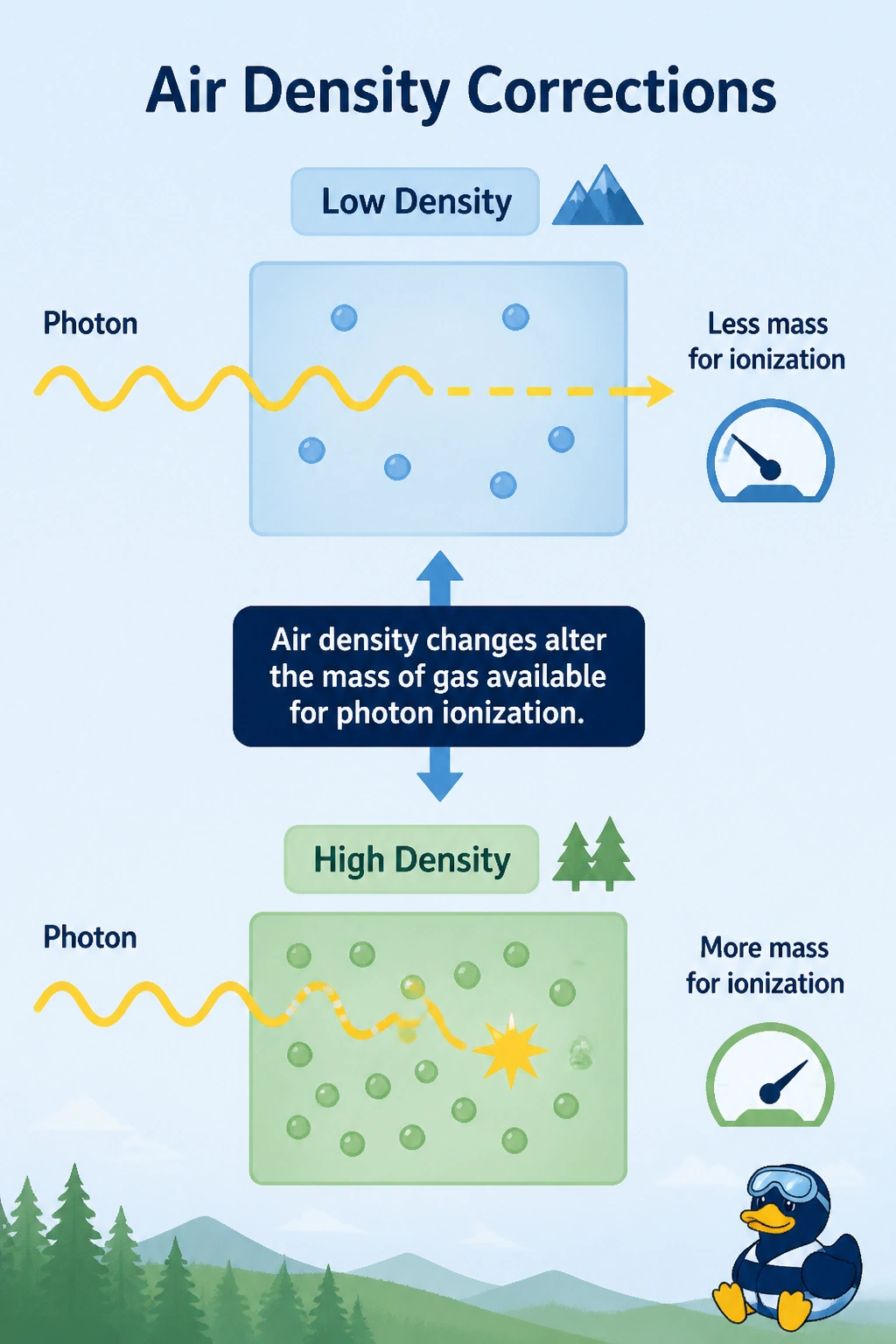
You can think of an unsealed ion chamber as breathing the surrounding air: at high altitude, thinner air means fewer gas molecules inside the chamber for photons to ionize. The key is air density, not dead time, gamma-photon energy, or quench gas leakage.
Full Explanation
A vented (unsealed) ionization chamber needs ambient temperature and barometric-pressure corrections because air density changes alter the mass of gas available for photon ionization. Exposure is defined per unit mass of air; at higher altitudes or warmer temperatures, air density drops, so fewer gas molecules occupy the fixed chamber volume and the meter under-reads unless you apply the temperature-pressure correction factor. The claim that low air pressure increases dead time of the chamber’s collection electrode is incorrect: ionization chambers operate in current or charge-integration mode without avalanche dead-time paralysis. The claim that high altitude shifts incoming gamma photons toward lower energies is also incorrect; atmospheric pressure does not alter the energy of photons emitted by a local source. The claim that reduced pressure causes halogen quench gas to leak outward confuses a vented, air-filled ion chamber with a sealed Geiger-Mueller tube containing quench gas. As an exam caveat, pressurized (sealed) ion chambers do not require ambient temperature and pressure corrections because their internal gas mass remains constant. For a practical check, record local barometric pressure and ambient temperature before surveying, then apply the manufacturer’s correction factor to all vented-chamber readings.
Prefer to study offline? Printable PDF study book + test engine ($7.50, unofficial). These questions stay free here.