
Before carrying a portable Geiger-Mueller survey meter into a radiologically controlled area, a technician inspects the calibration sticker and confirms the date is current. What additional check must the technician perform immediately before relying on the meter?
Select an answer to reveal the explanation.
Short Explanation
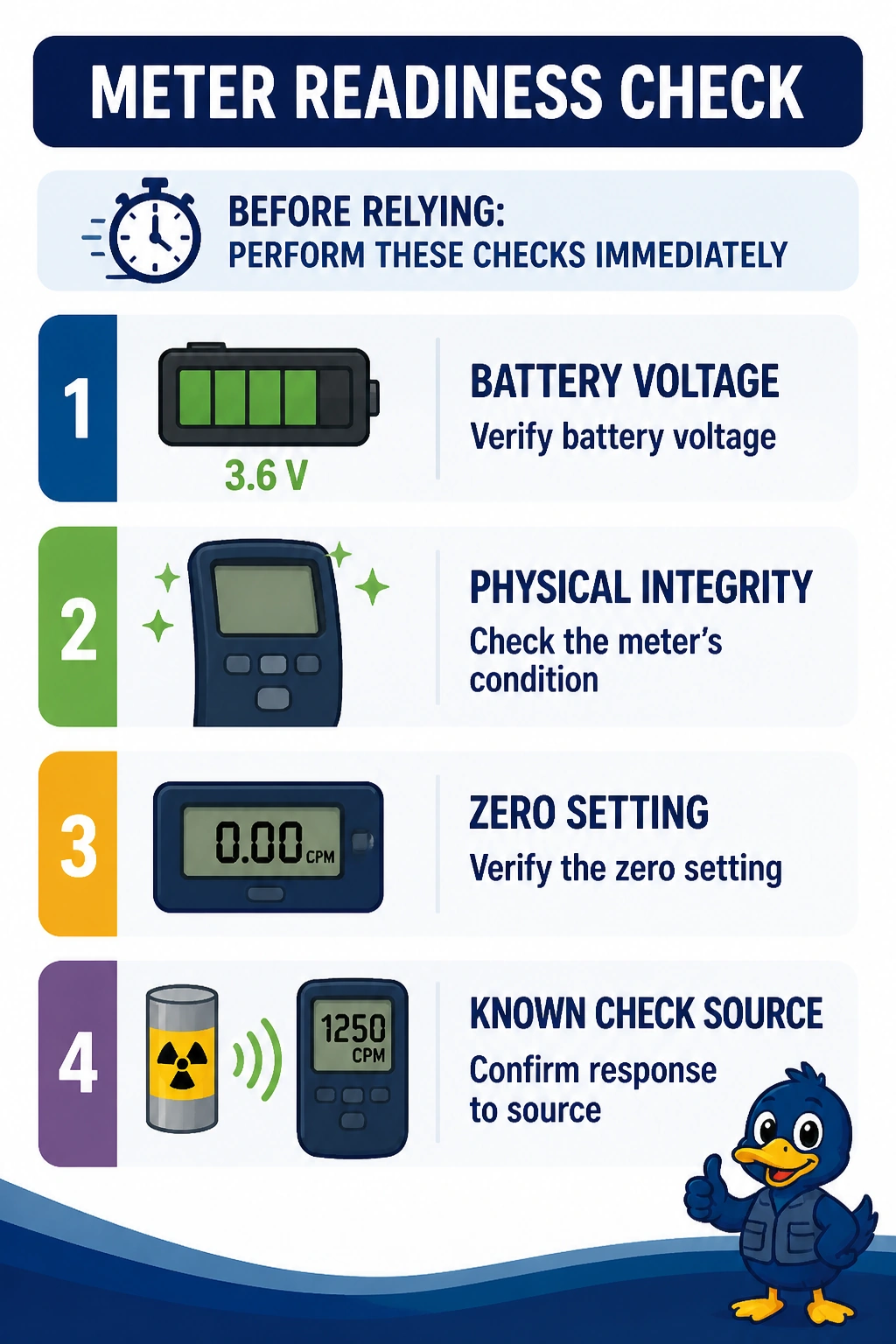
A current calibration sticker tells you the meter was calibrated, not that it survived handling or still works properly today. Before you rely on it, do a quick pre-use check of the battery, physical condition, zero setting, and response to a known check source.
Full Explanation
Before relying on a portable radiation survey meter, verify battery voltage, physical integrity, zero setting, and response to a known check source. Weak batteries, a punctured mylar window, loose coaxial cables, or a shifted electronic zero can make a recently calibrated meter read falsely low or fail completely. Adjusting the internal high-voltage potentiometer until the check source reads exactly twice its previous day’s value would invalidate calibration and could move the GM tube outside its proper operating plateau. Raising the high-voltage knob until the check source reads twice yesterday's value to offset battery sag would void calibration and mask a weak battery that should be replaced instead of compensated. Performing a full multi-point primary NIST-traceable exposure-rate calibration across every scale range before each shift confuses periodic metrological calibration with a daily operational response check. A current calibration sticker does not replace this immediate check. As an exam caveat, the check-source reading should be within the facility’s acceptable tolerance band, typically plus or minus 20 percent of the reference value. Before entering the controlled area, record the daily check-source reading and battery status in the instrument log.
Prefer to study offline? Printable PDF study book + test engine ($7.50, unofficial). These questions stay free here.