
During a short-duration accidental release of an airborne radioactive plume from a facility, why do emergency managers often instruct nearby residents to shelter-in-place with ventilation shut off rather than evacuate outdoors during plume passage?
Select an answer to reveal the explanation.
Short Explanation
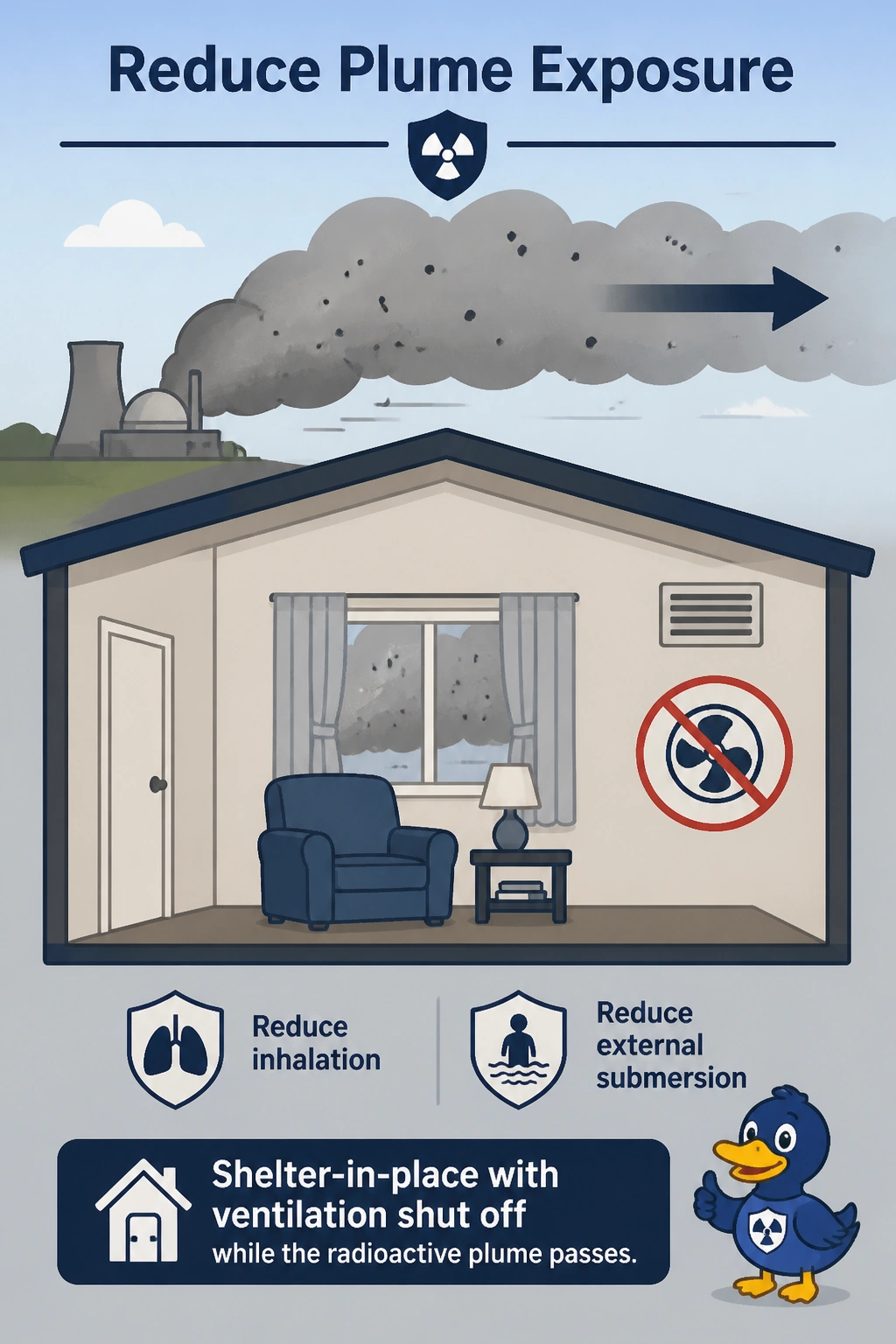
When a radioactive cloud is drifting past your neighborhood, stepping outside into traffic can put you right in the middle of the plume. Sheltering indoors with the windows shut and ventilation off buys you protection from both breathing it in and external shine. The trap is assuming air conditioners can scrub out noble gases.
Full Explanation
During an accidental atmospheric release of radioactive material, emergency directors often order nearby residents to shelter-in-place rather than evacuate through an active plume To reduce inhalation intake and external submersion dose while the radioactive plume passes. Closing windows, sealing doors, and shutting off heating, ventilation, and air-conditioning systems slows outdoor air infiltration, while building walls and roofs attenuate external gamma radiation from the passing cloud. Choosing To allow responders time to wash down local roadways before traffic moves misstates the protective purpose, as hosing down roads during plume passage is ineffective and risks spreading contamination into storm drains. Selecting To ensure residential air conditioners filter out radioactive noble gases is incorrect because standard HVAC filters do not capture noble gases such as xenon or krypton, and running ventilation draws outside air indoors. Relying on To prevent individuals from carrying surface contamination into medical clinics describes hospital reception controls rather than the protective basis for sheltering in place. As an exam caveat, sheltering-in-place is most effective for short-duration plumes and must be paired with turning off mechanical ventilation. As an operational check, verify during drills that facility and public notification scripts explicitly instruct occupants to shut off outside-air intake dampers.
Prefer to study offline? Printable PDF study book + test engine ($7.50, unofficial). These questions stay free here.