
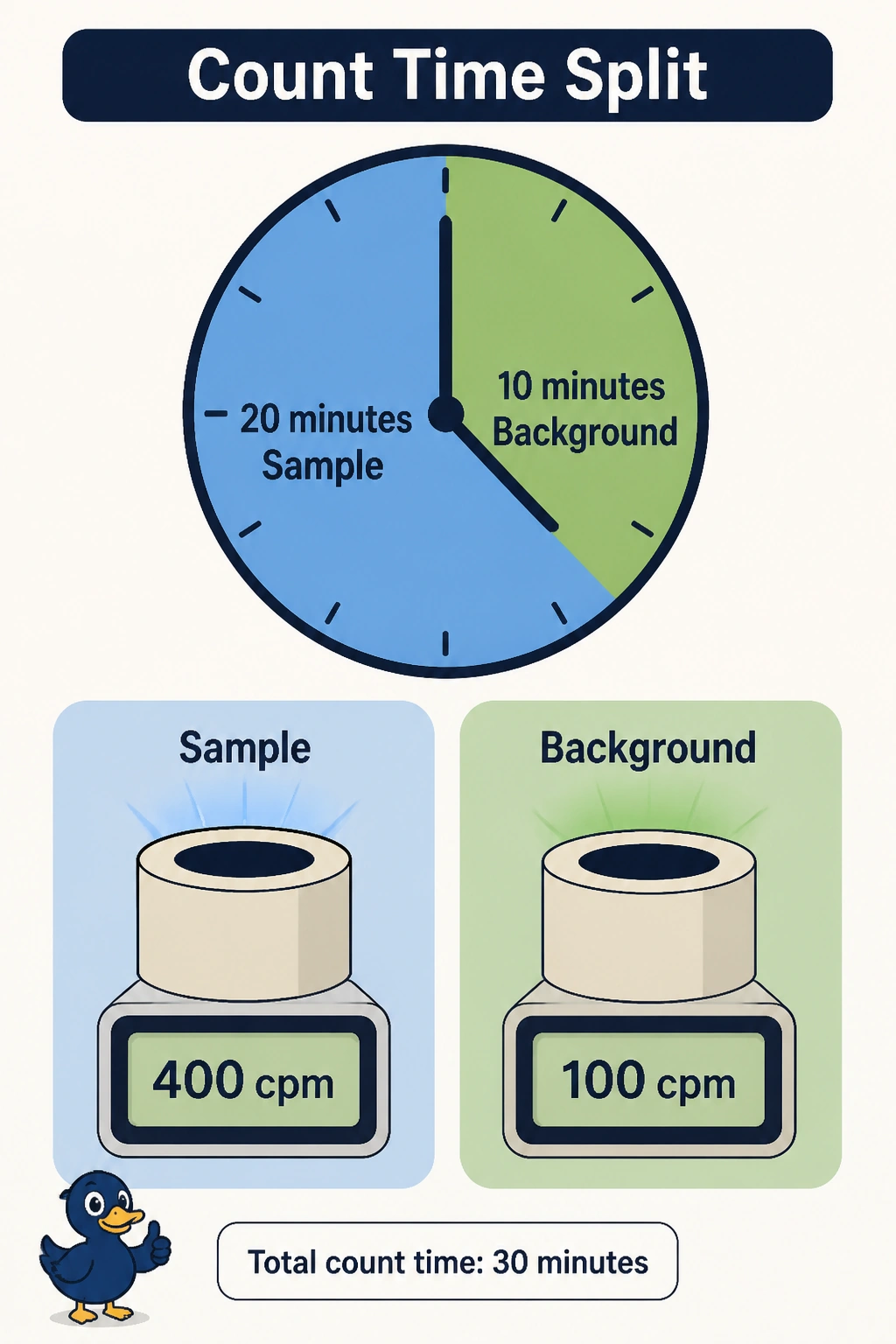
A technician has a fixed total counting time of 30 minutes to measure a sample with an approximate gross count rate of 400 cpm and a background count rate of 100 cpm. To minimize the statistical uncertainty of the net count rate, how should the 30 minutes be divided between the sample and background counts?
Select an answer to reveal the explanation.
Short Explanation
When your total counting clock is fixed, you give the noisier measurement more time according to the square root of the count-rate ratio. The trap is splitting the 30 minutes evenly at 15 and 15 or using the raw 4-to-1 ratio directly instead of taking its square root.
Full Explanation
To minimize the variance of a net count rate when total counting time is fixed, the optimal ratio of sample time to background time equals the square root of the gross sample count rate divided by the background count rate. Here, dividing 400 cpm by 100 cpm gives 4, and the square root of 4 is 2, meaning the sample should be counted twice as long as the background. Splitting 30 minutes in a 2-to-1 ratio gives 20 minutes counting the sample and 10 minutes counting background. Choosing 15 minutes on the sample and 15 minutes on background ignores the higher variance of the 400 cpm gross rate, while 24 minutes on the sample and 6 minutes on background uses the linear 4-to-1 rate ratio instead of its square root. Reversing the allocation to 10 minutes on the sample and 20 minutes on background increases net error by under-sampling the higher count rate. As a caveat, when sample activity is very close to background, the ratio approaches 1 and equal counting times become optimal. For an operational check, run a quick 1-minute pretest on both sample and background to estimate rates before locking in the automated scaler timer.
Prefer to study offline? Printable PDF study book + test engine ($7.50, unofficial). These questions stay free here.