
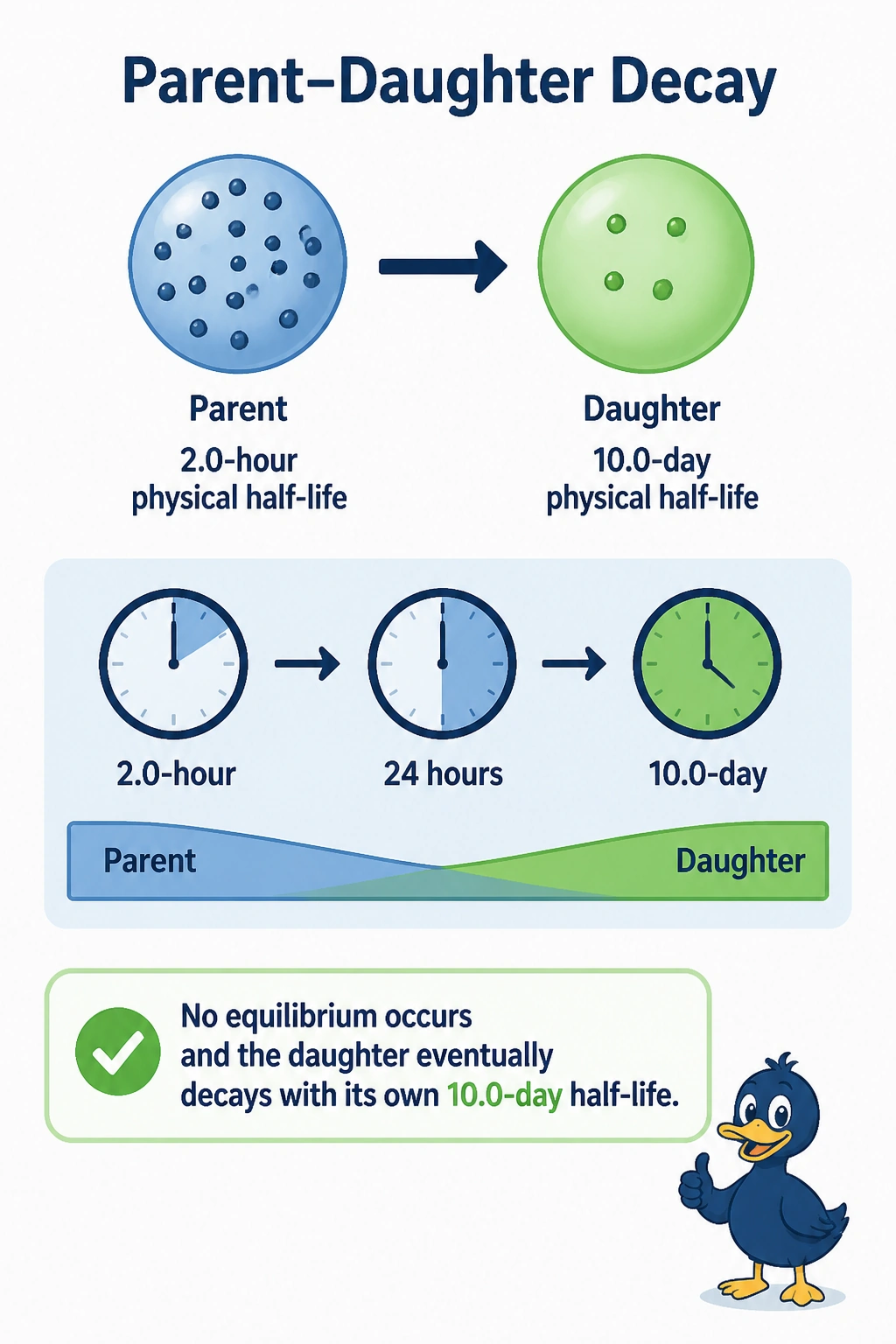
A freshly separated parent radionuclide with a 2.0-hour physical half-life decays into a radioactive daughter with a 10.0-day physical half-life. After 24 hours, what best describes the activity relationship between the parent and daughter?
Select an answer to reveal the explanation.
Short Explanation
Think of a fast-burning candle lighting a slow-burning log: once the candle is gone, the log keeps burning at its own pace. When a short-lived parent decays into a longer-lived daughter, no equilibrium forms, and the daughter outlasts the parent. The classic trap is assuming every parent-daughter pair settles into secular or transient equilibrium, so always check which half-life is longer before you predict the decay curve.
Full Explanation
When a parent radionuclide has a much shorter half-life than its radioactive daughter, the parent decays away rapidly while the daughter accumulates and then decays independently, so No equilibrium occurs and the daughter eventually decays with its own 10.0-day half-life. After 24 hours, twelve 2.0-hour parent half-lives have elapsed, reducing parent activity to less than 0.03 percent of its initial value while the 10.0-day daughter has barely begun to decay. By contrast, Transient equilibrium occurs and the daughter decays at the parent half-life only when the parent half-life is moderately longer than the daughter half-life, allowing the daughter activity to exceed and track the parent's decay rate. Similarly, Secular equilibrium occurs with daughter activity matching the parent activity only when the parent half-life is vastly longer than the daughter half-life, which is the exact reverse of this decay chain. Finally, The daughter activity peaks immediately and drops to zero once the parent decays is physically impossible because a daughter starting at zero activity must build up to a maximum before decaying at its own slower rate. As a practical caveat, even short-lived parent sources can leave behind long-lived progeny that prevent early clearance from decay-in-storage. For an operational check, perform gamma spectroscopy or sequential gross counts over several days to confirm the residual half-life matches the daughter before releasing or disposing of the material.
Prefer to study offline? Printable PDF study book + test engine ($7.50, unofficial). These questions stay free here.