
A freshly purified sample of radium-226 (half-life approximately 1,600 years) begins decaying into radon-222 (half-life approximately 3.82 days) inside a sealed container. After ten radon-222 half-lives have elapsed, what describes the activities of the parent and progeny?
Select an answer to reveal the explanation.
Short Explanation
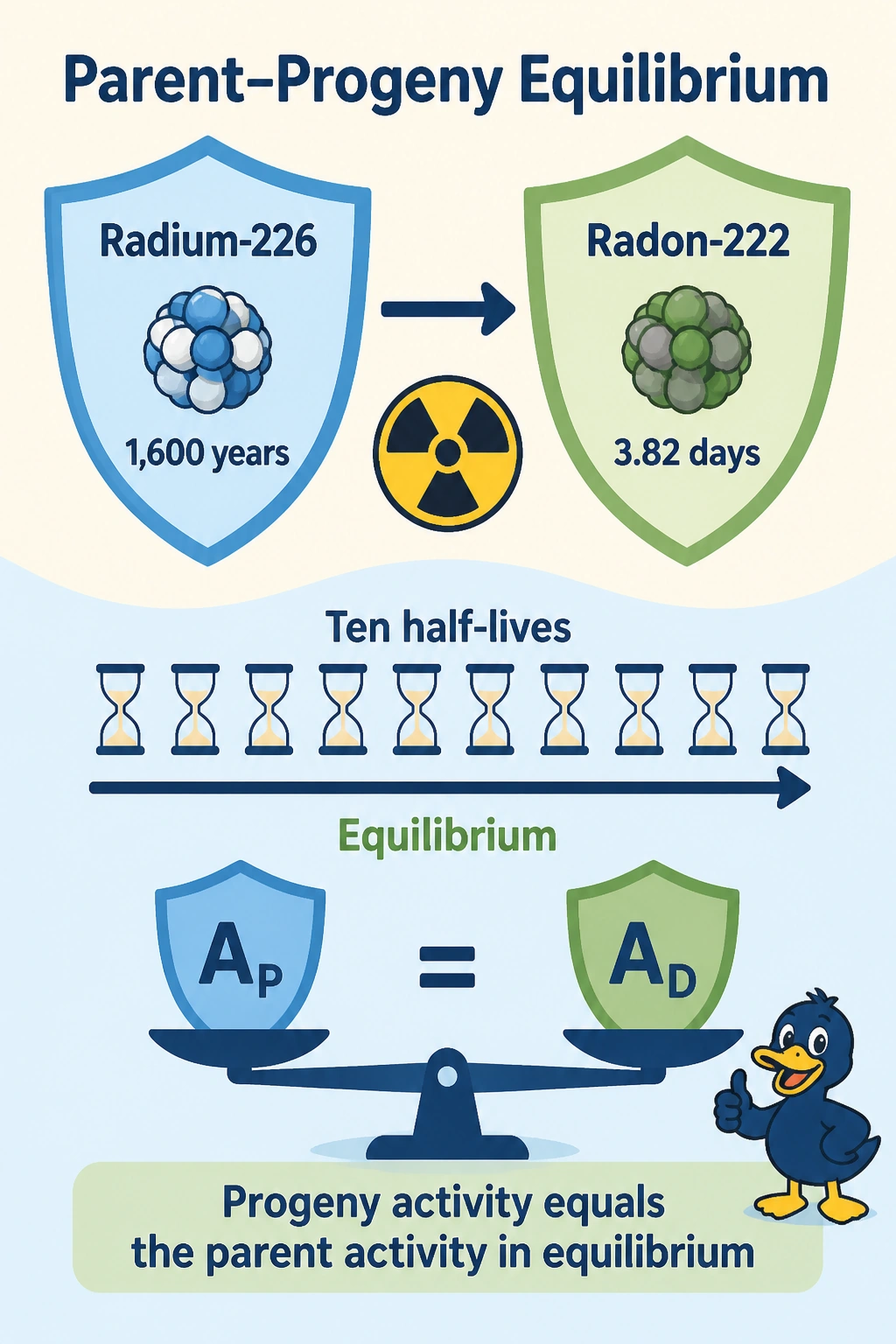
You can picture the long-lived radium-226 as a steady faucet feeding radon-222 until the progeny’s decay rate matches its supply. After about ten radon half-lives, secular equilibrium means their activities are equal—not that the progeny exceeds the parent or makes the parent decay faster.
Full Explanation
Because radium-226’s half-life is vastly longer than radon-222’s, the parent activity changes negligibly while radon builds up in the sealed container. After ten radon half-lives, the sample is effectively at secular equilibrium: the radon production rate matches its decay rate, so the progeny activity equals the parent activity. Both activities then decrease together at the much slower rate set by radium-226’s 1,600-year half-life. The progeny activity exceeds the parent activity by a constant factor describes transient equilibrium, which applies when the parent half-life is longer than the progeny half-life but not by such an enormous margin; it does not fit this pair. The parent activity drops rapidly to match the progeny half-life is incorrect because a daughter’s buildup does not alter the parent’s nuclear decay constant. The progeny decays independently at its own 3.82-day rate would apply if radon were separated from its radium source; in the sealed container, continuing production sustains its activity. One caveat is that escaping radon breaks the assumed closed-system equilibrium and can make progeny-based estimates unreliable. Before using radon activity to assess radium in practice, check that the container is intact and that enough time has passed for ingrowth.
Prefer to study offline? Printable PDF study book + test engine ($7.50, unofficial). These questions stay free here.