
A counting laboratory needs to cut the Minimum Detectable Activity (MDA) of a low-level smear counter in half using the same detector, geometry, and sample. Assuming equal sample and background counting times and a dominant background rate, how must the counting times be adjusted?
Select an answer to reveal the explanation.
Short Explanation
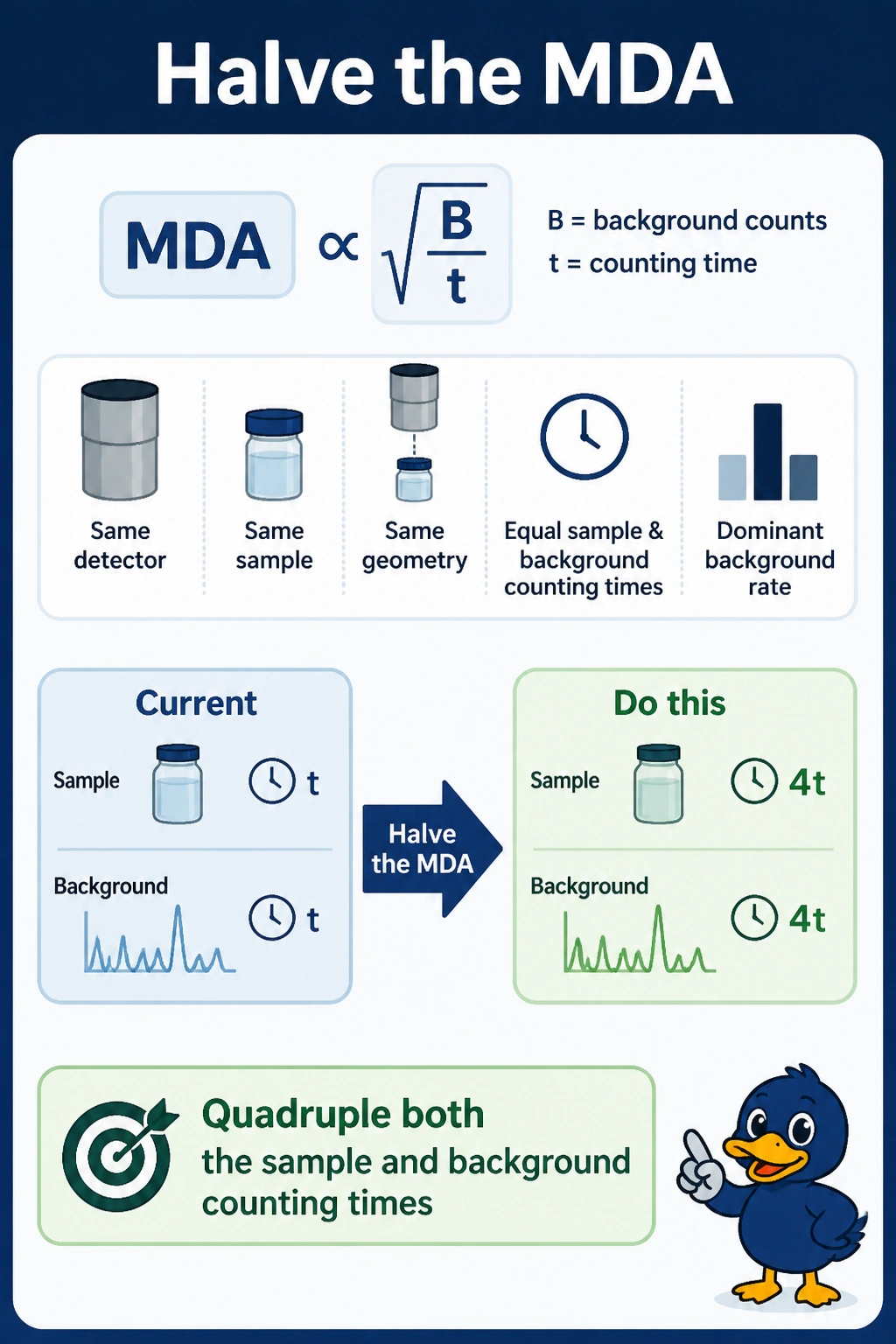
Counting statistics follow a square-root rule, so cutting your detection limit in half takes more than twice the patience. Just as halving a count-rate uncertainty requires four times the counting time, you must quadruple both sample and background times to halve your MDA.
Full Explanation
In the Currie formulation for Minimum Detectable Activity when background counts are substantial, the detection limit scales with the square root of the background count rate divided by the counting time. Because of this inverse square-root relationship, you must Quadruple both the sample and background counting times to reduce the MDA by a factor of two (since the square root of 4 equals 2). Choosing to Double both the sample and background counting times only reduces the MDA by a factor of 1.41 (the square root of 2), falling short of the target 50 percent reduction. Opting to Halve the background time and double the sample time actually degrades precision by increasing the background variance contribution in the net count rate uncertainty. Selecting Increase both counting times by a factor of eight would reduce the MDA by approximately 2.83 rather than 2, wasting valuable instrument throughput. As a caveat, when background is near zero (such as in alpha spectroscopy), the constant term in the Currie equation becomes significant and MDA scales more nearly with 1/t rather than 1/sqrt(t). As an operational check, verify that background stability and sample half-life remain valid over the longer counting interval before running extended MDA counts.
Prefer to study offline? Printable PDF study book + test engine ($7.50, unofficial). These questions stay free here.