
When surveying a dry workbench for alpha contamination with a ZnS(Ag) scintillation probe, why must a technician keep the probe face within roughly 0.5 centimeters of the surface without making contact?
Select an answer to reveal the explanation.
Short Explanation
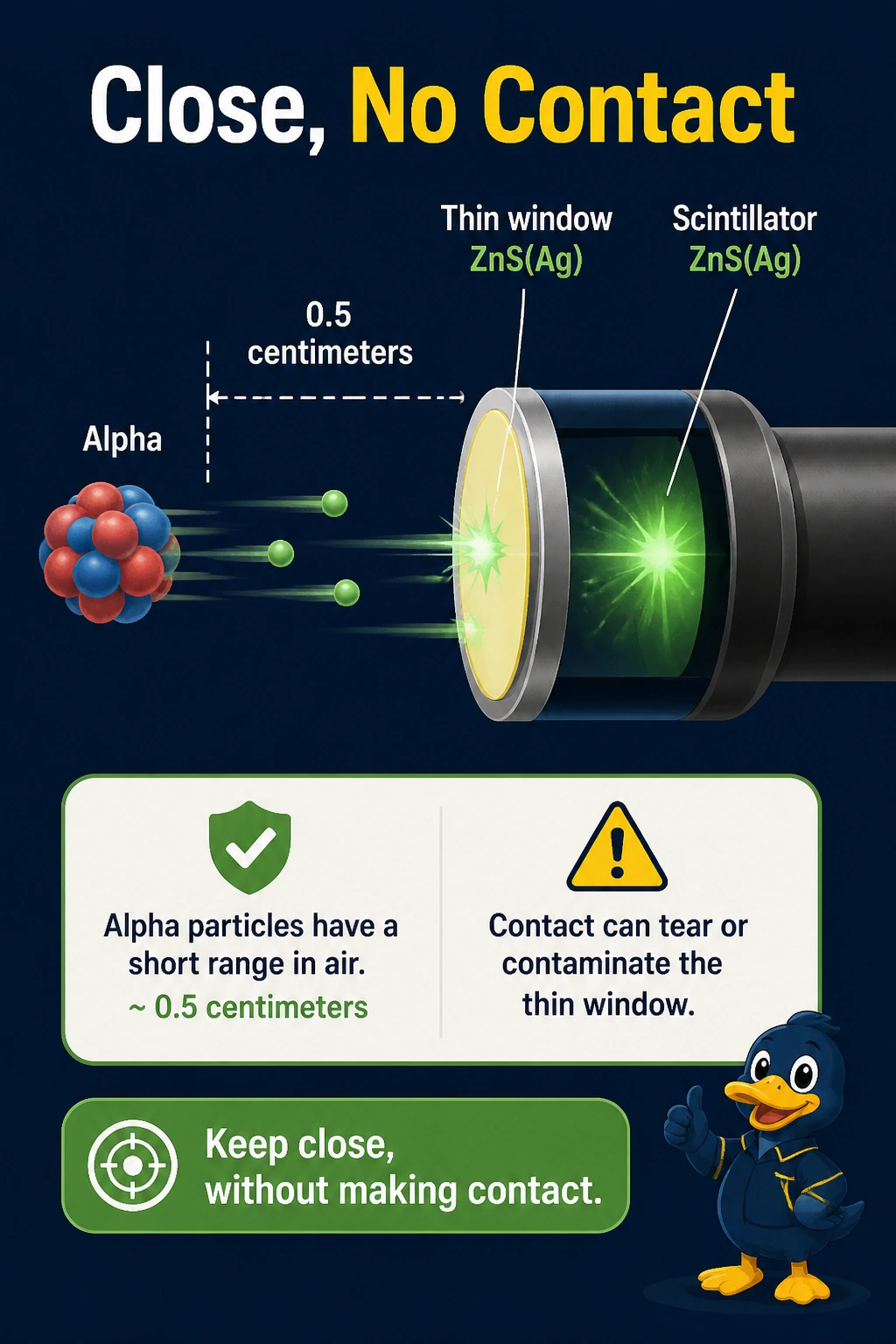
Surveying for alpha particles is like listening to a whisper across a noisy room: if you pull back even a few centimeters, the signal fades out completely. Keeping the probe close without touching protects both your count efficiency and the fragile window. The trap is blaming gamma interference or air ionization when range in air and window integrity are the real issues.
Full Explanation
Alpha particles deposit energy densely along short straight tracks and travel only a few centimeters in air, while the probe's aluminized Mylar entrance window is extremely thin so alpha particles can reach the phosphor, meaning Alpha particles have a short range in air and contact can tear or contaminate the thin window. Holding the probe within about half a centimeter maximizes geometric efficiency and prevents air absorption from hiding real contamination, while avoiding physical contact prevents pinholes that admit ambient light and cause spurious counts. By contrast, Greater distance increases gamma background interference while contact causes detector dead-time saturation is wrong because ZnS(Ag) is already insensitive to gamma rays and touching a surface does not saturate dead time. Similarly, Air scatter deflects alpha particles sideways while contact triggers thermal drift in the crystal misstates alpha physics, since heavy alpha particles undergo minimal lateral scatter and brief contact does not cause crystal thermal drift. Likewise, Alpha particles require air ionization outside the probe to trigger photomultiplier light pulses is incorrect because alpha particles excite the ZnS(Ag) phosphor directly rather than relying on external air ionization. Exam caveat: even a tiny light leak in a torn Mylar window can send an alpha scintillator off-scale. Operational check: inspect the probe window for pinholes or dirt and verify background stability before starting any alpha survey.
Prefer to study offline? Printable PDF study book + test engine ($7.50, unofficial). These questions stay free here.