
A laboratory technician counts a long-lived check source for 4 minutes and records 1,600 total counts, giving a count rate of 400 cpm with a one-sigma standard deviation of 10 cpm. Assuming negligible background, how long must the technician count the same source to reduce the count rate's one-sigma standard deviation to 5 cpm?
Select an answer to reveal the explanation.
Short Explanation
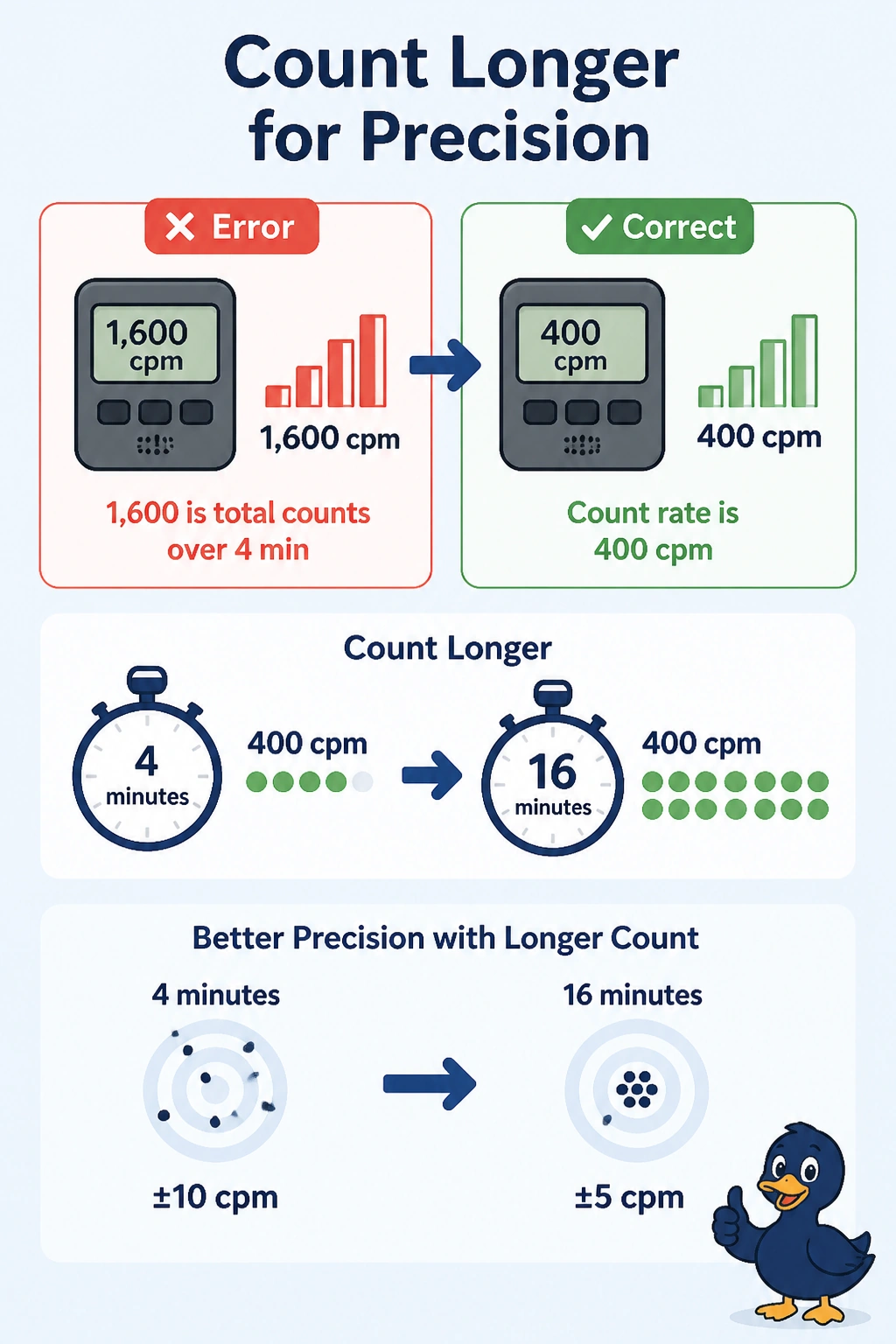
In counting statistics, cutting your uncertainty in half costs you four times the clock, not twice the clock. The trap is doubling the count time from 4 minutes to 8 minutes, which only shrinks the standard deviation by the square root of two. To drop the one-sigma rate uncertainty from 10 cpm to 5 cpm, you need 16 minutes of counting.
Full Explanation
For a constant count rate R with negligible background, the one-sigma standard deviation of the count rate equals the square root of (R divided by t), where t is the counting time. Because uncertainty scales inversely with the square root of counting time, halving the standard deviation from 10 cpm to 5 cpm requires increasing the count time by a factor of two squared, or four. Multiplying the original 4-minute count time by four gives 16 minutes of continuous source counting, which yields 6,400 total counts, a total-count standard deviation of 80 counts, and a rate uncertainty of 80 divided by 16, or 5 cpm. Selecting 8 minutes of continuous source counting only doubles the time, reducing the standard deviation by 1.414 to about 7.1 cpm. Choosing 12 minutes of continuous source counting triples the time, lowering the standard deviation to about 5.8 cpm rather than 5 cpm. Picking 32 minutes of continuous source counting for the sample multiplies the time by eight, reducing the standard deviation to about 3.5 cpm unnecessarily. As a caveat, this inverse-square-root shortcut assumes negligible background and a source half-life much longer than the 16-minute count; when background is significant, total uncertainty depends on both sample and background count times. Operationally, confirm the background count rate is negligible relative to 400 cpm and verify source geometry remains fixed throughout the extended count.
Prefer to study offline? Printable PDF study book + test engine ($7.50, unofficial). These questions stay free here.