
A planner proposes assigning four technicians for 15 minutes each instead of two technicians for 30 minutes each in a uniform 100 mrem/hr field, without changing tools or shielding. How does this staffing change affect individual dose versus collective dose?
Select an answer to reveal the explanation.
Short Explanation
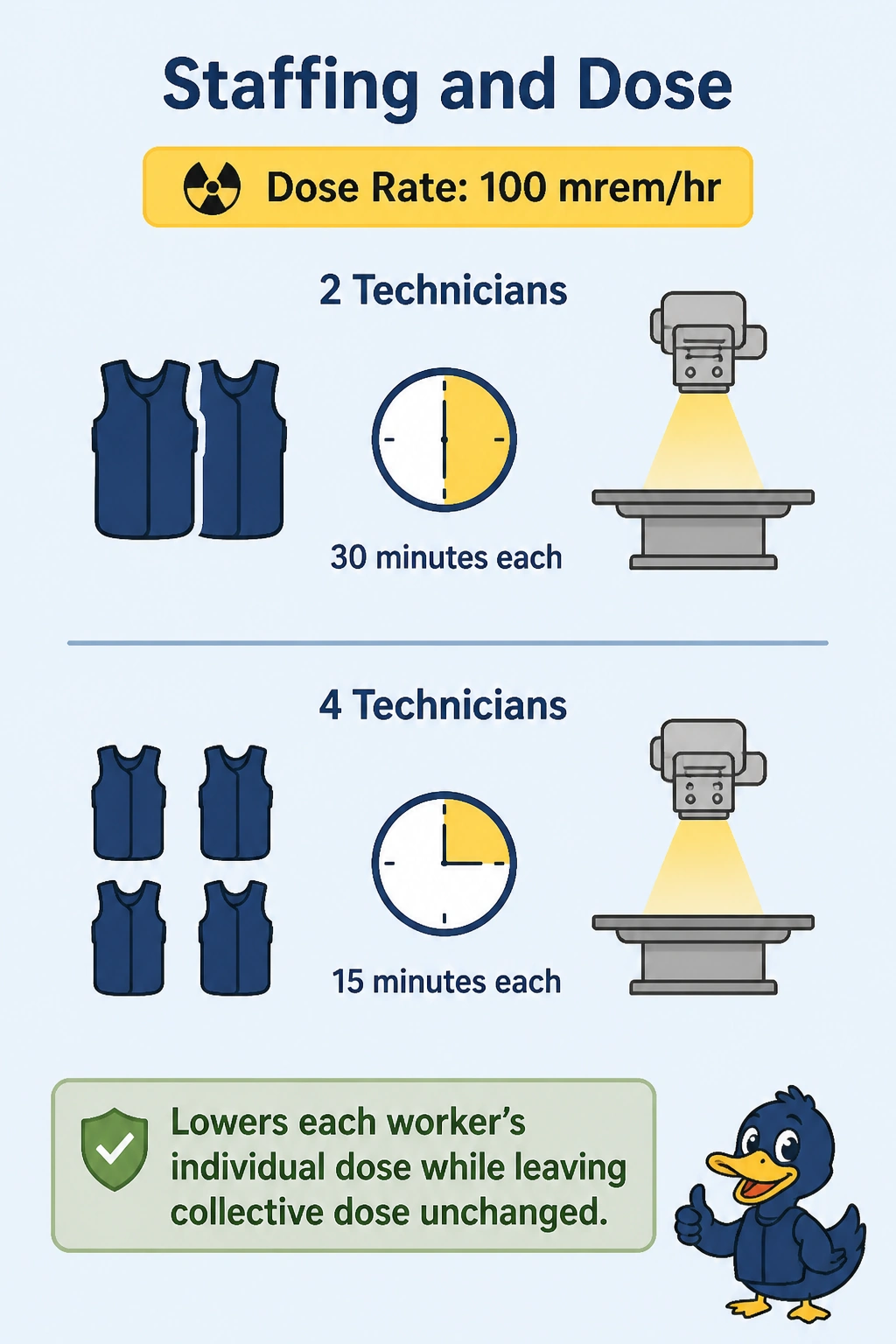
Think of the radiation field like a pizza: when you share the same work time among four people instead of two, you each get a smaller slice, but the whole pizza is still eaten. You lower your individual dose through rotation, but the total person-rem stays the same; rotation alone does not reduce collective ALARA dose.
Full Explanation
Two technicians working 30 minutes each in a uniform 100 mrem/hr field receive 50 mrem apiece, for a total collective dose of 100 person-mrem. With four technicians working 15 minutes each, each receives 25 mrem, while the collective dose remains 100 person-mrem. Thus, assigning more technicians for shorter periods lowers each worker’s individual dose without changing the total collective dose. The claim that both individual and collective doses fall by half confuses dividing the exposure among more people with reducing the total person-time in the field. The claim that collective dose doubles because four workers enter the field overlooks that each worker’s exposure duration is halved. The claim that individual dose stays unchanged while collective dose doubles instead describes adding workers without shortening their time in the field, not splitting the same total work time. A caveat is that additional workers can increase collective dose in practice through extra transit time, dressing, and handoffs at the job site. During ALARA work-package reviews, verify that crew rotation is used to manage individual dose limits and is not counted as a substitute for source reduction, shielding, or faster tooling.
Prefer to study offline? Printable PDF study book + test engine ($7.50, unofficial). These questions stay free here.