
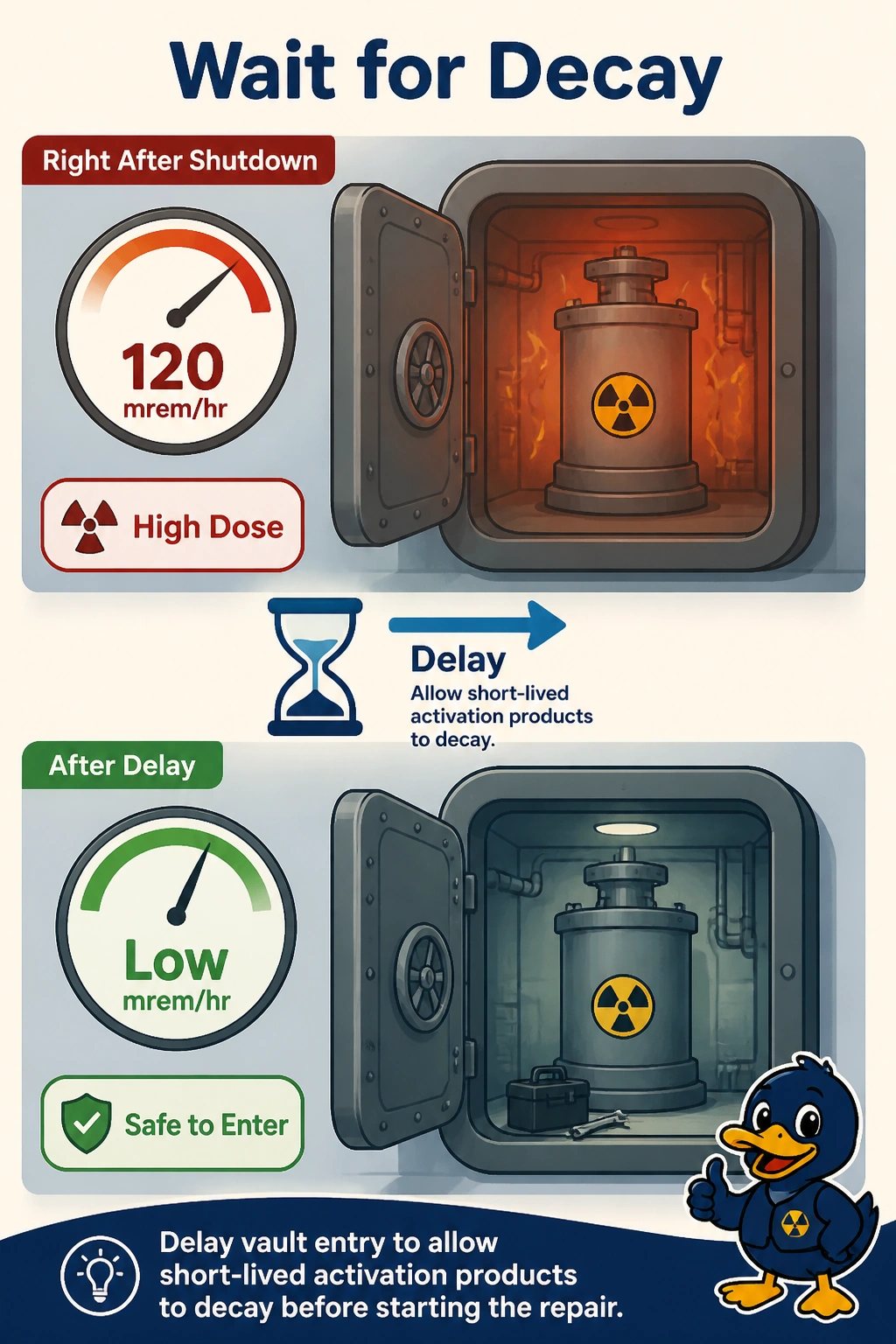
A maintenance crew needs to replace a sensor inside a cyclotron vault immediately after an irradiation run, where short-lived air and target activation products create a 120 mrem/hr field. If the repair is not urgent, which ALARA action most effectively reduces collective dose without adding shielding?
Select an answer to reveal the explanation.
Short Explanation
If a non-urgent job sits inside a hot room full of short-lived activation products, patience is one of the cheapest shields you have. Waiting several half-lives lets nature drop the radiation field before anyone even opens the door. Do not fall for the trap of splitting the work among more people—that spreads individual dose around without lowering total collective person-rem.
Full Explanation
ALARA planning prioritizes source-term reduction before relying on administrative work-sharing or personal protective equipment. When a cyclotron or reactor shutdown leaves short-lived activation products such as Nitrogen-13, Oxygen-15, or Sodium-24, waiting several half-lives sharply lowers area dose rates at zero exposure cost. Therefore, the best strategy is to "Delay vault entry to allow short-lived activation products to decay before starting the repair." The option "Divide the repair among six technicians working brief shifts so total collective person-rem drops." is a classic misconception because splitting a fixed task across more workers reduces individual dose but leaves total collective person-rem unchanged (or slightly higher due to transit). Similarly, "Require full-facepiece supplied-air respirators so technicians can remain in the vault longer." addresses internal airborne hazards rather than external gamma fields and can slow work down. Finally, "Increase ventilation flow solely to dilute external gamma fields from solid activated components." fails because airflow cannot remove activity fixed inside solid metal targets. As a caveat, verify that no long-lived activation products dominate the field before assuming decay will help. For an operational check, take remote or doorway dose-rate readings over time to confirm the expected decay curve before authorizing entry.
Prefer to study offline? Printable PDF study book + test engine ($7.50, unofficial). These questions stay free here.