
A maintenance crew must unbolt and replace a leaking valve on a process line that normally carries radioactive resin slurry. Which pre-job ALARA measure most effectively lowers the radiation field for the entire work crew?
Select an answer to reveal the explanation.
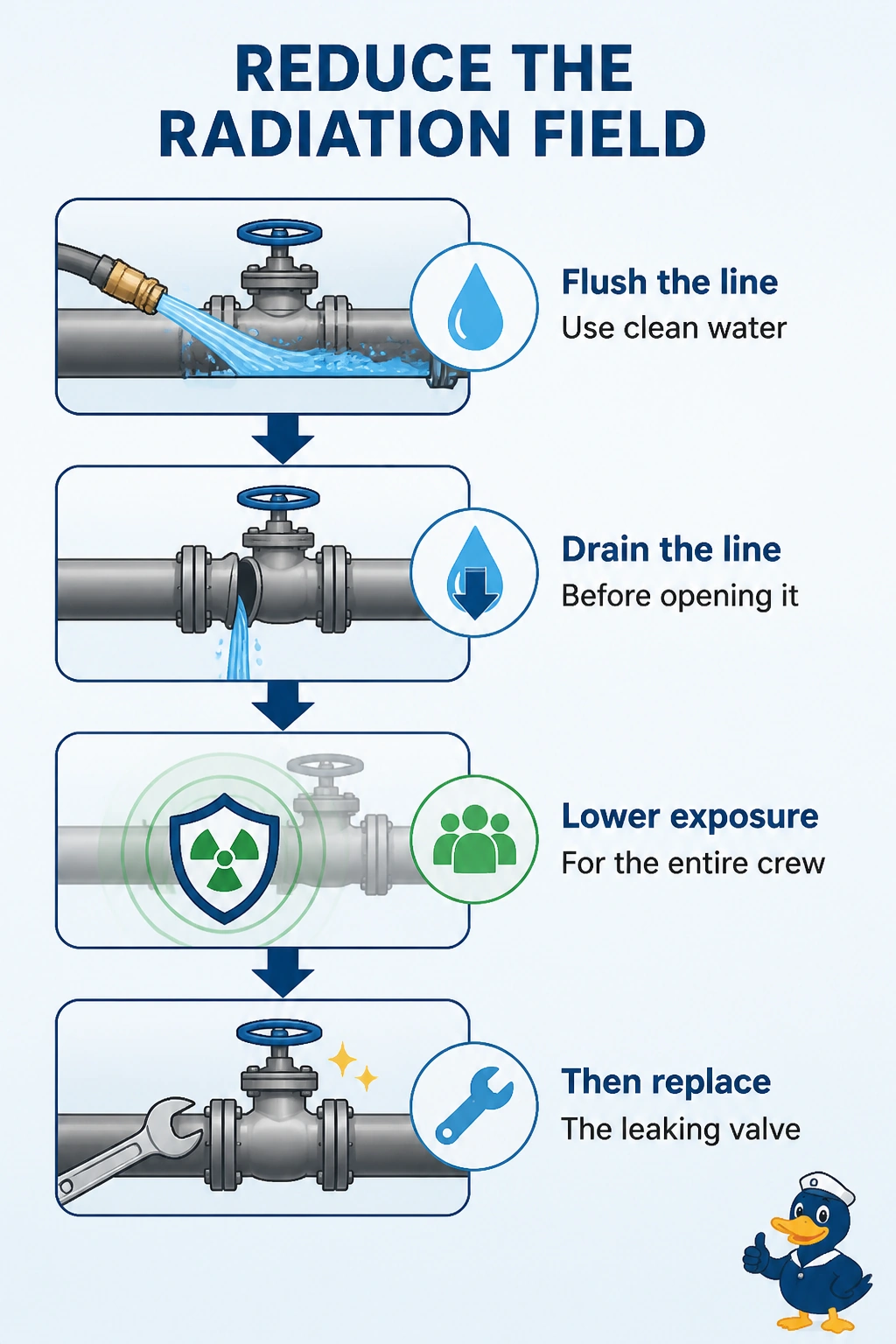
Short Explanation
Before you suit up extra workers or add more warning signs, ask whether you can simply remove the source from the pipe first. Rotating extra bodies through a hot room often raises total collective dose, whereas flushing the line cuts the hazard at its root for everyone.
Full Explanation
Flushing and draining the line with clean water before opening reduces the source term directly inside the pipe, lowering general area and contact gamma dose rates for every worker throughout the entire repair. Assigning twice as many mechanics to rotate through the room is a poor choice because adding extra personnel who incur transit dose and handoff delays often increases collective person-rem even if individual doses drop. Issuing double sets of cotton coveralls and rubber shoe covers helps control removable skin contamination during line breaking, but cloth PPE provides virtually no shielding against penetrating gamma rays from internal resin. Posting an extra Radiation Area sign at the cubicle entranceway communicates hazard boundaries for compliance, yet signage alone does nothing to reduce the radiation field at the valve. As an exam caveat, flushing must be routed to an approved radioactive liquid holdup system so you do not transfer contamination or create an unplanned spill elsewhere. Operationally, survey the valve contact and general work-area dose rates both before and after flushing to confirm the expected drop in radiation levels before authorizing line breach.
Prefer to study offline? Printable PDF study book + test engine ($7.50, unofficial). These questions stay free here.