
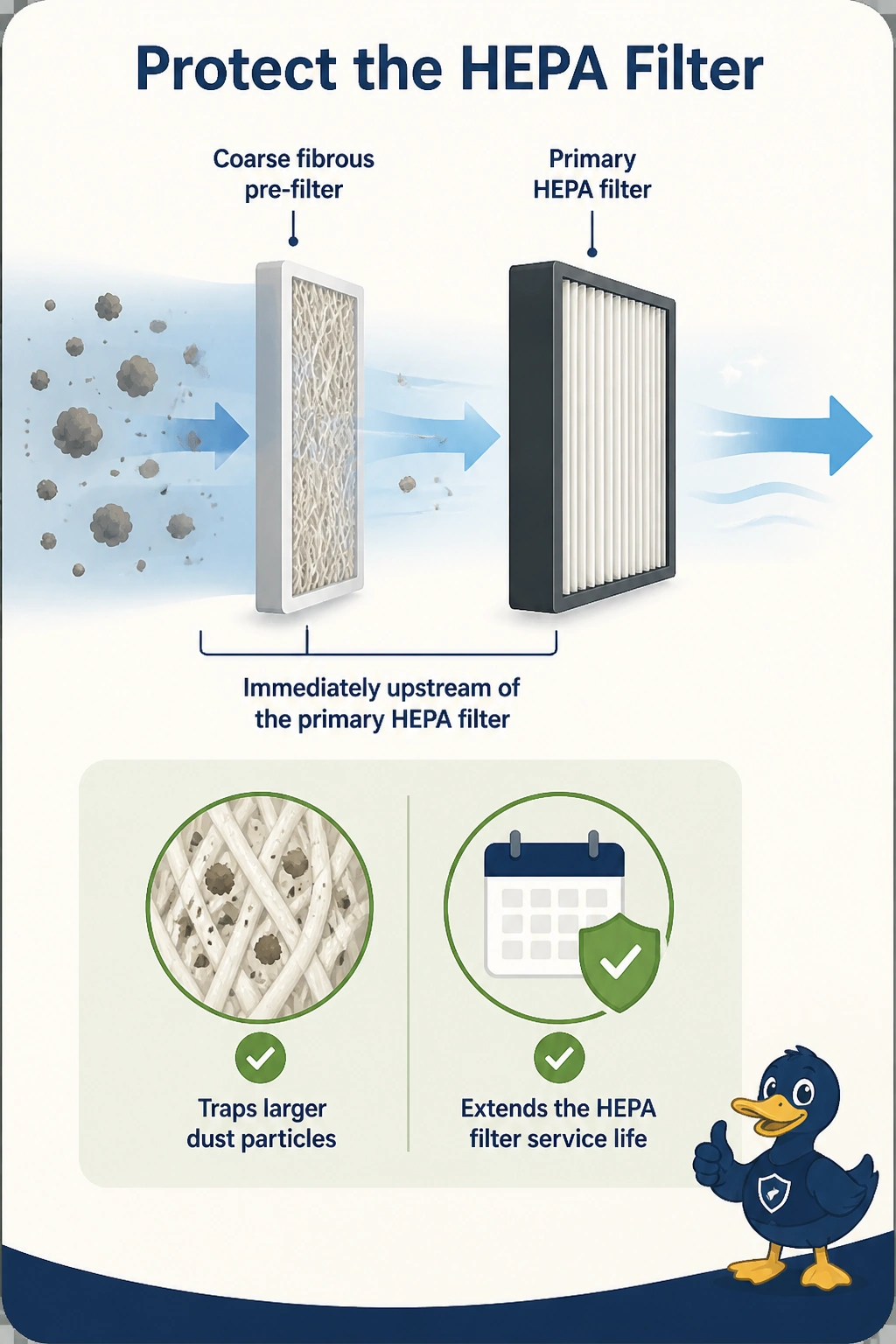
A facility's radiological exhaust ventilation bank uses a coarse fibrous pre-filter immediately upstream of the primary High-Efficiency Particulate Air (HEPA) filter. What is the primary operational purpose of this pre-filter?
Select an answer to reveal the explanation.
Short Explanation
Think of a pre-filter like the coarse screen on a coffee grinder or pool skimmer that catches big debris before it clogs the fine filter. If you skip the pre-filter, ordinary room dust chokes your expensive HEPA media long before its time.
Full Explanation
A coarse pre-filter is placed upstream of a HEPA filter To trap larger dust particles and extend the service life of the HEPA filter. HEPA filters are engineered to capture sub-micrometer aerosols with high efficiency, so large non-radioactive dust, lint, and debris would rapidly load the fine glass-fiber pleats, spike differential pressure, and force frequent, costly radioactive filter changeouts. To adsorb volatile radioiodine vapors before they reach the HEPA media is incorrect because gaseous radioiodine requires impregnated activated charcoal or silver zeolite downstream of the HEPA filter, not a fibrous dust pre-filter. To equalize airflow velocity across the downstream charcoal bed describes the role of ductwork geometry and baffling rather than a particulate pre-filter. To capture sub-micrometer aerosols that pass through HEPA pleats reverses the filtration hierarchy, because the HEPA filter has far higher efficiency for sub-micrometer particles than the coarse pre-filter. As a design caveat, pre-filters do not contribute meaningful credit toward final effluent decontamination factors for fine radioactive aerosols. Operationally, monitor the differential pressure gauge across both the pre-filter and HEPA bank and replace loaded pre-filters before airflow drops below design limits.
Prefer to study offline? Printable PDF study book + test engine ($7.50, unofficial). These questions stay free here.