
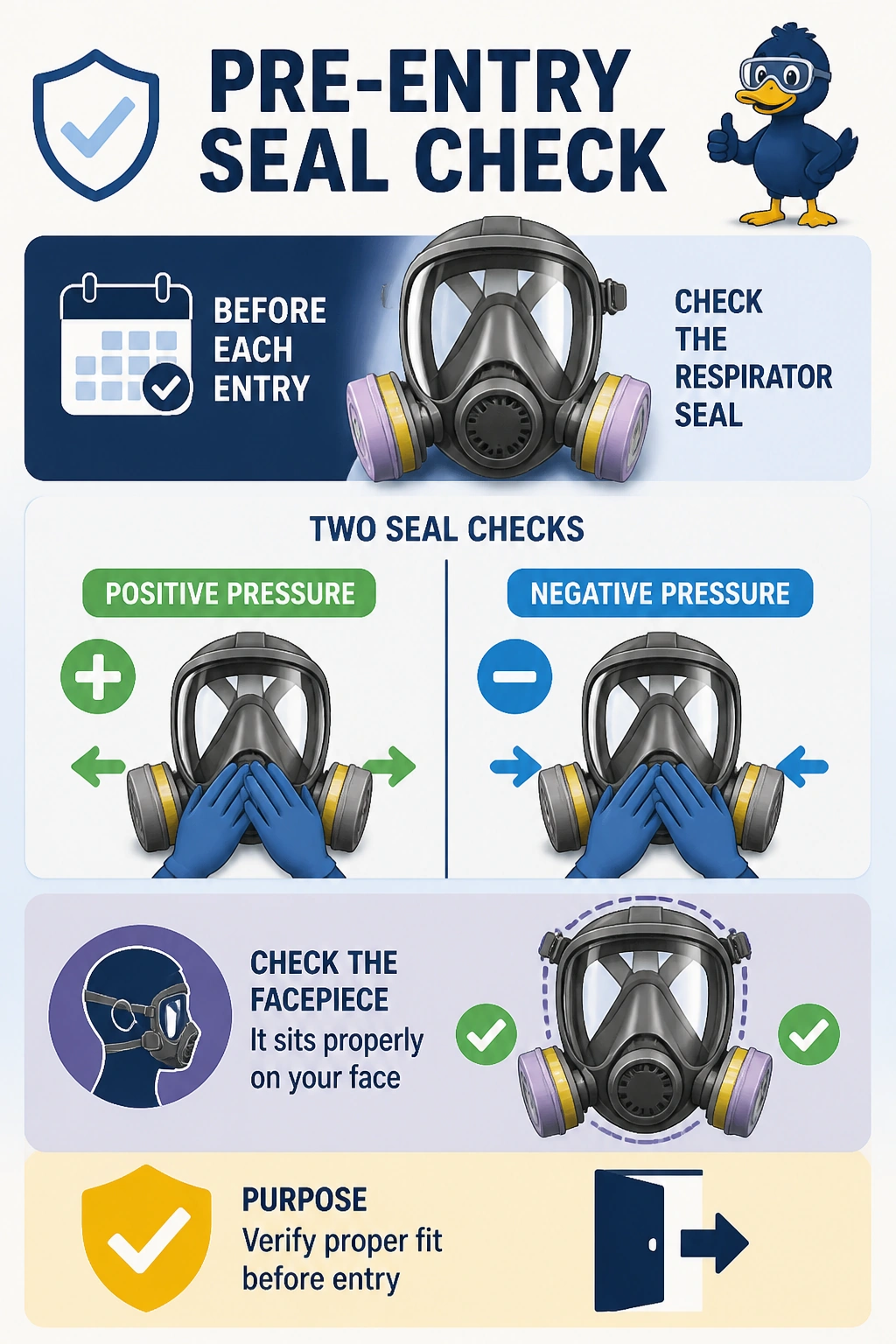
Before entering an Airborne Radioactivity Area wearing a tight-fitting negative-pressure air-purifying respirator, a worker performs positive- and negative-pressure user seal checks. What is the purpose of this pre-entry check compared with the annual fit test?
Select an answer to reveal the explanation.
Short Explanation
Think of a user seal check like checking your seatbelt click before driving, whereas the annual fit test is the formal safety inspection. Performing positive- and negative-pressure checks confirms your mask is seated cleanly on your face right before you enter. The trap is treating a quick pre-entry seal check as a substitute for formal fit testing or filter certification.
Full Explanation
A pre-entry positive- and negative-pressure user seal check is a rapid functional check performed by the wearer immediately after donning a tight-fitting respirator, so It verifies that the facepiece is properly seated on the face before each entry. Even a worker who passed a formal fit test can experience inward leakage if straps are loose, hair is caught under the seal, or an exhalation valve is fouled. Conversely, It replaces the required annual quantitative respirator fit test is false because NRC 10 CFR 20.1703 requires formal fit testing initially and at least annually, and a quick seal check cannot quantify fit factors across head movements. Similarly, It determines the Assigned Protection Factor for the specific radionuclide is incorrect because Assigned Protection Factors are regulatory values listed in 10 CFR 20 Appendix A by respirator class rather than derived from a user seal check. Finally, It certifies the filter cartridge against volatile radioiodine vapors is wrong because cartridge performance depends on sorbent chemistry and service-life limits rather than facepiece seal checks. Exam caveat: a user seal check never grants credit for respiratory protection without current medical qualification, training, and fit testing. Operational check: verify the worker is clean-shaven in the sealing surface and inspect valves and cartridges before each entry.
Prefer to study offline? Printable PDF study book + test engine ($7.50, unofficial). These questions stay free here.