
Why are High-Efficiency Particulate Air (HEPA) filters in radiological ventilation systems rated and challenged using 0.3-micrometer aerosols rather than smaller 0.01-micrometer particles?
Select an answer to reveal the explanation.
Short Explanation
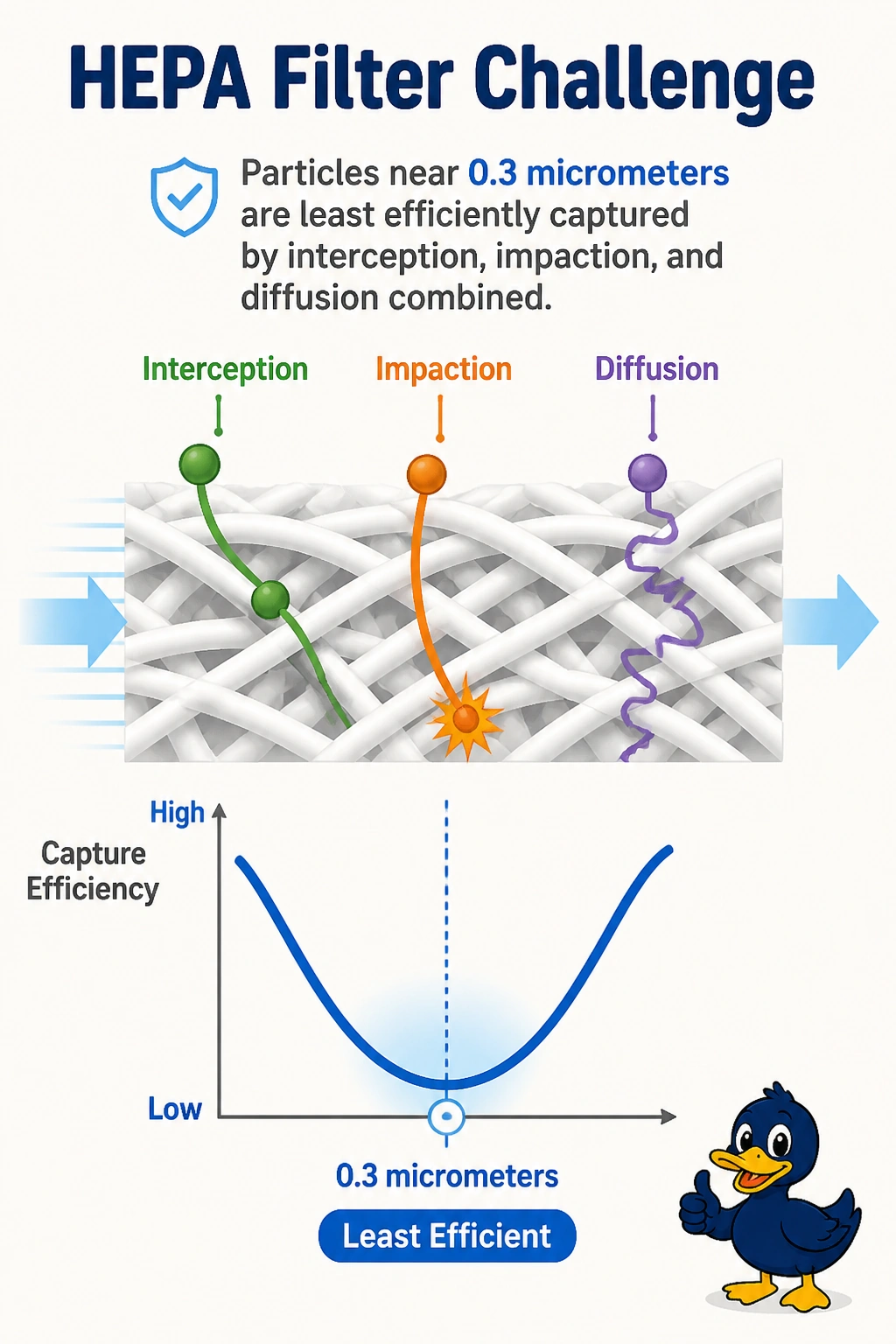
Around 0.3 micrometers sits the 'sweet spot' for sneaking through a HEPA filter—too light to crash into fibers by inertia, yet too heavy to jitter into them by diffusion. Testing your filters at that worst-case size guarantees at least 99.97 percent capture for particles both larger and smaller. The trap is assuming smaller particles always slip through more easily.
Full Explanation
HEPA filter efficiency reaches a minimum near 0.3 micrometers because Particles near 0.3 micrometers are least efficiently captured by interception, impaction, and diffusion combined, making 0.3 micrometers the most penetrating particle size (MPPS). Larger particles are readily trapped by inertial impaction and direct interception, whereas much smaller particles undergo vigorous Brownian motion that drives them into filter fibers by diffusion. Particles smaller than 0.3 micrometers pass straight through the filter fibers without colliding reverses the physics of Brownian diffusion, which actually increases capture efficiency for ultrafine particles. Particles larger than 0.3 micrometers evaporate into gases before reaching the filter media is false because solid radioactive particulates do not spontaneously vaporize in ambient duct air. Test aerosols smaller than 0.3 micrometers cannot be detected by optical photometers ignores the fundamental filtration physics behind the 0.3-micrometer standard. As an engineering caveat, HEPA filters do not capture radioactive noble gases or volatile vapors such as radioiodine. Operationally, verify in-place HEPA bank integrity with periodic aerosol challenge testing and monitor differential pressure across the filter housing.
Prefer to study offline? Printable PDF study book + test engine ($7.50, unofficial). These questions stay free here.