
A technician must enter an area with a particulate airborne concentration of 25 DAC while wearing a properly fit-tested, full-facepiece negative-pressure air-purifying respirator (APF of 50 under 10 CFR 20 Appendix A). What is the effective airborne concentration inside the facepiece?
Select an answer to reveal the explanation.
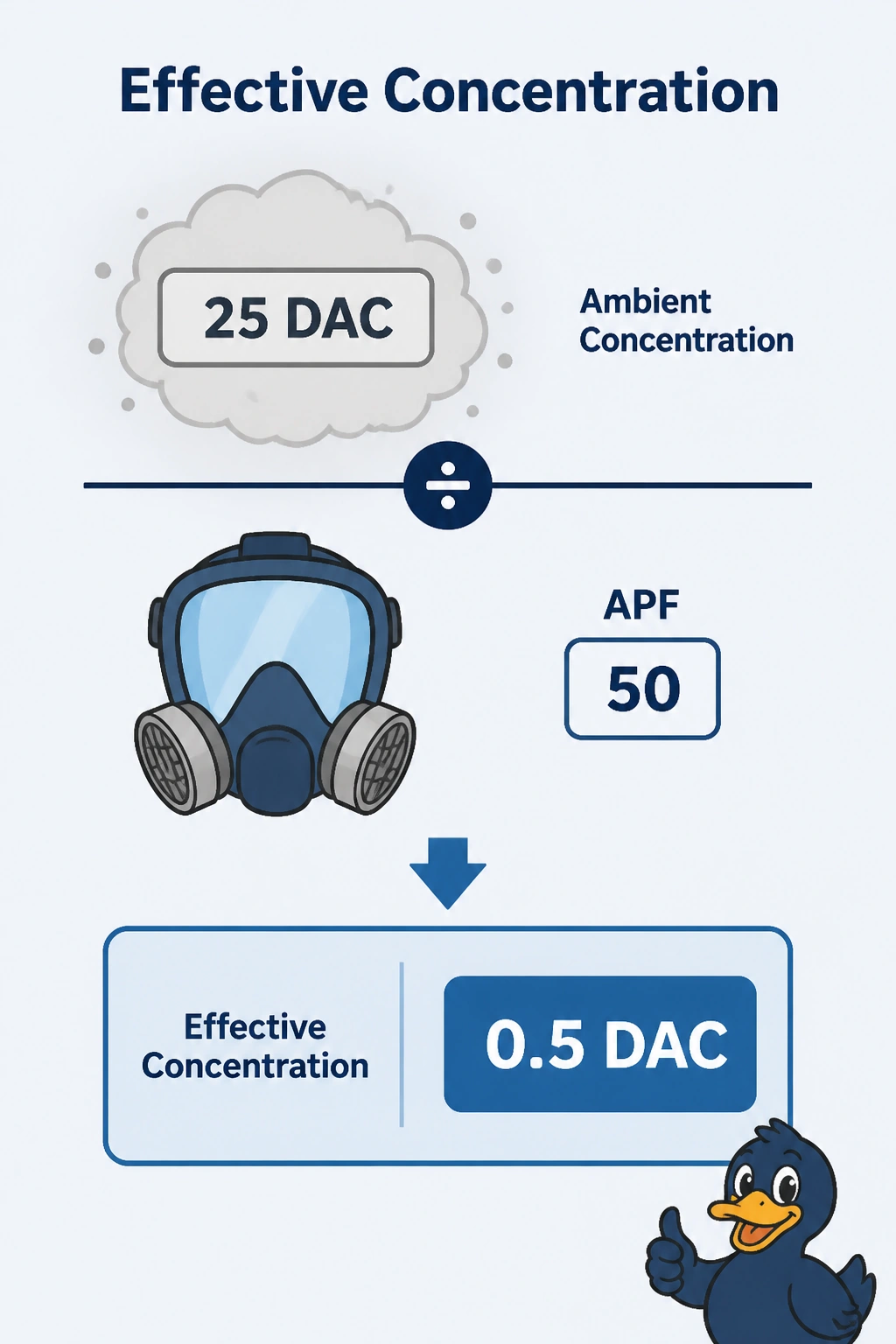
Short Explanation
Think of an Assigned Protection Factor like a shield factor for your lungs—it divides the outside concentration down to what actually reaches your breathing zone. The trap is treating an APF of 50 as a 50 percent reduction instead of dividing 25 DAC by 50 to get 0.5 DAC.
Full Explanation
Under 10 CFR 20 Appendix A, a full-facepiece negative-pressure air-purifying respirator carries an Assigned Protection Factor (APF) of 50, meaning it reduces the airborne concentration inside the facepiece by a factor of 50 when properly fitted and worn. Dividing the ambient 25 DAC concentration by 50 yields 0.5 DAC, by dividing the ambient concentration by 50. The estimate of 0.2 DAC, because the APF is doubled for particulate filters is incorrect because particulate filters are already assumed in the assigned factor and do not double it. Choosing 2.0 DAC, because an APF of 50 reduces intake by half confuses a protection factor of 50 with a 50 percent reduction, which would correspond to an APF of 2. Selecting 5.0 DAC, assuming a 90 percent filter collection efficiency ignores the regulatory APF of 50 and instead applies an arbitrary factor of 5. As a regulatory caveat, NRC licensees may only take credit for an APF when a complete respiratory protection program—including medical evaluation, annual fit testing, and training—is active under 10 CFR 20.1703. Before entry, perform an operational user seal check and inspect the facepiece valves, straps, and cartridges for damage.
Prefer to study offline? Printable PDF study book + test engine ($7.50, unofficial). These questions stay free here.