
Airborne sampling in a work room shows an average radionuclide concentration of 0.4 DAC, which is below 1 DAC, and an unmasked worker is scheduled to spend 40 hours there during the week. Under NRC 10 CFR 20.1003 and 20.1902(d), why must this room be posted as an Airborne Radioactivity Area?
Select an answer to reveal the explanation.
Short Explanation
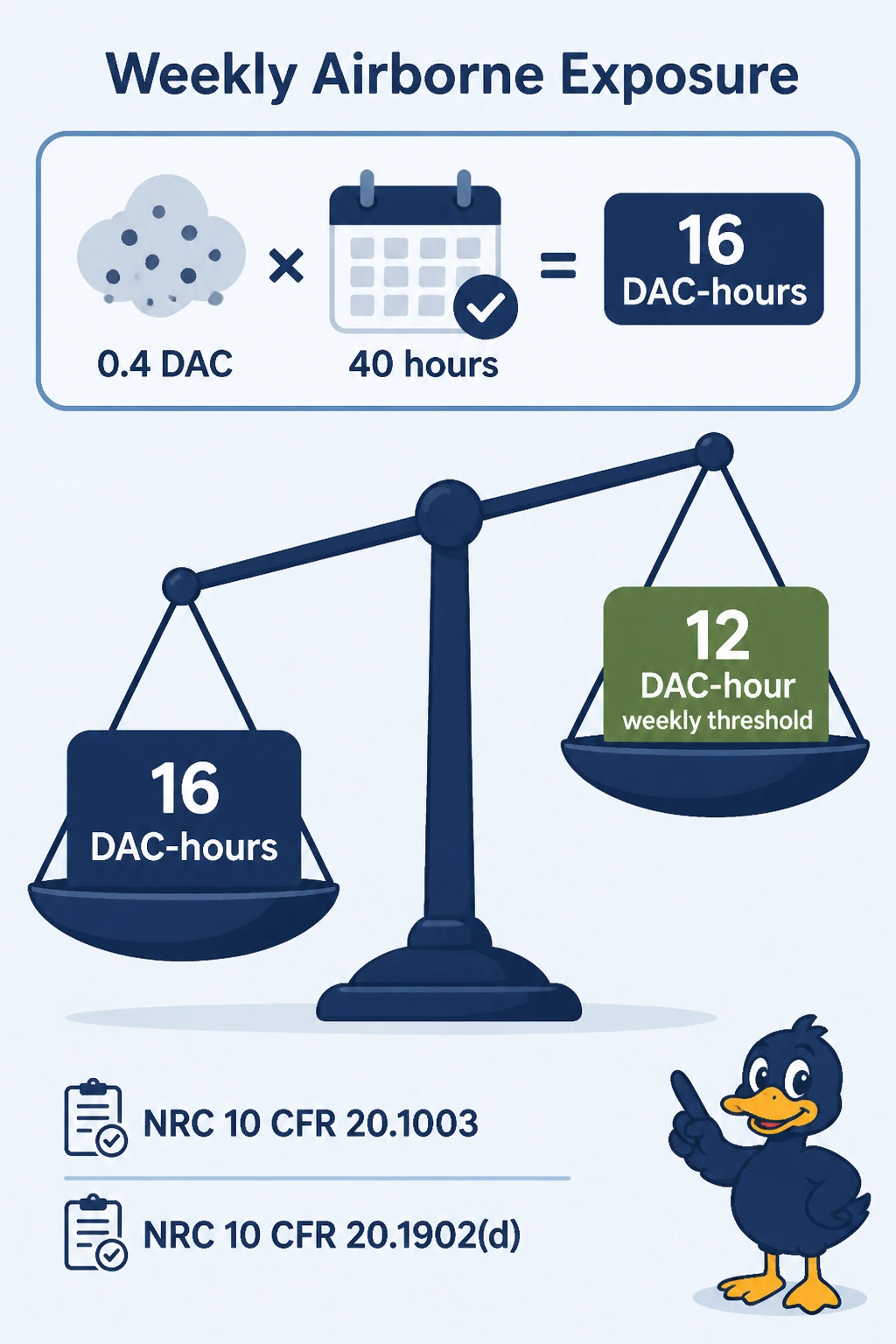
Even when airborne levels sit below 1 DAC, long stay times can push your weekly intake over the posting trigger. The trap is checking only the instantaneous DAC value and missing the second half of 10 CFR 20.1003: any exposure above 12 DAC-hours in a week requires Airborne Radioactivity Area posting.
Full Explanation
Under NRC 10 CFR 20.1003, an Airborne Radioactivity Area is defined not only by concentrations exceeding 1 DAC, but also by conditions where an individual without respiratory protection could exceed an intake of 0.6 percent of the Annual Limit on Intake, or 12 DAC-hours, during the hours present in a week. Multiplying 0.4 DAC by 40 hours equals 16 DAC-hours, so Weekly exposure reaches 16 DAC-hours, exceeding the 12 DAC-hour weekly threshold and requiring posting under 10 CFR 20.1902. The statement Any measurable concentration above 0.1 DAC always requires posting is wrong because 10 CFR 20 uses the 1 DAC and 12 DAC-hour criteria rather than a fixed 0.1 DAC floor. Choosing Weekly exposure reaches 16 DAC-hours, exceeding the 10 DAC-hour limit uses an incorrect threshold of 10 DAC-hours instead of the regulatory 12 DAC-hours. Likewise, The concentration exceeds 0.3 DAC, which triggers posting for 40-hour weeks is not a regulatory rule; 0.3 DAC for 40 hours equals exactly 12 DAC-hours, and posting is triggered when 12 DAC-hours is exceeded. As a caveat, respirator protection factors are not credited when determining whether the area itself must be posted. Before starting multi-day work in low-level airborne rooms, multiply projected stay hours by the measured DAC fraction and post the boundary whenever the product exceeds 12 DAC-hours.
Prefer to study offline? Printable PDF study book + test engine ($7.50, unofficial). These questions stay free here.