
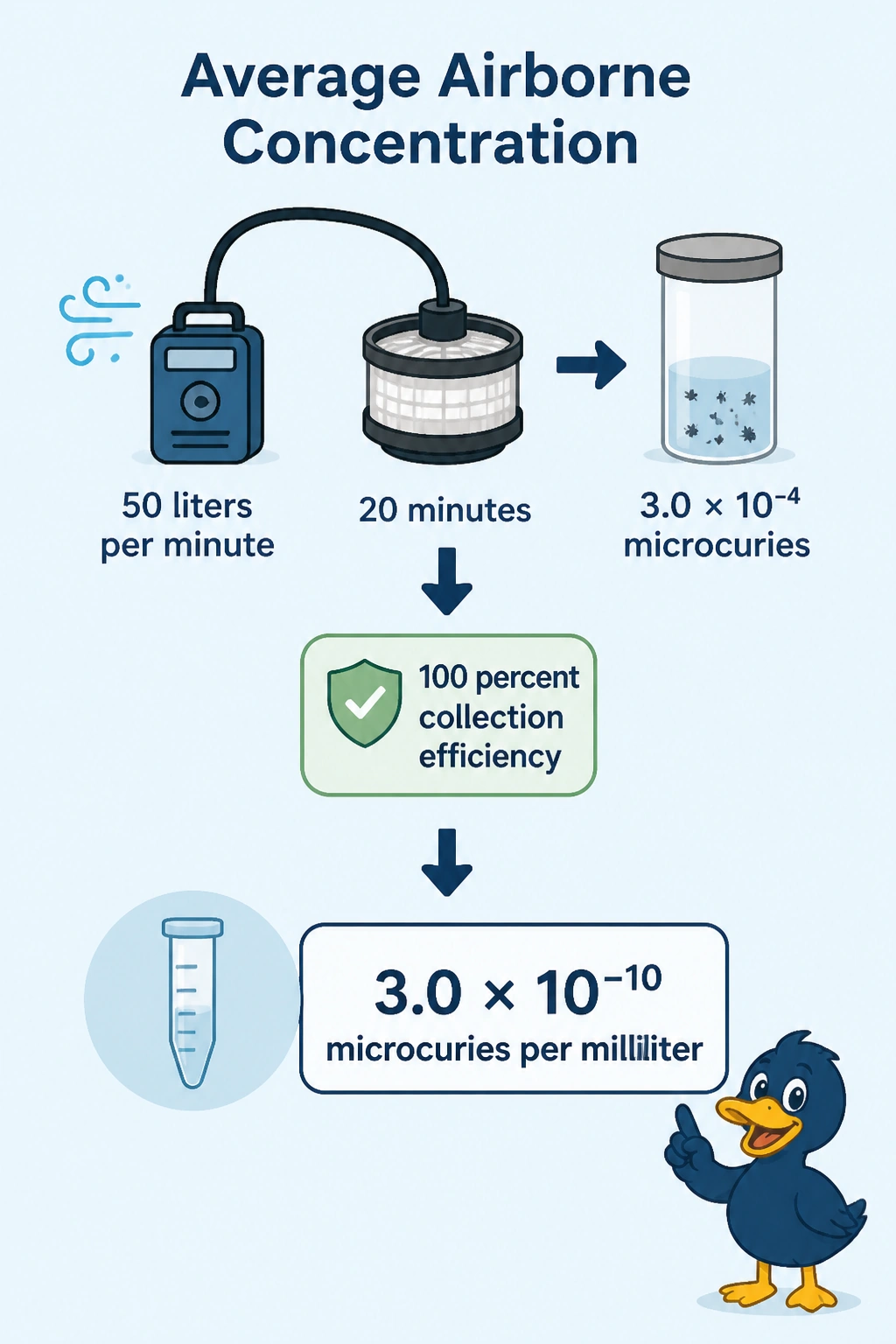
A technician runs a portable air sampler at a constant flow rate of 50 liters per minute for 20 minutes in a work area and collects 3.0 x 10^-4 microcuries of a long-lived alpha emitter on the filter. Assuming 100 percent collection efficiency, what is the average airborne concentration?
Select an answer to reveal the explanation.
Short Explanation
Air concentration math is straightforward once you convert liters into milliliters carefully, because one missed factor of a thousand throws your result off by three orders of magnitude. Keep your exponents clean by turning liters into millions of milliliters before you divide.
Full Explanation
To find airborne concentration in microcuries per milliliter, divide the total collected activity by the total air volume sampled in milliliters. Multiplying 50 liters per minute by 20 minutes gives 1,000 liters of air sampled. Because 1 liter equals 1,000 milliliters, 1,000 liters equals 1,000,000 milliliters, or 1.0 x 10^6 milliliters. Dividing 3.0 x 10^-4 microcuries by 1.0 x 10^6 milliliters yields 3.0 x 10^-10 microcuries per milliliter. Selecting 3.0 x 10^-7 microcuries per milliliter occurs when dividing by 1,000 liters directly without converting liters to milliliters. Selecting 3.0 x 10^-12 microcuries per milliliter introduces an extra factor of 100 in the denominator, underestimating the actual airborne hazard. Selecting 1.5 x 10^-8 microcuries per milliliter results from dividing activity by the 20-minute duration and mixing up flow-rate units. As an important caveat, real air samples for long-lived alpha emitters are typically recounted after short-lived radon and thoron progeny decay so natural background does not mask or inflate the result. As an operational check, verify the rotameter or mass-flow reading at both the start and end of the run and adjust for filter loading if the flow rate drops.
Prefer to study offline? Printable PDF study book + test engine ($7.50, unofficial). These questions stay free here.