
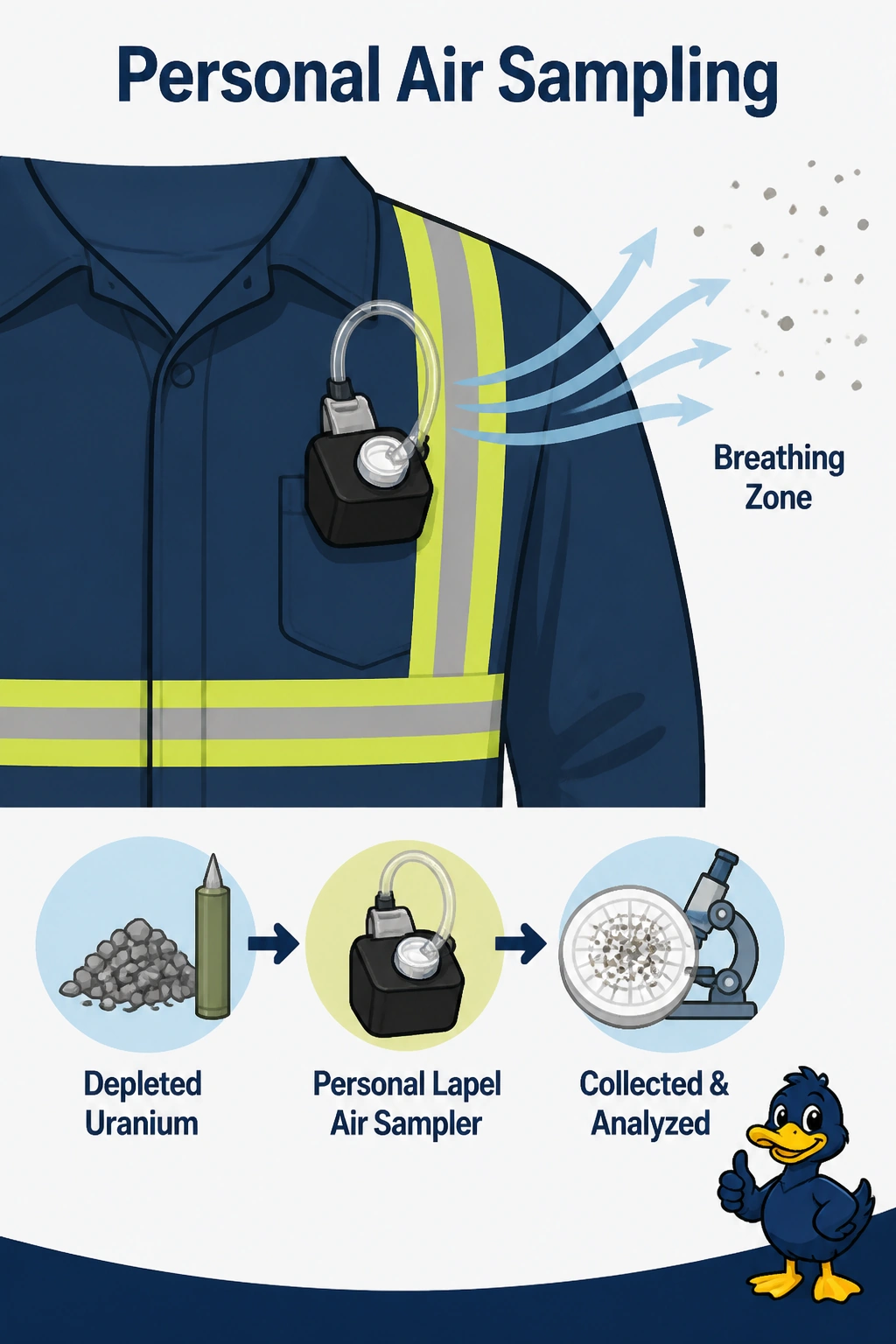
A technician works inside a glovebox room where localized grinding of depleted uranium can create steep airborne concentration gradients. Which air-sampling method provides the most representative estimate of that individual worker's inhalation intake?
Select an answer to reveal the explanation.
Short Explanation
Think of airborne dust like campfire smoke—standing ten feet away tells you nothing about what is right in front of your face. A common trap is trusting a big room monitor, which misses localized plumes right at the worker's collar.
Full Explanation
Airborne particulate concentrations around localized work such as grinding can vary by orders of magnitude over short distances, so only A personal lapel air sampler worn in the worker's breathing zone captures air representative of what the technician actually inhales. Because the intake pathway depends on air drawn near the nose and mouth, breathing-zone sampling directly supports dose assessment and bioassay correlation. By contrast, A high-volume general area air sampler stationed near the room's main exhaust return measures diluted room air and can severely underestimate localized exposure. Similarly, A fixed continuous air monitor mounted on the corridor wall outside the airlock tracks boundary leakage rather than conditions inside the work area. Finally, A passive charcoal canister placed on a workbench at the far end of the room is designed for noble gases or radioiodine vapor rather than uranium particulates and sits outside the plume. As a caveat, lapel samplers operate at low flow rates, so short tasks may yield small sample volumes with higher minimum detectable concentrations. For an operational check, verify the lapel pump flow rate with a calibrated primary standard before and after the shift and confirm the filter cassette sits unobstructed on the upper chest.
Prefer to study offline? Printable PDF study book + test engine ($7.50, unofficial). These questions stay free here.