
A laboratory handles volatile radioiodine (I-131) in a fume hood exhaust system equipped with a pre-filter and a HEPA filter. Why must an activated charcoal adsorber also be installed downstream of the HEPA filter?
Select an answer to reveal the explanation.
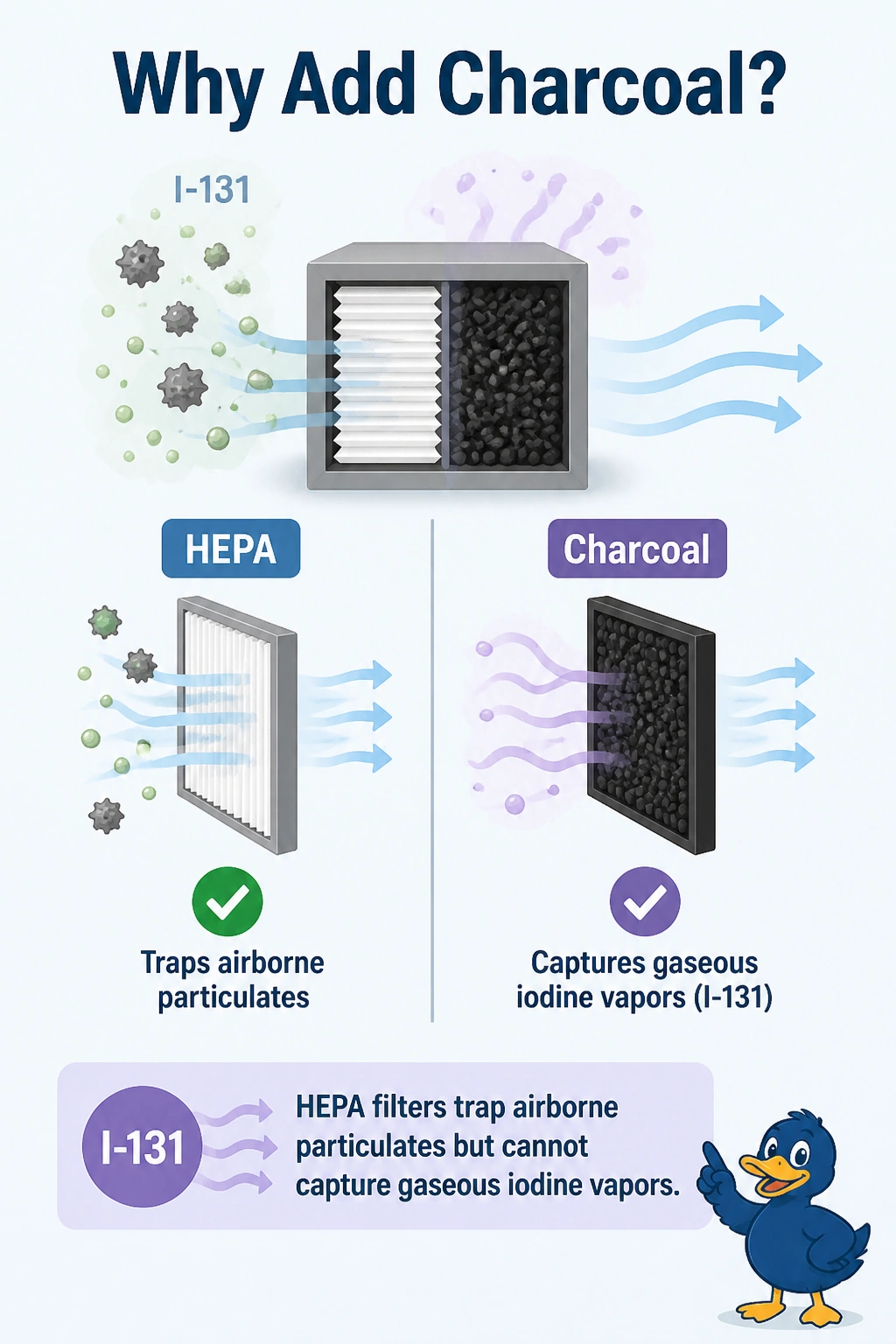
Short Explanation
Think of a HEPA filter as a fine screen that catches microscopic dust, yet gaseous vapors slip right through its fibers. The trap is assuming a HEPA filter stops all radioactive material, or thinking charcoal somehow neutralizes radioactivity. Because volatile radioiodine travels as a vapor, you need an activated charcoal bed downstream to adsorb the gas.
Full Explanation
High-efficiency particulate air (HEPA) filters are engineered to capture solid and liquid aerosols by interception, impaction, and diffusion, but they cannot retain gases or vapors. Because radioiodine easily volatilizes into elemental iodine and organic iodides, HEPA filters trap airborne particulates but cannot capture gaseous iodine vapors, making an activated charcoal adsorber essential downstream. Claiming that HEPA filters only trap particles above 10 micrometers and allow submicron dust through is false, because HEPA media are rated to remove at least 99.97 percent of 0.3-micrometer particles. Stating that "Activated charcoal neutralizes the beta radiation emitted by iodine before stack release" misunderstands adsorption: charcoal physically and chemically binds iodine molecules inside its porous carbon matrix so they decay in place rather than altering nuclear decay. Arguing that HEPA filters degrade rapidly when exposed to normal room humidity without charcoal ahead reverses the train order; the pre-filter and HEPA filter sit upstream to protect the charcoal pores from plugging with dust. As a caveat, high moisture or solvent vapors can poison charcoal beds and reduce iodine retention efficiency. Operationally, verify differential pressure across the HEPA bank and perform periodic in-place charcoal and DOP/PAO efficiency testing.
Prefer to study offline? Printable PDF study book + test engine ($7.50, unofficial). These questions stay free here.