
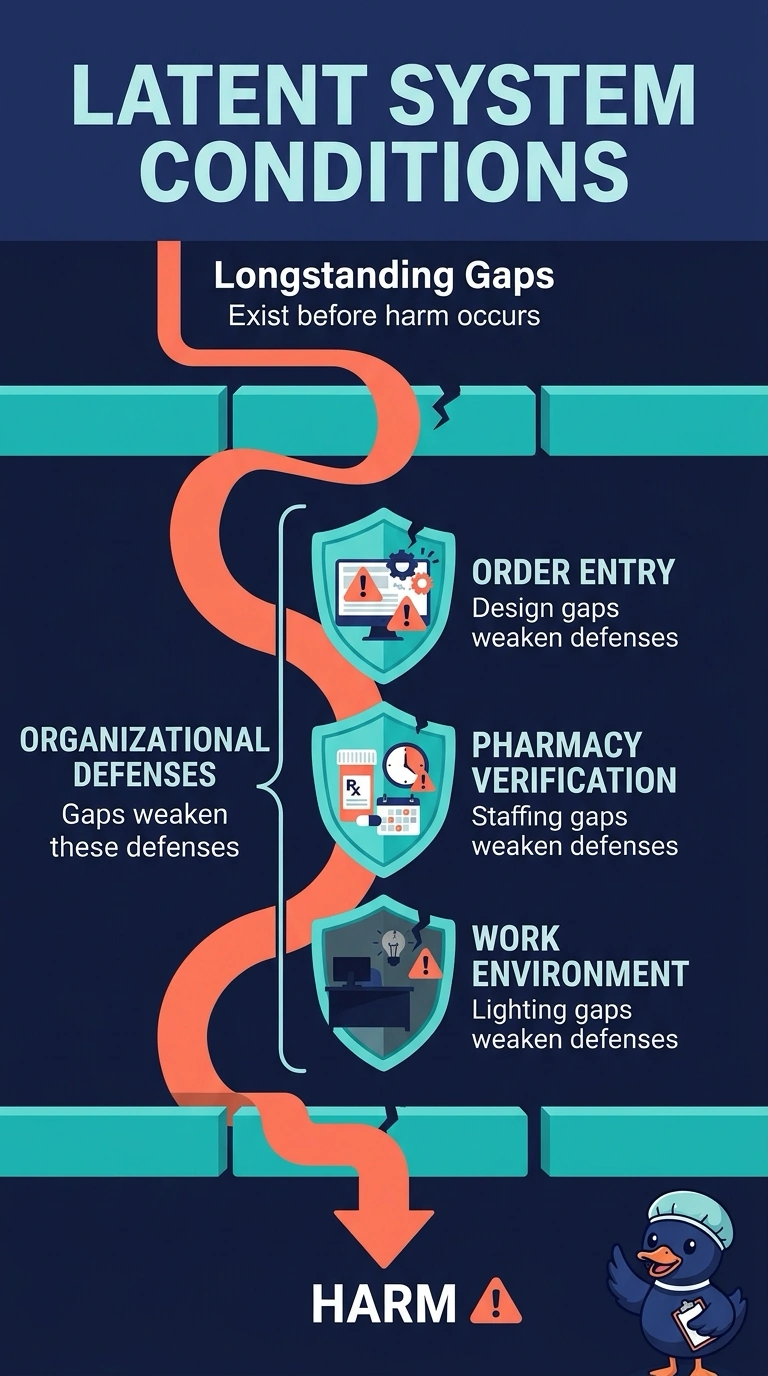
While investigating a wrong-dose chemotherapy administration, a patient safety specialist notes both the nurse's miscalculation at the pump and longstanding gaps in pharmacy verification staffing, lighting, and order-entry design. How should the specialist classify those longstanding organizational gaps?
Select an answer to reveal the explanation.
Short Explanation
In Reason's Swiss Cheese Model, those hidden staffing and design flaws are holes already sitting in the system long before your nurse touches the pump. The trap is lumping background hazards together with frontline slips, which keeps teams focused on individual blame instead of fixing the environment.
Full Explanation
Latent system conditions that weaken organizational defenses before harm occurs describe upstream design, staffing, and environmental weaknesses—often called blunt-end factors—that align to allow an error to reach the patient. Identifying these conditions is central to systems-based safety analysis because fixing lighting, verification capacity, and order-entry defaults protects every future clinician and patient. Active frontline errors committed during medication administration refer to the sharp-end actions at the point of care, such as the pump miscalculation itself, rather than longstanding structural hazards. Unavoidable clinical complications inherent to oncology therapy describe expected physiological side effects of treatment, not preventable dosing errors caused by system design flaws. Isolated policy violations requiring immediate disciplinary action mischaracterizes systemic infrastructure deficits as intentional individual misconduct, undermining a Just Culture. A key caveat is that recognizing latent conditions does not ignore individual accountability for reckless behavior; rather, it separates human error from system vulnerability. Operationally, track whether root cause action plans target at least one latent condition with measurable engineering or workflow controls.
Prefer to study offline? Printable PDF study book + test engine ($7.50, unofficial). These questions stay free here.