
A city transit agency ranks agent projects by the license price alone and treats that price as the entire cost. Maker time, model consumption, support, and training are left out of the criteria. What should the architect change?
Select an answer to reveal the explanation.
Short Explanation
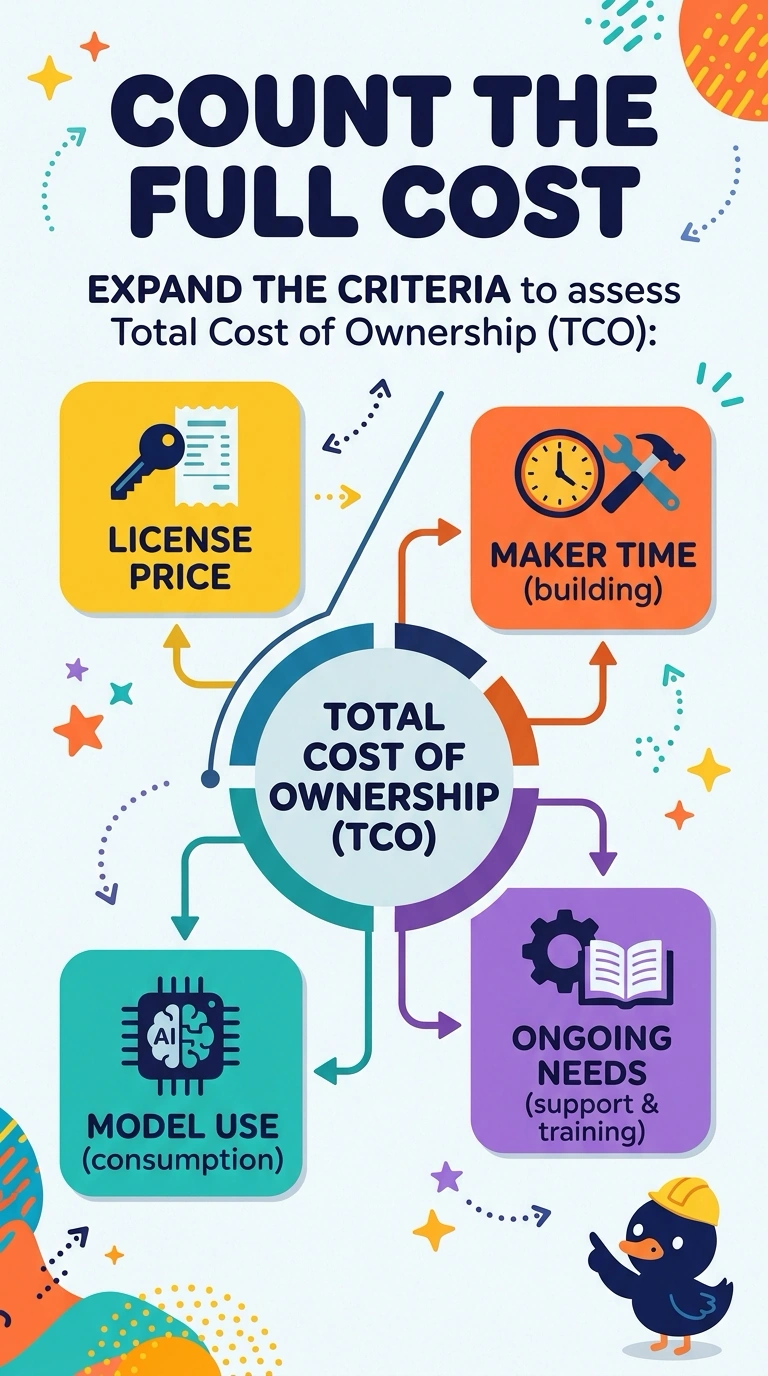
The price painted on the fare box is not the cost of running the bus. You expand the criteria to total cost of ownership so maker time, consumption, support, and training sit beside the license. A license-only score blesses the project that is cheap to buy and expensive to run.
Full Explanation
Return criteria have to name every cost the organization will actually carry. That set is total cost of ownership, not the most visible license line. For this agency the missing lines are maker time, model consumption, support, and training, and those belong beside the license before any project is ranked. Keeping the license price as the only cost line repeats the defect and continues to drop the people and run costs the stem already says are ignored. Ranking by model size scores a technical choice as if it were the cost, and a small model can still be expensive to adopt when the process around it is heavy. Replacing the cost criteria with a count of how many agents could be published this year measures volume, not cost, so a flood of thin agents would outrank one costly project that pays for itself. Exam caveat: total cost of ownership is a criterion you set before the comparison, not a footnote you add after a winner has been picked. Operational check: open the ranking sheet and confirm each project has lines for license, people, consumption, support, and training, and that a blank line blocks the rank.