
A regional airline must tag every flight delay note into a fixed set of reason codes, across that day's departures. Which model choice fits?
Select an answer to reveal the explanation.
Short Explanation
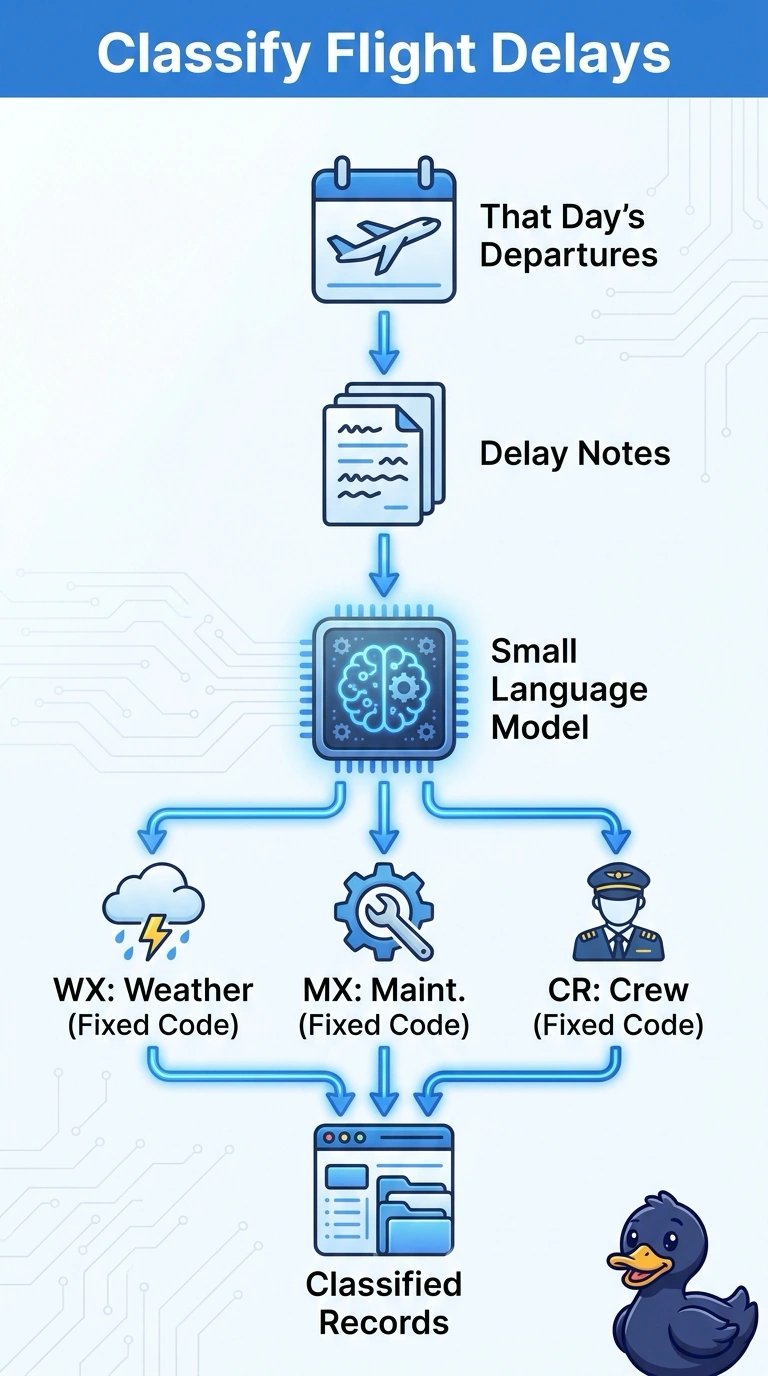
You can use a small language model to stamp each delay note with one code from the fixed list, without writing a speech. A general assistant that drafts apologies and invents codes does a different job, while a nightly report comes too late to tag the day’s departures. Training a custom model from scratch is unnecessary for this ordinary classification task.
Full Explanation
A small language model fits because the airline needs the same narrow classification applied to every delay note, using a closed list of reason codes. The notes are short, the codes are fixed rather than something the model must invent, and the tag is needed across the day’s departures—not as part of a passenger conversation. A general assistant that writes passenger apologies and invents new reason codes changes the task into open-ended writing, so its tags may not align consistently with the approved list. A nightly warehouse report ranks delays only after clerks have selected each code by hand; it does not perform the needed tagging during the day. A custom model trained from scratch is not justified for ordinary classification into a stable code list that a small model can already handle. Exam caveat: choosing a small model for coding does not rule out using a larger model later to write passenger-facing replies, since those are separate tasks. Practical check: run one day’s notes through the classifier and confirm every output is an approved code, with no free-text reason added beside it.