
A retailer wants an agent on the point-of-sale register. The register is not a Microsoft 365 app, and the associate's Copilot cannot run there. Which build strategy fits?
Select an answer to reveal the explanation.
Short Explanation
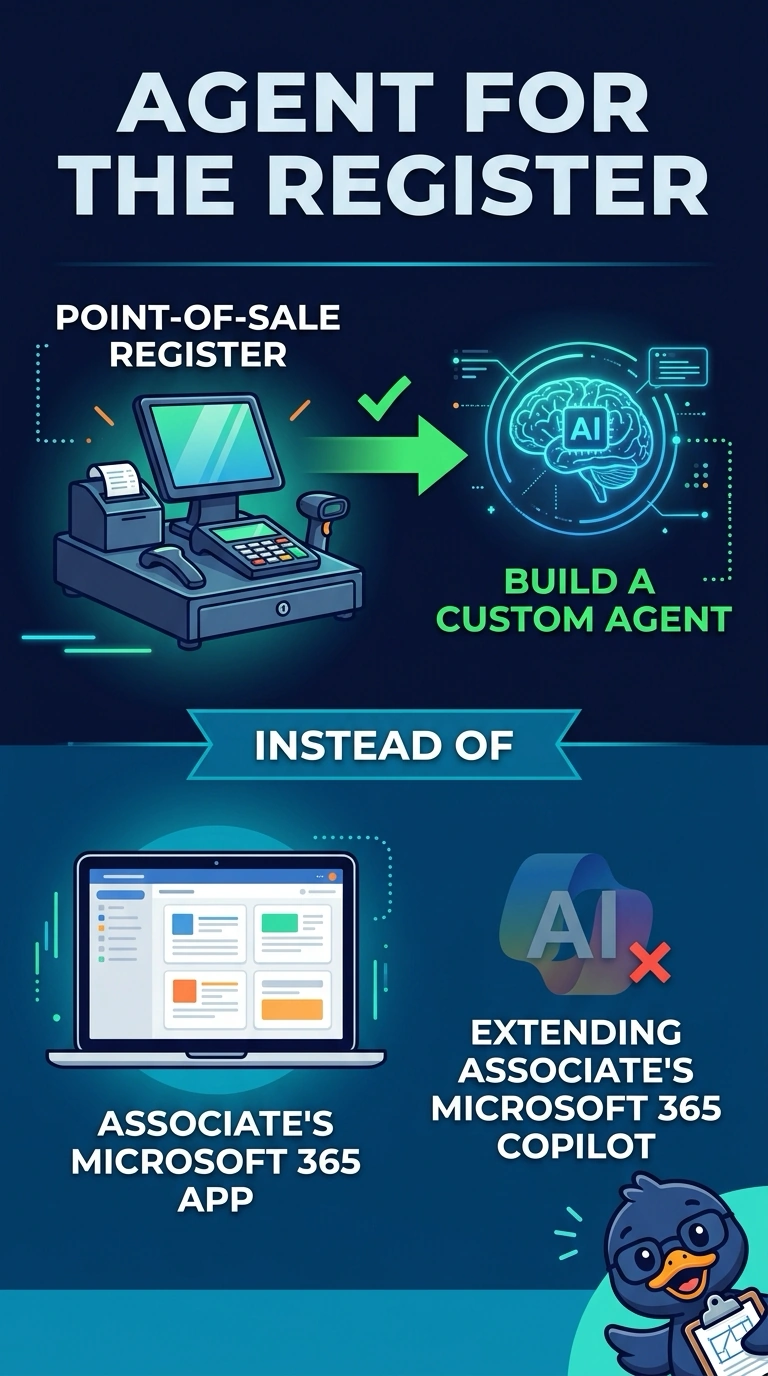
The register is a different counter from the associate's mailbox. You build a custom agent for that point-of-sale register instead of extending a Copilot that cannot run there. Hoping the register will host a Microsoft 365 extension does not make it a Microsoft 365 app.
Full Explanation
Extend Microsoft 365 Copilot when the person is working in Microsoft 365 and the agent should use that person's own mail and files. The point-of-sale register is not that surface, and the associate's Copilot cannot run on it, so an extension does not reach the sale. Build a custom agent that lives on the register and talks to the register's own process. Extending the associate's Microsoft 365 Copilot and expecting the register to host that extension assumes a host the hardware does not provide. Extending Microsoft 365 Copilot in Outlook and leaving the register without an agent helps the associate's inbox and misses the counter where the agent was requested. Turning on Microsoft 365 Copilot for the store and leaving the register on its current screens licenses a surface the cashier is not using at the moment of the sale. Exam caveat: custom here means an agent built for the register's channel and identity. Turning on Microsoft 365 Copilot for the store does not move that agent onto the register. Operational check: complete a test sale on the register and confirm the agent responds there without a Microsoft 365 Copilot session.