
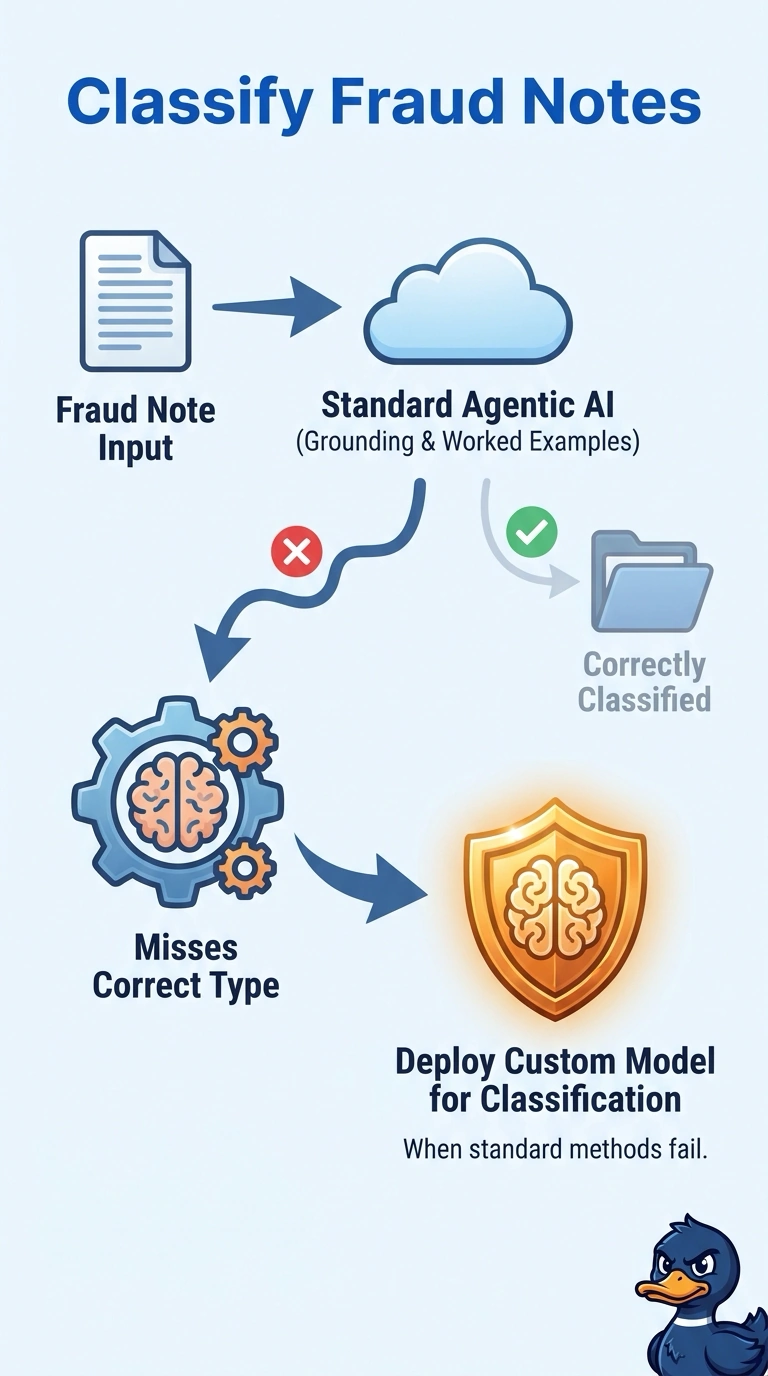
An insurer must classify fraud notes into a stable set of labeled types. Grounding and worked examples still leave the foundation model on the wrong type. Which choice fits?
Select an answer to reveal the explanation.
Short Explanation
After you have shown the clerk the guide and a stack of marked examples, a repeated miss means you need a specialist for that sort. You use a custom model for the fraud-note types, because grounding and examples still land on the wrong type. Another lap through the same guide is the lap you already ran.
Full Explanation
A custom model is justified when prompting, grounding, and tools cannot produce the behavior and the labels are stable. These fraud notes are already labeled with a stable set of types, the type is a judgment on the note rather than a field an API returns, and the foundation model still misses after grounding and worked examples. That is the point where a custom model is the next build, aimed at this classification. Another round of the same grounding documents asks the same model to reread material that did not change the miss. Lengthening the system prompt with the type names is more prompting, and a longer instruction is not a trained classifier. Dropping the classification for an open summary abandons the type the investigators need and substitutes a paragraph no queue can route. Exam caveat: the custom model stays justified only while those type labels stay stable. If the type list churns, the model is chasing a target the business has not fixed. Operational check: hold out a labeled set the model was not trained on, score it against the foundation model on the same notes, and promote only if the custom model reduces the wrong-type count.