
A hotel group wants its first proof of concept to answer guest complaints on the public website immediately. No use case has been ranked or proven yet. How should the Cloud Adoption Framework plan start?
Select an answer to reveal the explanation.
Short Explanation
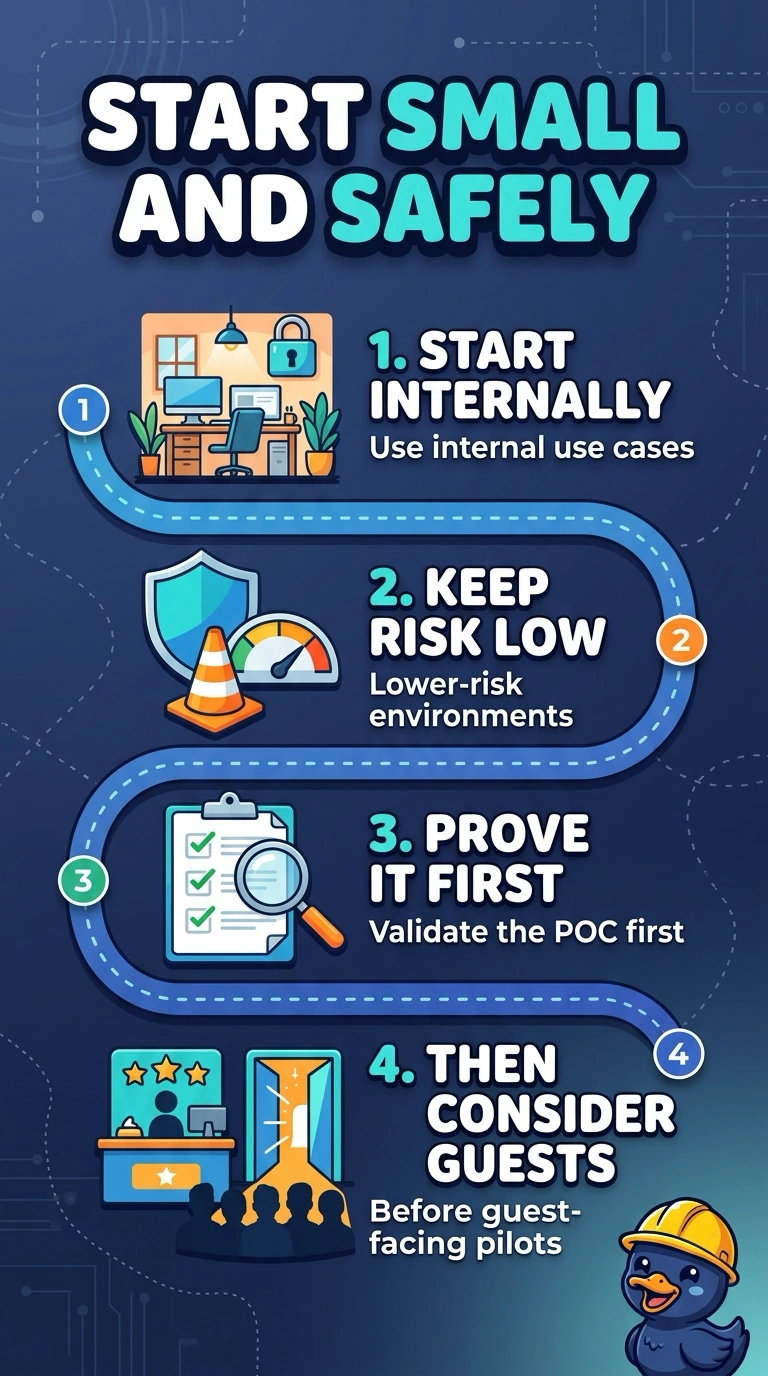
You do not test a new alarm by pulling it in a full lobby. You start the proof of concept on an internal, lower-risk use case and prove that one before any guest sees it. Public traffic is not a reason to skip the plan.
Full Explanation
The Cloud Adoption Framework plan ranks use cases and proves one in a controlled scope before the organization exposes guests. The plan guidance starts that proof on internal, non-customer-facing work so the first test limits risk while the team learns its approach. A public complaint agent on day one skips that step. Putting the guest website agent into production first so public traffic can supply training examples makes guests the test harness and collects examples from people the hotel has not yet decided to serve this way. Standing up a second landing zone used only for guest chat adds a platform and still puts the unproven complaint agent in front of guests, so it does not answer how the plan should start. Treating the website complaint agent as the finished strategy and stopping the ranking leaves every other use case unexamined, which is the gap the hotel already has. Exam caveat: an internal proof is still a real use case with an owner and a result you can measure, not a demo with no business question. Operational check: write the first proof's users, data, risk, and success measure, confirm no guest channel is inside that first scope, and keep the proof off the public website until the measure is met.