
An insurer's draft strategy says no agent may take an action, including an agent that only reads a policy to answer a question. What should the architect change?
Select an answer to reveal the explanation.
Short Explanation
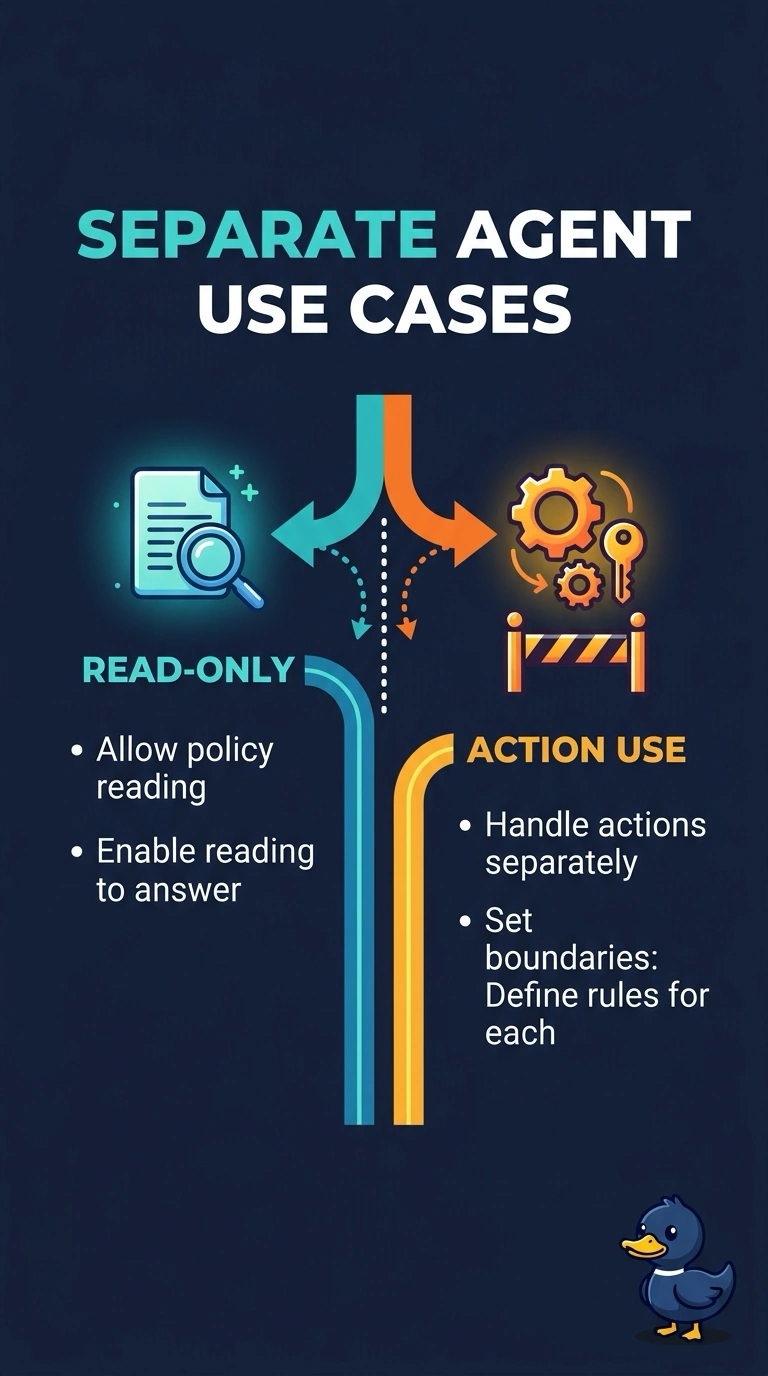
Locking every door, including the reading room, does not make the building safer. You separate use cases that only read and answer from use cases that take an action, instead of one ban that blocks both. A wide-open permission is the opposite mistake.
Full Explanation
A blanket ban on every action also blocks agents whose job is to read a policy and answer, which is not the same risk as an agent that posts a transaction. The strategy should separate read-only use cases from action use cases, with controls that match each kind, rather than one sentence that stops both. Keeping the single ban so that answering from a policy is treated as an action and blocked saves no risk on the read path and stops the use cases the insurer can adopt with the least harm. Dropping the ban and letting every proposed agent post transactions as well as answer questions removes the distinction in the other direction and leaves consequential writes ungoverned. Limiting the ban to customer-facing agents and allowing every internal agent to take actions uses the channel as a proxy for risk, so an internal agent could still post a payment with no extra control. Exam caveat: separating the two kinds is not permission for action agents to skip approval. The action use cases still need least privilege and a person on consequential steps. Operational check: rewrite the strategy page into a read-only list and an action list, and confirm a policy-answer agent is on the first list with no write tools.