
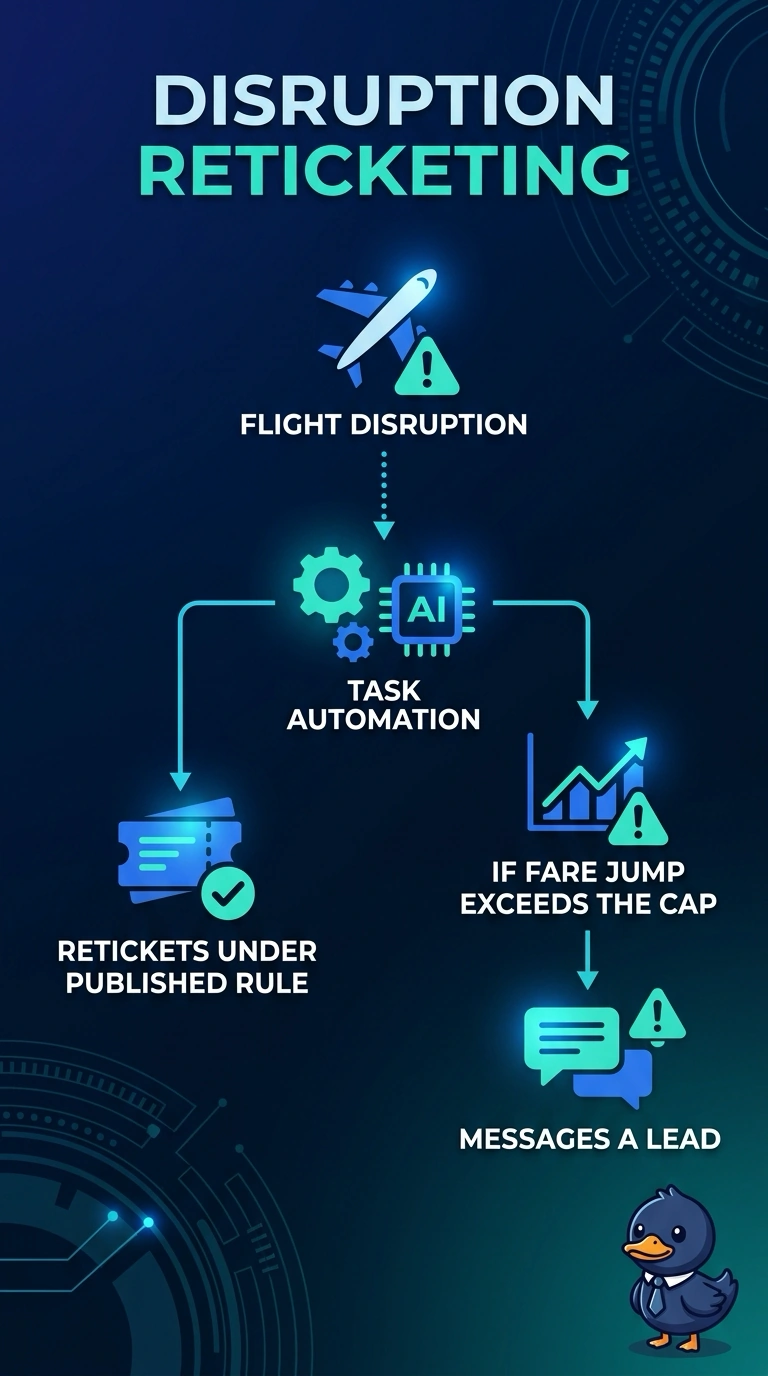
An airline wants an agent that retickets disrupted passengers under a published rule and messages a lead only when the fare jump exceeds a written cap. Which use of an agent matches this requirement?
Select an answer to reveal the explanation.
Short Explanation
The rulebook already says how to reticket, and the lead is called only when the fare jumps past the cap. You want task automation that carries out that published rule. Holding every ticket for a chat approval turns a settled rule into a committee.
Full Explanation
Task automation fits when the business rule is already published and the agent carries it out. Reticketing under that rule is the action, and the lead is messaged only when the fare jump exceeds the cap, which is an exception inside the same rule rather than a fresh decision on every passenger. Decision support that holds every new ticket until a lead accepts it in chat puts a person on the path the airline reserved for the expensive cases alone. Analytics that explains yesterday's disruptions and does not issue a replacement ticket describes the past and leaves the disrupted passenger holding the old ticket. Knowledge lookup that shows the disruption policy and leaves reticketing to counter staff retrieves the rule for a person to apply, which is the manual process this agent is supposed to perform. The cap has to be a value the agent can compare at runtime, so the lead is pinged only on the jumps that cross it. Exam caveat: a person on the exception path does not convert the whole use into decision support. Operational check: reticket one test passenger under the cap and one over it, and confirm only the second run messages a lead.