
A bank splits monthly statements into chunks before they ground a service agent. A retrieved passage sometimes shows one customer's lines under another customer's name. What should each chunk keep?
Select an answer to reveal the explanation.
Short Explanation
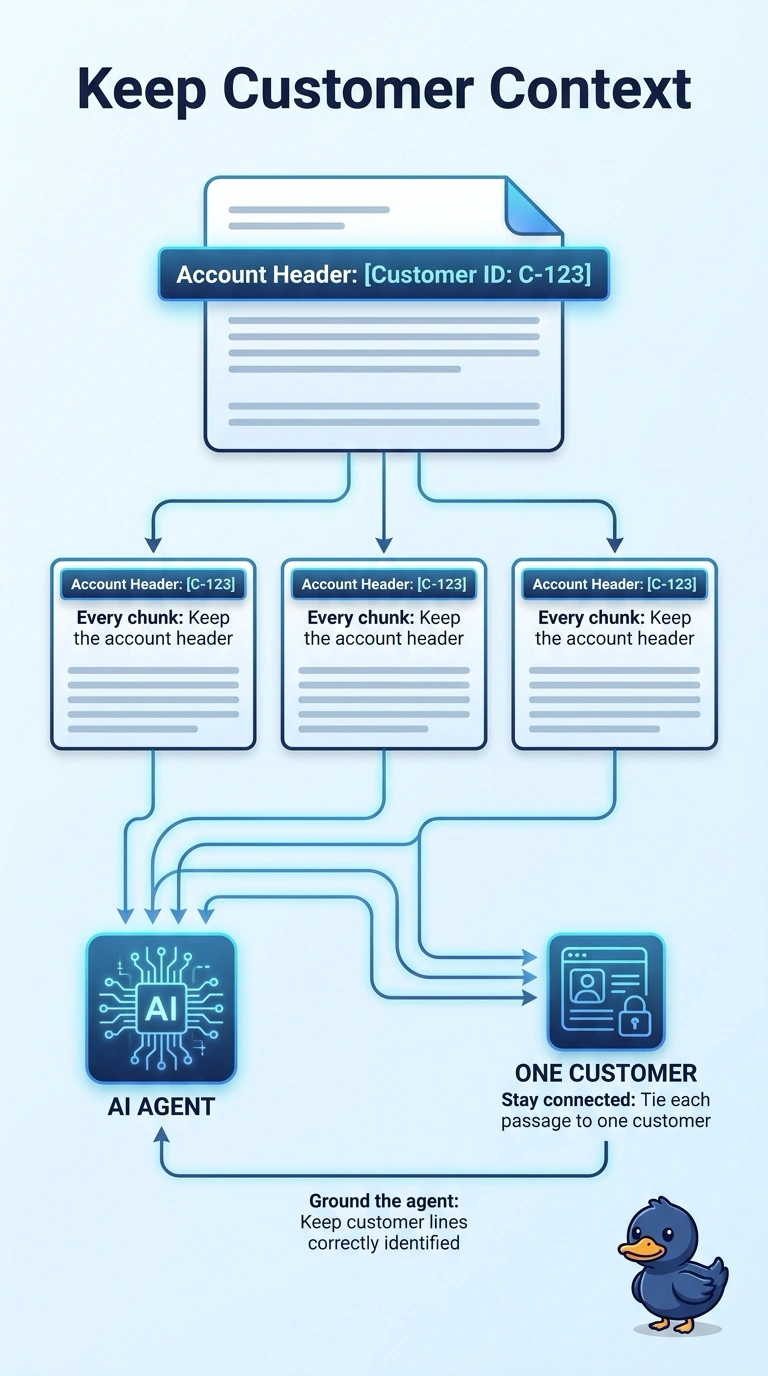
A torn page from a statement helps you only if the account name is still on it. Keep the account header on every chunk so a retrieved passage stays tied to one customer. Asking the model to sort out a mix afterward leaves the customer identity missing from the data.
Full Explanation
Chunking for grounding has to preserve the identity that makes a passage safe to quote. When the account header is stripped off, a transaction line can be retrieved under the wrong customer, which is the defect the bank is seeing. Each chunk should carry that header so the passage stays tied to one customer. Keeping only the transaction lines while storing the header in a file the retriever is not given separates the lines from the identity needed to interpret them. A single shared header for the whole archive does not travel with each retrieved chunk, so the model still lacks the customer link on the passage it sees. A longer system prompt cannot repair a chunk that has already lost its customer identity; the retrieved text is the data the model will use. The header should carry the account identifier operations already trust and be repeated on every chunk from that statement. A retrieved line with no identifier is a failed preparation step, even when the surrounding prose sounds fluent. Exam caveat: this is a preparation choice about what stays inside the chunk, not a reason to fine-tune on mixed statements. Operational check: retrieve a passage for a known account and confirm the header on that chunk names the same customer as the transaction lines.