
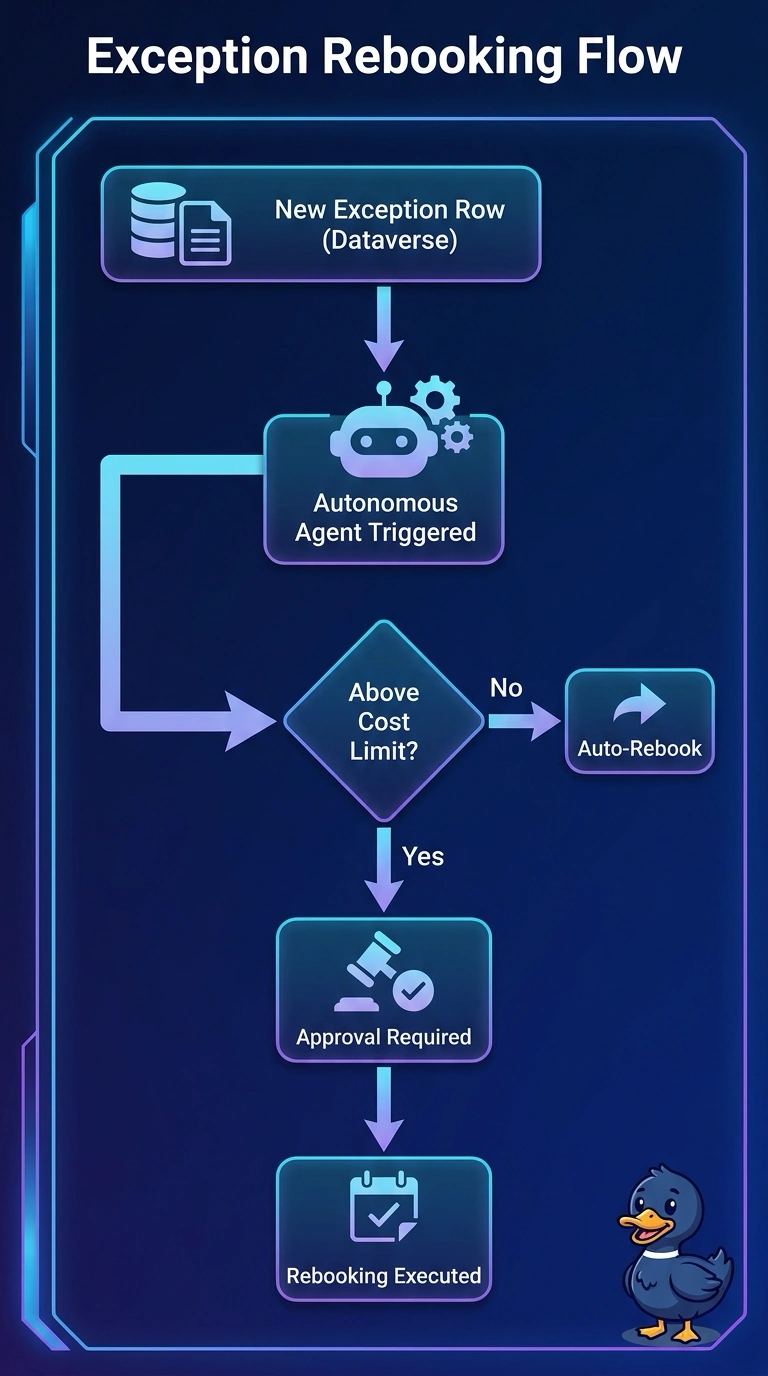
A logistics company writes a shipment-exception row into Dataverse whenever a delivery fails. An agent should rebook a carrier from that row and should ask a dispatcher only when the new cost is above an approved limit. Which design fits?
Select an answer to reveal the explanation.
Short Explanation
Think of a dispatcher who starts dialing the moment the exception hits the board, and who calls a supervisor only when the price jumps. You want an autonomous agent on that new row, with a person in the loop only above the cost limit. Waiting for someone to type a chat message misses the point of the trigger.
Full Explanation
An autonomous agent starts from an event, uses tools to do the work, and stops for a person when a boundary is crossed. The exception row is the event, rebooking the carrier is the action, and the cost limit is the boundary that requires a dispatcher. A prompt-and-response agent would wait for a chat message, so exceptions would sit until someone noticed them and typed a request. A topic that only explains the exception code is a knowledge reply, and it never contacts a carrier. A nightly ranking export is analytics after the fact, and it does not rebook anything. The cost limit is a business rule the agent must be able to read at runtime, not a sentence buried where no tool enforces it. Exam caveat: human approval on the expensive path does not turn the agent into a chat bot. It is the safeguard on an autonomous action. Operational check: create a test exception under the cost limit and confirm a rebooking is attempted with no chat, then create one over the limit and confirm the dispatcher is asked before the carrier is changed.