
A hospital agent must send every appointment-cancellation request into one existing topic and must extract the appointment identifier. Patients phrase the request in many ways, and trigger phrases keep missing them. Free-form answers are not acceptable for this action. Which understanding approach fits?
Select an answer to reveal the explanation.
Short Explanation
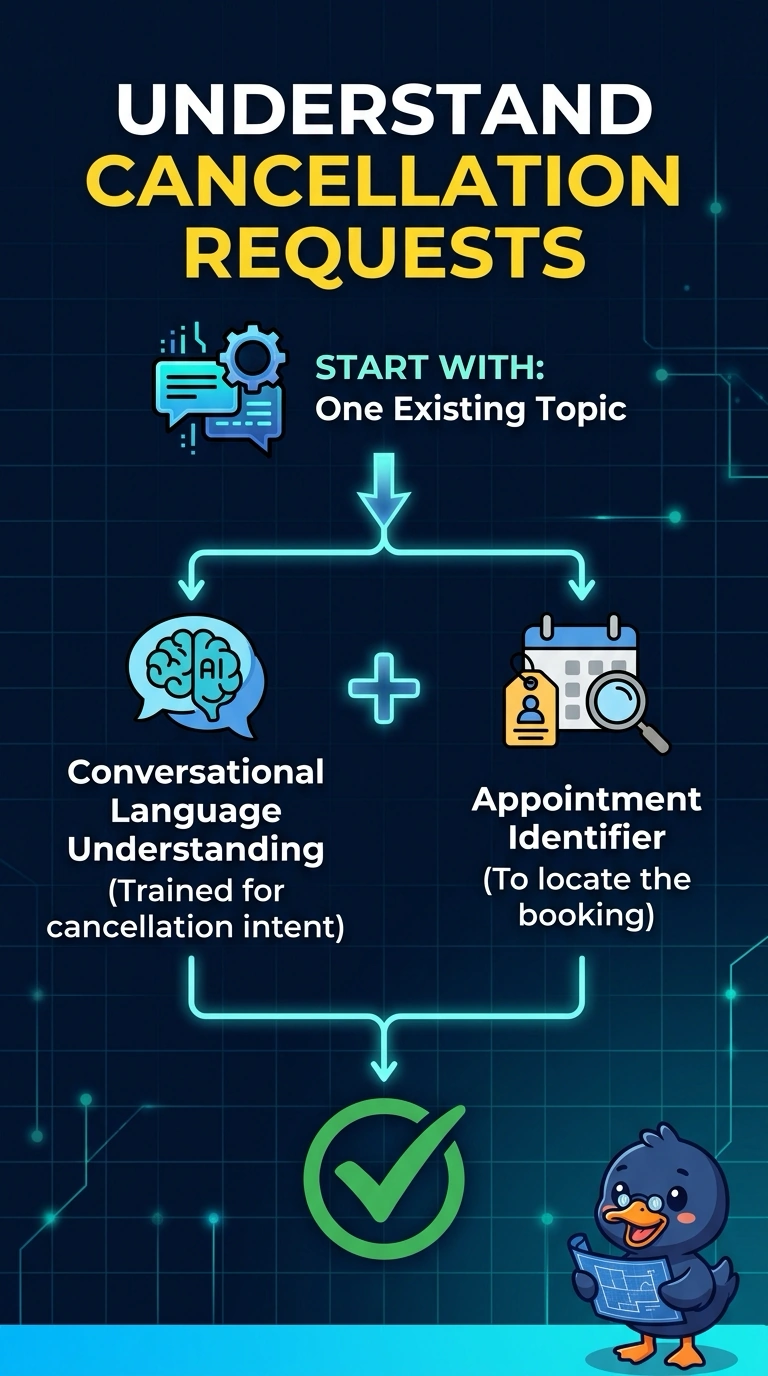
You need a clerk who recognizes a cancellation no matter how it is worded and still pulls the confirmation number. You train conversational language understanding for that closed intent and the identifier. A growing pile of trigger phrases is how this agent already fails.
Full Explanation
Conversational language understanding fits when the intent list is closed, the wording varies, and the agent must pull specific entities and land on a known topic. Cancellation is one intent, the appointment identifier is the entity, and the hospital forbids a free-form answer, so a trained understanding model is the design. Classic trigger phrases are what is already failing, and adding a phrase after each miss never catches the next paraphrase. Generative orchestration is the right tool when the agent should choose among tools and knowledge and can answer in its own words, but this action must enter the cancellation topic rather than reply with prose. A fallback topic that sends the patient to the phone turns every new phrasing into a failure and extracts nothing. Exam caveat: generative orchestration can classify too, but it is the wrong primary control when the business requires a deterministic route into one topic. Operational check: run a set of cancellation phrasings that were never used as trigger phrases and confirm each one enters the cancellation topic with the identifier filled in.